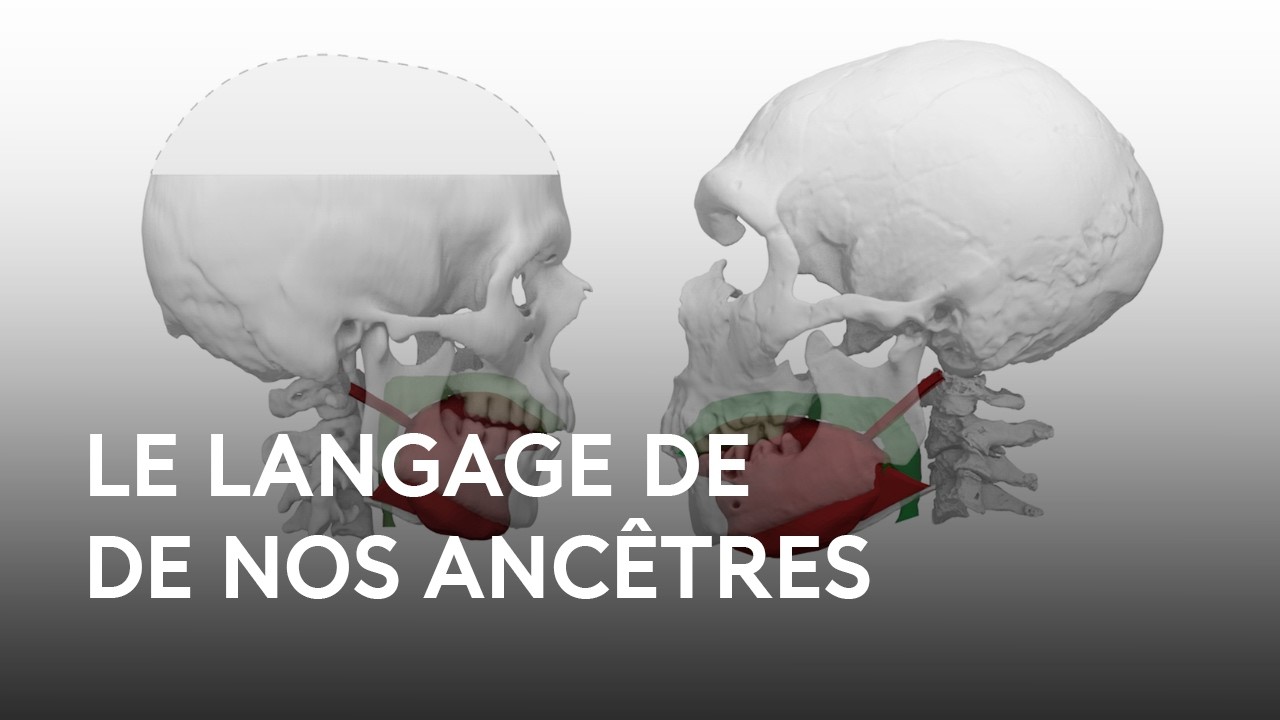
L'origine du langage, apports de la linguistique et de la paléoanthropologie
The Origin of Language: Contributions from Linguistics and Paleoanthropology
Keywords
Summary
220 words
Critical Evaluation
Value of the Information & Strength of the Argument
The lecture offers valuable insight into how interdisciplinary research can tackle complex questions like language origins. The paleoanthropological segment benefits from recent biomechanical modeling, providing a concrete method for testing hypotheses about extinct hominins’ speech capabilities. The argument that non-human primates possess the vocal tract potential for similar vowel production is compelling and shifts focus from anatomy to cognitive and social factors. The linguist’s historical overview provides context but is less directly integrated with the scientific modeling, instead offering a philosophical and historical backdrop. The joint attempt to reconstruct proto-languages is presented as exploratory, with reasonable caveats about uncertainty. The inclusion of a discussion about the documentary series adds a public-engagement dimension but does not always deepen the scientific argument. Overall, the reasoning is solid, but the speculative nature of the conclusions is frankly acknowledged, which strengthens credibility.
Scientific Rigor, Source Quality, Title Accuracy
The speakers are credible: Amélie Vialet is a paleoanthropologist at the Musée de l’Homme, and Jacques François is a professor emeritus of linguistics. The conference is part of an official museum event, and the description links to the museum’s page. The sources explicitly cited within the talk include researchers like Philip Lieberman, Tecumseh Fitch, and the Gypsa Lab, but no external papers are listed in the video description beyond the lecture page. The title accurately reflects the content, as both linguistic and paleoanthropological approaches are discussed. No clear bias is evident, though the speakers acknowledge that their reconstructions are inherently speculative due to the lack of direct evidence. Public comments were not provided, so no analysis of audience reception is possible.
274 words
Title / Content Match
The title accurately reflects the content, which explores the origins of language through the complementary lenses of linguistics and paleoanthropology.
Quality & Reliability
7/10
The lecture is delivered by recognized experts and presents current scientific research and models, but much of the discussion about proto-languages is speculative and acknowledges the inherent limitations of paleoanthropological evidence.
Key Moments
Markers derived by PSI from the transcript: the creator did not define chapters.
- Introduction to the conference and the documentary project 'Retour vers la préhistoire'.
- Palaeoanthropological methods: indirect evidence from endocranium and archaeology.
- Paradigm shift: baboons can produce similar vowel space, challenging anatomical determinism.
- Biomechanical tongue model applied to Neanderthals and Arago fossils; simulation of vowels.
- Historical overview of linguistics from 18th century philosophers to 19th century evolutionists.
- Synthesis: combining linguistic and paleoanthropological data to propose proto-languages.
Cited Sources
- Conference page at Musée de l'Homme — Official page for this conference, providing description and additional information.
Contribution & Novelties
The lecture contributes original perspectives by presenting a novel biomechanical simulation approach to reconstruct the tongues of extinct hominins, grounded in recent research challenging long-standing assumptions about the vocal tract. It also bridges paleoanthropology and linguistics, an interdisciplinary effort that is still rare. The presentation openly discusses the speculative nature of such reconstructions, encouraging critical reflection on methodologies.
Pour aller plus loin :
- Origin of language (Wikipedia) — Overview of historical and scientific perspectives on how language emerged.
- FOXP2 gene (Wikipedia) — A key gene associated with language, mentioned in the lecture in relation to Neanderthals.
- Hyoid bone (Wikipedia) — Anatomical structure crucial for speech, discussed in the context of fossil evidence.
- Biomechanics of the tongue (Wikipedia) — Provides background on the muscle structure and function relevant to the modeling described.
131 words
Radar Profile
The profile shows a strong emphasis on information quantity and quality, with moderate technical depth and reasonable reliability, reflecting a high-quality yet speculative scientific discourse.