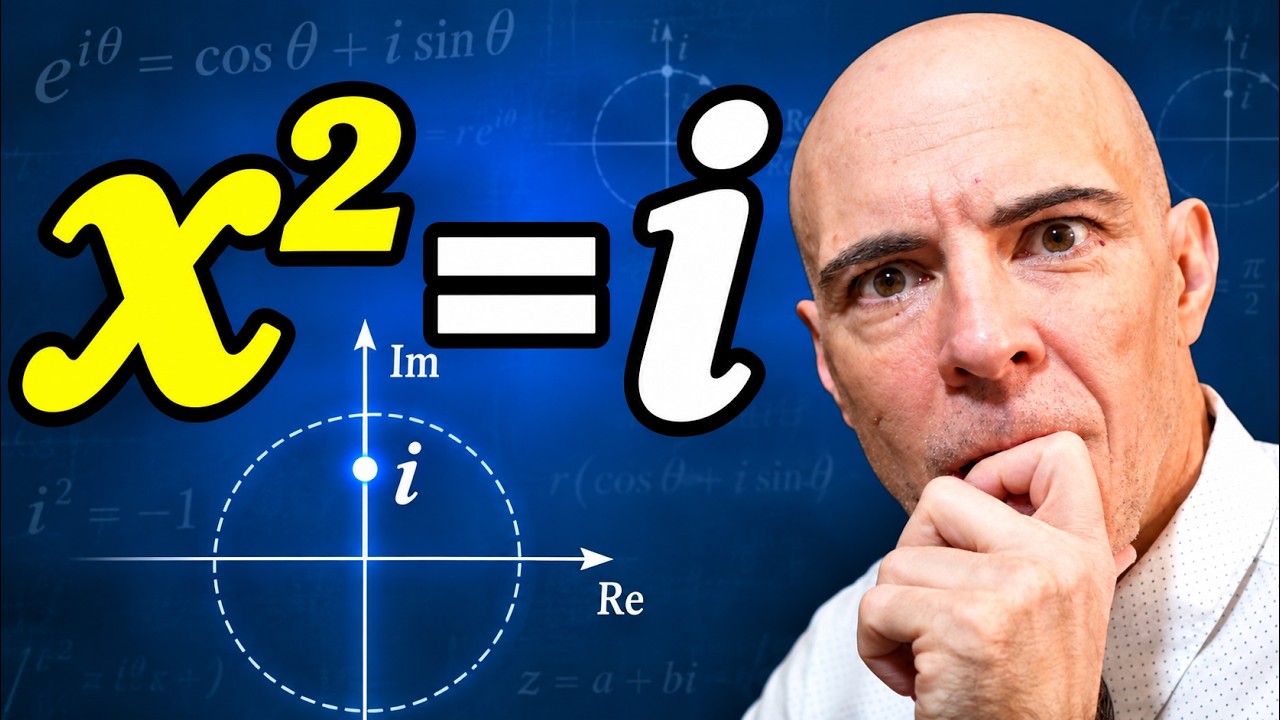
Cálculo de x^2=i
Calculating x^2=i
Keywords
Summary
141 words
Critical Evaluation
Value of the Information & Strength of the Argument
The video’s value lies in its clear, methodical approach to a non-intuitive topic. By solving x² = i and x² = 4 in parallel, the presenter highlights the general procedure for extracting square roots of complex numbers and correctly handles the multiplicity of arguments. The argumentation is solid and mathematically sound; every step is justified, and the reliance on Euler’s formula is explicitly referenced. The presentation is logical and avoids unnecessary jargon, making the reasoning accessible without sacrificing rigor.
Scientific Rigor, Source Quality, Title Accuracy
The scientific rigor is high: the mathematical reasoning is correct and transparent. The presenter clearly states the use of Euler’s formula and gives a reference for its derivation in the description. The quality of sources is adequate for a tutorial, though the video itself does not delve into proof; the provided link to a derivation mitigates this. The title is perfectly aligned with the content, and the video does not overpromise. The lack of external source citations within the video is compensated by the direct referencing of related material in the description.
186 words
Title / Content Match
The title precisely reflects the content: the entire video is devoted to solving the equation x² = i, with a supporting parallel example.
Quality & Reliability
9/10
The video presents a correct and rigorous resolution of the equation x² = i using complex numbers, Euler's formula, and all possible arguments. The mathematical steps are sound and clearly explained, with no errors detected. The only minor weakness is the absence of a proof of Euler's formula, but it is referenced in the description.
Chapters
- Introducción: x² = i y x² = 4
- Dos ecuaciones resueltas en paralelo
- Escribir i y 4 como números complejos
- Fórmula de Euler
- Representación de i en el plano complejo
- Representación de 4 en el plano complejo
- Forma trigonométrica de i
- Forma exponencial de i
- Forma trigonométrica y exponencial de 4
- Argumento principal de un número complejo
- Argumentos equivalentes y vueltas completas
- Forma exponencial general de i
- Forma exponencial general de 4
- Ecuación x² = i
- Ecuación x² = 4
- Cómo calcular las raíces cuadradas
- Soluciones xₖ y argumentos
- Raíces cuadradas de i y de 4
- Primera raíz cuadrada de i
- Forma trigonométrica y forma binómica
- Primera raíz cuadrada de 4: 2
- Segunda raíz cuadrada de i
- Argumento 5π/4 y circunferencia goniométrica
- Forma trigonométrica de e^(i5π/4)
- Las dos raíces cuadradas de i
- Segunda raíz cuadrada de 4
- Fórmula de Euler aplicada a e^(iπ)
- Las dos raíces cuadradas de 4: 2 y −2
- Despedida
Cited Sources
- Deducción de la fórmula de Euler — Referenced in the video as the justification for Euler's formula.
- Más ejercicios relacionados con los números complejos — Playlist of additional complex number exercises mentioned in the description.
Contribution & Novelties
The video’s original contribution is the parallel pedagogical presentation of solving x² = i and x² = 4, which effectively demonstrates the universal method for finding square roots of complex numbers and clarifies the role of all possible arguments. It also corrects a common erroneous notation regarding square roots of complex numbers. The explanation of the principal argument and the addition of 2πk is particularly well illustrated.
Pour aller plus loin :
- Complex number — Essential background for understanding the topic.
- Euler’s formula — The key identity used in the video.
- Principal argument — The concept of argument and its principal value.
102 words
Radar Profile
The radar profile shows a well-balanced video with high reliability and good information quality, but slightly lower quantitative density and technical depth. This reflects a focused tutorial that prioritizes clarity and correctness over exhaustive coverage.