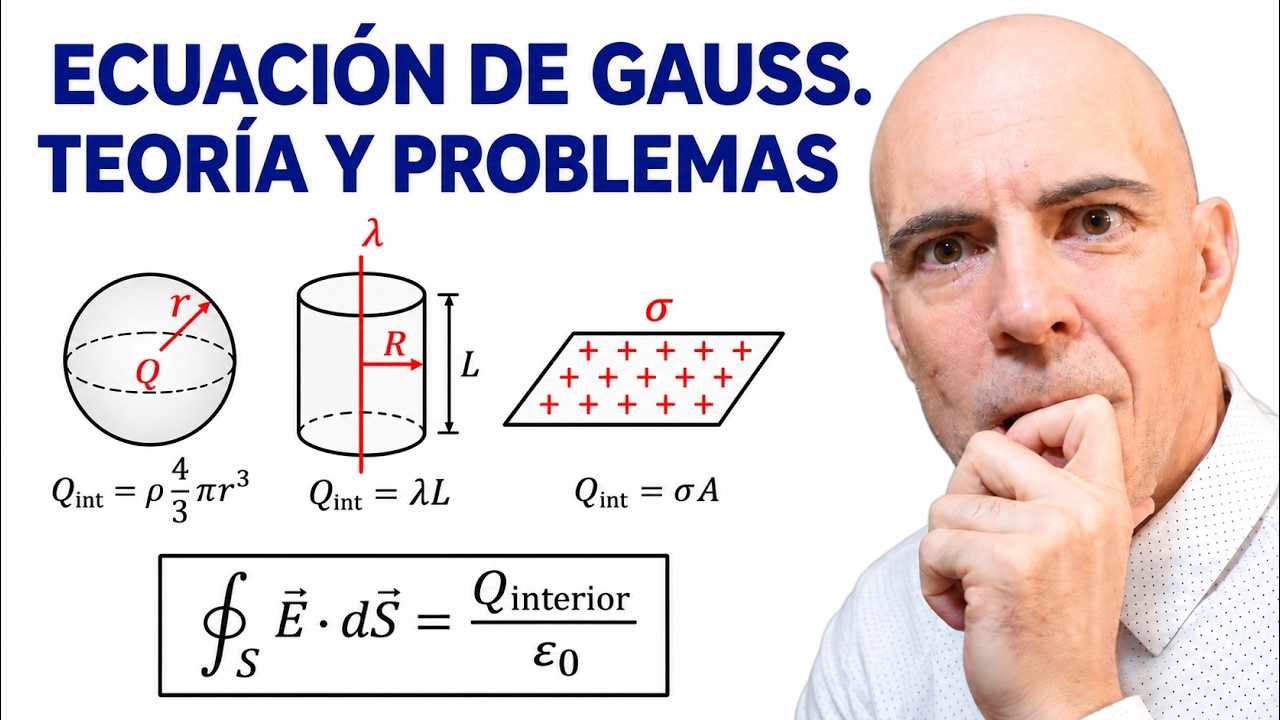
LEY DE GAUSS desde cero | Teoría y PROBLEMAS. CAMPO ELÉCTRICO
GAUSS'S LAW from scratch | Theory and PROBLEMS. ELECTRIC FIELD
Keywords
Summary
212 words
Critical Evaluation
Value of the Information & Strength of the Argument
The informational value lies in a coherent, sequential exposition that connects the abstract definition of flux to a working computational tool. The argumentation is solid at the level of standard electrostatics: the scalar product is used correctly, the surface integral is introduced before the closed-surface form, and the derivation from Coulomb’s law is explicit. Each application follows a consistent pattern—identify symmetry, choose a Gaussian surface, evaluate the flux, express the enclosed charge, and solve for the field. The treatment of enclosed charge in the solid-sphere interior, the zero-field result inside the hollow shell, and the cancellation of lateral flux for the line and plane are physically correct. Graphs reinforce the limiting behavior of the field. The main limitations are those of an idealized lecture: infinite line and plane are treated without discussing edge effects or experimental realization, the differential form of Gauss’s law is not developed, and the connection to divergence is omitted. These omissions do not invalidate the argument, but they bound its scope to introductory electrostatics.
Scientific Rigor, Source Quality, Title Accuracy
Scientific rigor is good for a textbook-level presentation: formulas, units, and limiting cases are handled consistently, and the derivations avoid circular reasoning by starting from Coulomb’s law. The lecture does not cite external literature, so source quality cannot be assessed through references; rigor is internal and based on standard physics. The title is fully adequate: it announces theory and problems on Gauss’s law and the electric field, and the video delivers both in a structured sequence.
259 words
Title / Content Match
The title accurately announces a from-scratch treatment of Gauss's law with theory and worked problems on the electric field. The content follows that promise closely.
Quality & Reliability
8/10
The physics presented is standard and internally consistent: the definition of electric flux, the statement and derivation of Gauss's law, and the four canonical applications are treated correctly. Reliability rests on textbook-level correctness, but the lecture provides no external citations or primary references.
Chapters
Cited Sources
- Electricidad y Magnetismo playlist — Creator's playlist for the electricity and magnetism course, referenced in the description.
- Matemáticas con Juan website — Creator's website linked in the description.
Contribution & Novelties
The video does not present new scientific results; its contribution is pedagogical. It offers a single, continuous treatment that moves from electric flux to the statement and derivation of Gauss’s law and then applies the law to four canonical charge distributions. The value is in the explicit symmetry reasoning and the graphical interpretation of the field for each case.
Further reading (Pour aller plus loin):
- Gauss’s law — Standard reference for the integral and differential forms of the law.
- Electric flux — Background on flux as a surface integral of the electric field.
- Gaussian surface — Explains the role of symmetry in choosing surfaces for Gauss’s law.
- Coulomb’s law — The starting point used in the video’s derivation of Gauss’s law.
121 words
Radar Profile
The profile is strong in information quantity and quality, with solid reliability and a moderate-to-high technical level. The lecture is dense but well organized, and its main weakness is the absence of external references rather than any apparent physical error.