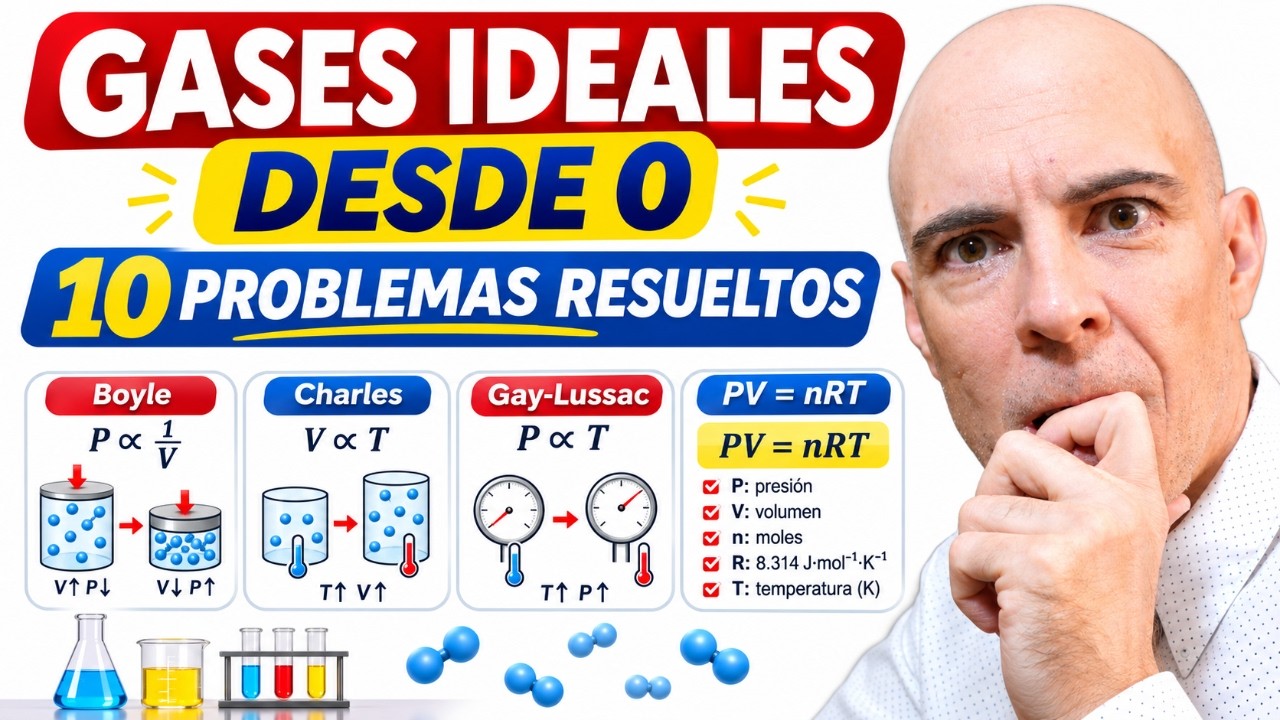
APRENDE LAS LEYES DE LOS GASES IDEALES DESDE 0. 10 problemas resueltos
Title history
- APRENDE LAS LEYES DE LOS GASES IDEALES DESDE 0. 10 problemas resueltos — observed on 20261112-0400 UTC (YouTube)
Keywords
Summary
124 words
Critical Evaluation
Value of the Information & Strength of the Argument
The value lies in the thorough, progressive approach: the instructor starts with simple scenarios and builds to more complex ones, always deriving the relevant formula from PV=nRT. The argumentation is solid: each step is justified, and unit conversions are explicitly shown, reducing common errors. The explanations are clear despite occasional flubs, and the use of real numbers makes the calculations tangible. Emphasis on reasoning rather than memorization enhances the educational worth.
Scientific Rigor, Source Quality, Title Accuracy
Scientifically, the content is accurate and follows conventional textbook treatments of ideal gas laws. No external sources are cited beyond the creator’s own material links; however, the formulas and constants (R=0.082 atm·L/(K·mol)) are standard. The title faithfully reflects the content; the video delivers exactly what it promises. The few light-hearted digressions do not detract from the overall rigor.
144 words
Title / Content Match
The title accurately describes the content: a from-scratch lesson on ideal gas laws with 10 worked problems.
Quality & Reliability
8/10
Clear step-by-step explanations, correct use of gas laws and unit conversions, but with some digressions and occasional slips that are corrected. Standard instructional content with no original research.
Key Moments
Markers derived by PSI from the transcript: the creator did not define chapters.
- Introduction: definition of ideal gas and the core equation PV=nRT.
- Problem 1: Boyle-Mariotte law – pressure and volume at constant temperature.
- Problem 2: Charles's law – volume change with temperature at constant pressure.
- Problem 3: Gay-Lussac's law – pressure change with temperature at constant volume.
- Problem 4: Combined gas law – simultaneous changes in pressure, volume, and temperature.
- Problem 5: Using PV=nRT to calculate the number of moles.
- Problem 6: Calculating the mass of CO2 using the ideal gas law and molar mass.
- Problem 7: Deriving and applying the formula for gas density.
- Problem 8: Dalton's law – partial pressures in a gas mixture.
- Problem 9: Gas collected over water – account for water vapor pressure.
- Problem 10: Stoichiometry – volume of CO2 produced from a chemical reaction.
Cited Sources
- HAGOROMO Japanese chalk — Material used by the creator, mentioned in the video description.
- StreamYard referral — Promotional link for streaming software, presented as a discount offer.
Contribution & Novelties
The video’s added value is its clear, methodical progression from basic concepts to complex applications, all built on the single equation PV=nRT. Solving ten problems of increasing difficulty demonstrates how to handle unit conversions and algebraic rearrangements, which is particularly useful for beginners. The teacher’s style makes the material accessible, though not particularly novel beyond a standard textbook treatment.
Pour aller plus loin :
- Ideal gas law — In-depth explanation of the equation and its derivation.
- Boyle’s law — Historical context and formulation.
- Charles’s law — Temperature-volume relationship.
- Dalton’s law — Partial pressures in gas mixtures.
96 words
Radar Profile
The profile shows balanced strengths in information quantity, quality, and reliability, with lower technical level due to its beginner-oriented nature. This reflects a solid, accessible tutorial that does not go beyond introductory level.