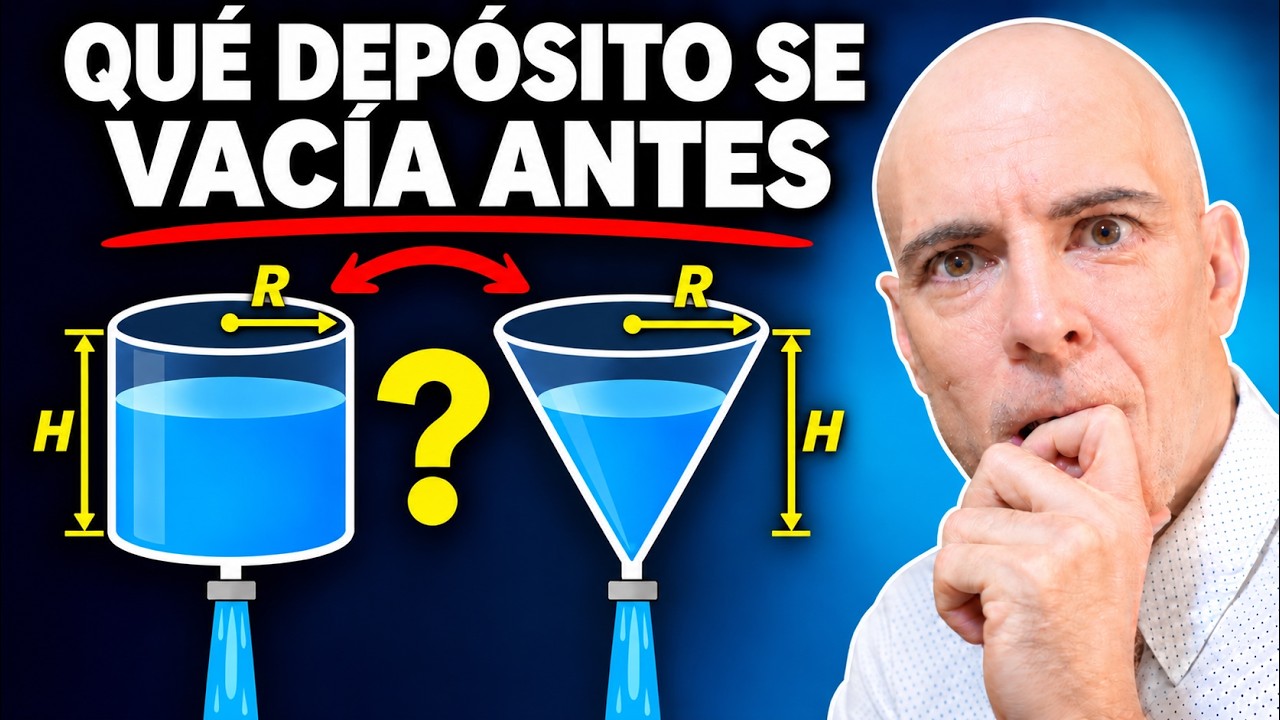
¿QUÉ DEPÓSITO SE VACÍA ANTES, UN CILINDRO O UN CONO?
WHICH CONTAINER EMPTYES FIRST, A CYLINDER OR A CONE?
Title history
- ¿QUÉ DEPÓSITO SE VACÍA ANTES, UN CILINDRO O UN CONO? — observed on 20261121-1609 UTC (YouTube)
Keywords
Summary
185 words
Critical Evaluation
Value of the Information & Strength of the Argument
The video provides a coherent and mathematically solid argument. It starts from fundamental principles (energy conservation via Bernoulli) and builds up logically: first deriving the outflow velocity, then using the continuity equation to set up a differential equation, and finally integrating to obtain the drain times. The argumentation is rigorous, with careful approximations justified (e.g., neglecting the surface velocity relative to the jet velocity). The final ratio of 5:1 is derived cleanly, and the presenter emphasizes the counterintuitive nature of the result, which adds value by showcasing how mathematics reveals surprising outcomes. The explanation is didactic and maintains a step-by-step clarity, making it accessible to learners with a background in calculus and basic physics.
Scientific Rigor, Source Quality, Title Accuracy
The scientific rigor is high: the derivation follows standard textbook methods, and all steps are explicitly shown. However, the video relies solely on the presenter’s exposition; no external sources or academic references are cited in the video itself. The description links to related videos and playlists (e.g., ‘50 problemas de física de fluidos’ and ‘Aplicaciones del cálculo integral’), which are relevant but not primary sources. The title perfectly matches the content, and the presenter even acknowledges the surprising result, reinforcing the educational intent. No comments were provided for analysis, so no public reception data is available.
225 words
Title / Content Match
The title exactly matches the content, posing the question that is answered conclusively.
Quality & Reliability
8/10
The video provides a rigorous, step-by-step derivation of the drain time for cylindrical and conical tanks, correctly applying Bernoulli's principle, Torricelli's law, the continuity equation, and integral calculus. The result (5:1 ratio) is mathematically verified and clearly explained. No external citations are given, but the reasoning is internally consistent and reproducible.
Chapters
- ¿Qué depósito se vacía antes: cilindro o cono?
- Cómo se produce el vaciado de los depósitos
- Principio de Bernoulli y conservación de la energía
- Aplicación de Bernoulli a dos puntos del fluido
- Aproximaciones: velocidades y presión atmosférica
- Deducción de la ley de Torricelli
- Caudal y ecuación de continuidad
- La importancia de la geometría del depósito
- Ecuación diferencial del vaciado
- Integración y límites de integración
- Fórmula general del tiempo de vaciado
- CASO 1: depósito cilíndrico
- Fórmula del tiempo de vaciado del cilindro
- CASO 2: depósito cónico
- Semejanza de triángulos y radio variable
- Resolución de la integral para el cono
- Fórmula del tiempo de vaciado del cono
- Comparación de los tiempos de vaciado
- RESULTADO FINAL: el cilindro tarda 5 veces más
- Despedida y recomendaciones
Cited Sources
- 50 problemas de física de fluidos — Related video on fluid mechanics problems, linked in the description.
- Aplicaciones del cálculo integral — Playlist on integral calculus applications, linked in the description.
Contribution & Novelties
This video offers a thorough, self-contained derivation of a specific fluid dynamics problem, demonstrating how to apply Bernoulli’s equation and integral calculus to real-world geometry. The result (5:1 ratio) is presented with full steps, making it a valuable educational resource. It explicitly contrasts the constant cross-section case with a variable one, illustrating the power of integration over shape-dependent areas.
Pour aller plus loin :
- Torricelli’s law — Directly applicable to the exit velocity formula.
- Bernoulli’s principle — The underlying conservation of energy in fluid flow.
- Differential equation — The type of equation used to model the draining process.
98 words
Radar Profile
The radar profile shows high scores in quality and reliability, reflecting the rigorous mathematical derivation. Quantity and technical level are also strong, while the absence of external references slightly lowers the 'sources' aspect, but overall the video is a compact and effective tutorial.