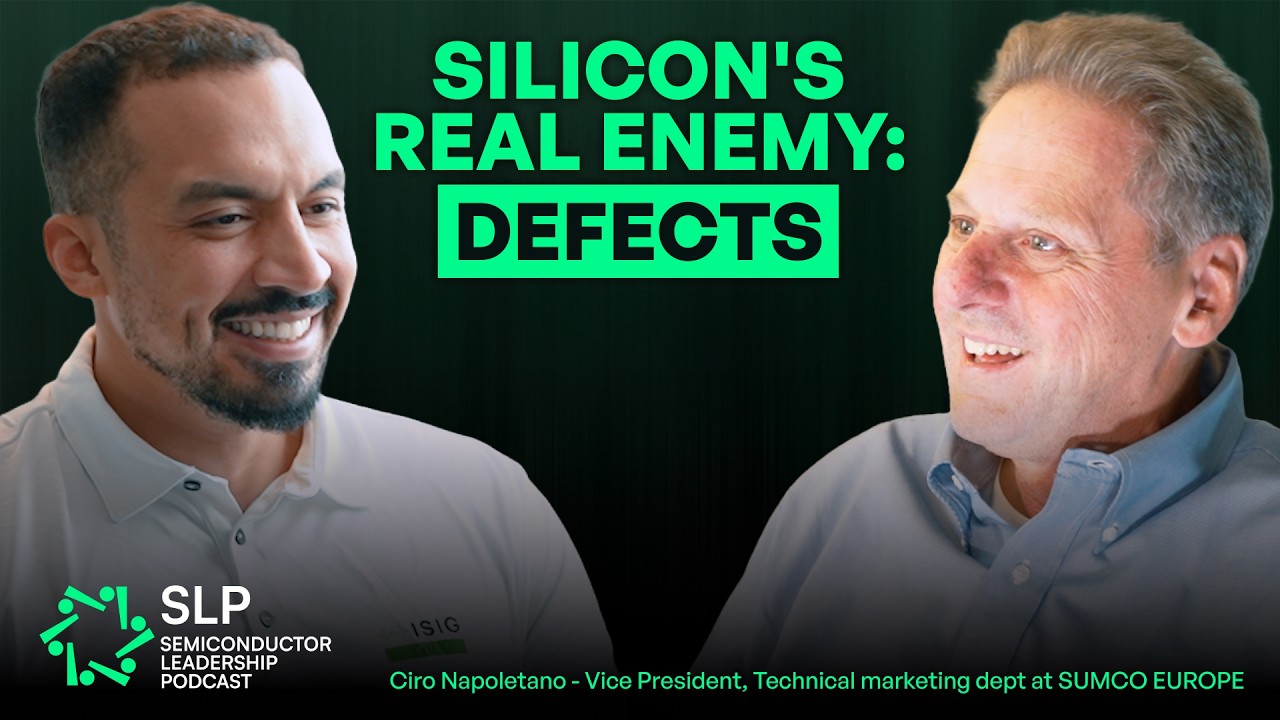
Both Sides of the Silicon Wafer
Keywords
Summary
316 words
Critical Evaluation
Value of the Information & Strength of the Argument
The informational value lies in the testimony rather than in transferable knowledge. The guest has spent four decades in one narrow but strategic segment, silicon wafers, and has occupied both the buying and the selling side of the same transaction, which is genuinely uncommon and gives his remarks on specification negotiation a real practical edge. The clearest substantive point is that a mismatch between supplier material and customer expectation is often not a material defect at all but a need to rebalance the device design and the specification jointly. The description of the applications engineer as simultaneously the company’s lawyer towards the customer and the customer’s advocate inside the company is a precise and useful formulation of a boundary role. The account of working remotely from a fab, having to ship wafers to a distant laboratory for analysis, and of cultural asymmetries around refusal, is concrete and credible. Beyond this, the argumentation is thin. Claims are asserted rather than demonstrated: transparency is declared to be what separates a good supplier relationship from a great one, with the only support being that data will later confirm the judgment, which is a restatement rather than a proof. Industry cycles are discussed at the level of personal stress and cost reduction, without any quantitative or structural analysis. The long-term outlook for silicon rests on the observation that a 2017 prediction has not materialised and on an expectation of tighter defect control, which is plausible but argued by assertion rather than by roadmap data, node requirements or substrate economics. The forward-looking statements on wide-bandgap substrates and on silicon for quantum computing are explicitly hedged by the guest himself, who describes quantum as very early stage and evaluations only. There is no counter-argument tested, no alternative view presented, and no attempt by the host to press on figures. The episode therefore functions as an oral-history document of professional practice, valuable for context and tacit knowledge, weak as evidence.
Scientific Rigor, Source Quality, Title Accuracy
Scientific rigour is low by construction: this is a conversation, not an investigation. No data, no measurement, no specification, no cost figure and no dated roadmap is cited at any point, and the technical vocabulary that does appear, such as crystal growth, point defects, oxygen and interstitial control, stacking faults and wide-bandgap materials, is used at the level of general orientation rather than explanation. Two references are made to external literature. The first is the Nobel Prize awarded for conductive organic polymers, where the guest hesitates over the names and the year, offering ‘1999 or the year 2000’, which is an imprecision on a well-documented fact and a signal of the recall-based nature of the whole testimony. The second is an article from 2017 predicting that silicon would disappear within ten years, attributed with visible uncertainty to the Journal of the Electrochemical Society ‘or another important journal’; no author, title or volume is given, so the reference cannot be checked from the episode itself. The only firm dates supplied elsewhere, his degree in 1985, his move to SUMCO in 1998, his vice presidency in 2011 and the creation of the technical marketing department in 2020, come from the host’s introduction and are corroborated by the guest’s own narrative, giving the biographical thread reasonable internal consistency. No source is used to support the material claims about silicon’s future or about quantum computing applications. On the title, ‘Both Sides of the Silicon Wafer’ is a fair and accurate label for a conversation built around the guest’s successive positions as customer and supplier, and there is no gap between promise and delivery.
607 words
Title / Content Match
The title fits the content exactly: the guest describes his career first as a customer of silicon wafers inside Texas Instruments, then as a supplier at SUMCO Europe, and the interview is structured around that dual vantage point.
Quality & Reliability
5/10
First-hand testimony from a long-serving industry practitioner (forty years, Texas Instruments then SUMCO Europe) gives genuine insider value and is internally coherent. However, the episode rests almost entirely on personal recollection and anecdote: no data, no figures, no documents are presented, technical statements remain generic (crystal growth, point defects, wide-bandgap substrates, silicon for quantum computing), and one bibliographic reference is recalled with hesitation ('Journal of the Electrochemical Society or another important journal'), while the Nobel attribution is left imprecise. The material is credible as experience narrative but provides no verifiable evidence base.
Chapters
- Game of Chips announcement
- Episode highlights
- Welcome and guest introduction
- From organic polymer semiconductors to Texas Instruments
- Rapid Fire
- How a chemist ends up in the semiconductor industry
- Incoming materials at TI: responsibility at the start of the line
- Joining SUMCO Europe and bridging Europe and Japan
- Launching Europe’s Technical Marketing Department
- Wide bandgap substrates and silicon for quantum computing
- What separates a good supplier relationship from a great one
- Navigating the ups and downs of the industry
- Maestro del Lavoro
- The next decade of semiconductor materials
- Retirement and what’s next
- Advice to his 1985 self
- Closing
Cited Sources
- Nobel Prize in Chemistry awarded for the discovery and development of conductive polymers (Heeger, MacDiarmid, Shirakawa) — Invoked by the guest to situate his 1985 thesis on conductive organic polymer semiconductors within the research wave of the time; he recalls the laureates and the year imprecisely.
- 2017 article predicting that silicon would disappear as a substrate within ten years — Cited by the guest as the origin of the claim he disputes; attributed hesitantly to the Journal of the Electrochemical Society 'or another important journal', with no author or title given, so the reference is not identifiable from the episode.
Concurring Sources
- Nobel Prize in Chemistry 2000 — conductive polymers — Independently confirms the scientific wave the guest describes as the backdrop of his chemistry thesis, although the episode states the year with hesitation.
Contribution & Novelties
The episode’s originality does not come from new findings but from a rare symmetrical vantage point: the same person qualified incoming silicon wafers as a customer at Texas Instruments and then defended wafer supply as a supplier at SUMCO Europe, which allows him to describe the customer-supplier interface from both ends. Two elements are worth retaining. First, the account of how a device specification is translated into a material specification, and of the frequent need to rebalance the design rather than condemn the material, which reframes many apparent quality disputes. Second, the description of the European technical marketing function created in 2020, aimed at connecting a dense European landscape of R&D and design centres with a Japanese substrate manufacturer, including a deliberate watch on wide-bandgap substrates and on silicon for quantum computing. The counterpoint on silicon’s longevity, set against a 2017 prediction of its disappearance and reframed as a shift towards ever stricter control of intrinsic point defects, is a useful corrective but remains an assertion rather than a demonstrated forecast.
Pour aller plus loin :
- Nobel Prize in Chemistry 2000 — Institutional page documenting the discovery of conductive polymers that frames the guest’s early research.
- Conductive polymer — Overview of the field of the guest’s 1985 experimental thesis and of its later applications.
- Czochralski method — Technical background on the crystal-growth step the guest sketches when describing how a wafer is produced from polysilicon.
- Wide-bandgap semiconductor — Context for the silicon carbide and gallium nitride substrates covered by his technical marketing department.
- Quantum computing — Background on the application area in which he expects silicon substrates to play a central role.
272 words
Radar Profile
The profile is flat and mid-range: a moderate amount of information delivered at a modest technical level, with quality and reliability limited by the purely testimonial format. The strong points sit in professional experience and contextual insight rather than in verifiable technical depth. The episode reads as career narrative and supplier-relationship practice, not as a materials-science briefing.