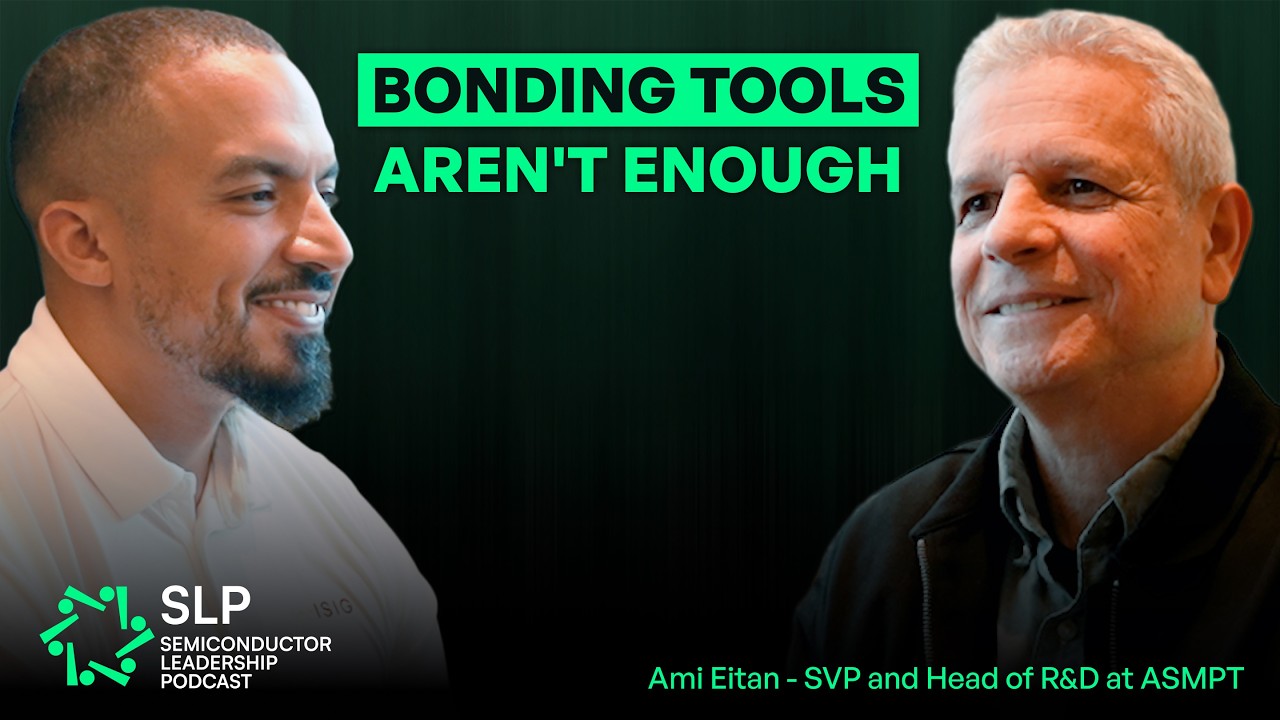
It’s Not Packaging, It’s Construction
Title history
- It’s Not Packaging, It’s Construction — observed on 20261028-1551 UTC (YouTube)
Keywords
Summary
157 words
Critical Evaluation
Value of the Information & Strength of the Argument
The interview offers exceptional value by providing firsthand accounts of TCB development from paper concept to mass production, and the different challenges faced by an IDM versus a foundry. Eitan’s arguments are well-grounded in his extensive experience, and he articulates complex technical concepts clearly. He makes a compelling case for the need for metrology advancements and a holistic approach to equipment design. The argumentation is solid, though it remains opinion-based rather than data-driven, and he acknowledges uncertainty in future predictions.
Scientific Rigor, Source Quality, Title Accuracy
Eitan references the book ‘Chip War’ and mentions Morris Chang’s biography, but no specific scientific papers. The episode is primarily anecdotal and draws on personal experience. The title is clever and accurately reflects the central theme that advanced packaging is construction. However, the lack of citations and reliance on personal narrative limits its scientific rigor. The content is credible due to the speaker’s authority, but it is not a peer-reviewed source.
166 words
Title / Content Match
The title aptly summarizes the central thesis that advanced packaging is actually construction, as discussed in the episode.
Quality & Reliability
8/10
Expert interview with deep insights from an experienced engineer, but relies on personal opinion and experience rather than peer-reviewed data.
Chapters
- Intro: Game of Chips hits 20,000 orders
- Episode preview
- Welcome and guest introduction
- Rapid fire: TCB or hybrid bonding?
- Intel or TSMC: what each taught him
- The book every packaging engineer should read
- The most underestimated material: interfaces
- Be’er Sheva, Rehovot or Troy
- Advanced packaging won’t fix a poor design
- Lessons from Intel and TSMC
- Why move from customer to equipment supplier
- Starting TCB at Intel from a piece of paper
- What is thermocompression bonding?
- From IDM to foundry: substrate vs wafer-based integration
- Who has the hardest problem to solve?
- What is ASMPT?
- The equipment provider is no longer just an equipment provider
- Unsolved problems: metrology and polymer rheology
- Is hybrid bonding a threat to EUV?
- HBM and the move from TCB to hybrid bonding
- The hardest decision of his career
- Proudest moments
- Why “packaging” is the wrong word
- The next big shift: silicon photonics
- The mission and the future of intelligence
- Closing
Cited Sources
- Chip War: The Fight for the World's Most Critical Technology — Recommended by the guest as a book every semiconductor engineer should read to understand the big picture.
Contribution & Novelties
The original contribution is the unique perspective of an engineer who has been on both sides of the equipment supply chain, providing insights into the challenges of TCB and hybrid bonding from Intel and TSMC. Eitan highlights the critical role of interfaces and the need for better metrology and polymer understanding. He also predicts the gradual adoption of hybrid bonding in HBM and the emergence of silicon photonics.
Pour aller plus loin :
- Thermocompression bonding — Background on the bonding technique discussed extensively.
- Hybrid bonding — The other key technology; explanation of copper-to-copper bonding.
- High Bandwidth Memory — HBM is a major application driving advanced packaging.
106 words
Radar Profile
The profile shows a strong technical depth (niveau_technique), balanced with strong information quality and quantity, but slightly lower reliability due to the reliance on personal opinion. The overall impression is of a highly informative but subjective interview.