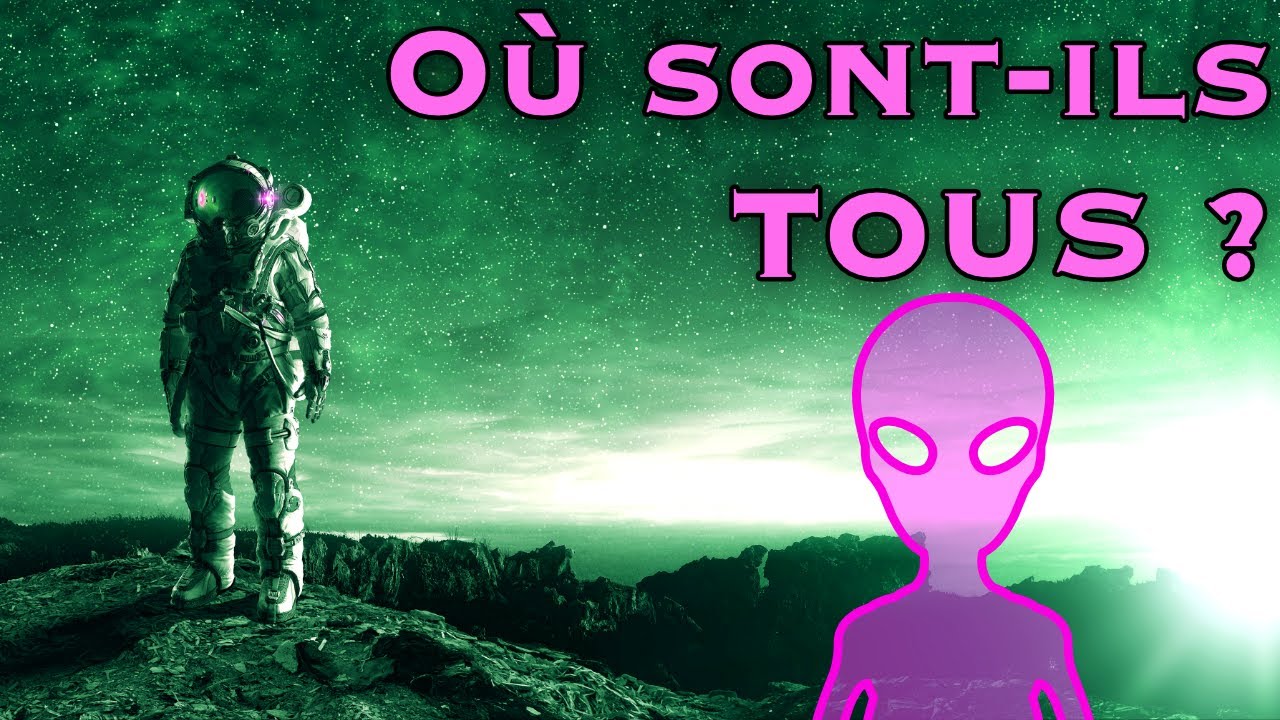
Sommes-nous seuls dans l'Univers ? — Le paradoxe de Fermi [Astrobiologie #3]
Are we alone in the Universe? — The Fermi paradox [Astrobiology #3]
Keywords
Summary
168 words
Critical Evaluation
Value of the Information & Strength of the Argument
The video’s strength lies in its structured argumentation. It logically builds from astronomical statistics to terrestrial peculiarities, then to biological improbabilities, and finally to sociological hypotheses. Each argument is clearly explained and supported by evidence or authoritative references. The use of simulations and analogies (e.g., the ants and the highway) makes complex ideas accessible without oversimplifying. The presenter openly acknowledges uncertainties and gives credit to competing explanations, fostering critical thinking. The argumentation is particularly solid in the discussion of the difficulty of abiogenesis and the role of the Moon in stabilizing Earth’s climate, which are often presented as speculative but are grounded in scientific research. The conclusion, focusing on the vast technological gap, is thought-provoking and original, offering a fresh perspective on the paradox.
Scientific Rigor, Source Quality, Title Accuracy
The video demonstrates rigorous scientific practice. Louapre references the companion blog post for additional details and even issues a correction about Mercury’s rotation. He mentions the Kepler telescope’s exoplanet discoveries and the SETI program, grounding the discussion in real research. The sources cited (the blog post, his books, the channel) are reliable and directly relevant. The title accurately reflects the content, and the video stays on-topic throughout. The public comments are overwhelmingly positive, praising its clarity, depth, and absence of sensationalism. Many viewers noted the video’s intellectual rigor and its ability to make complex topics engaging. The only minor point is that the video relies on some speculative hypotheses, but they are explicitly labeled as such. Overall, the content is trustworthy and well-sourced.
262 words
Title / Content Match
The title accurately reflects the content, which thoroughly explores the Fermi Paradox and its proposed solutions. The astrobiology reference is apt given the focus on life in the universe.
Quality & Reliability
9/10
The video is produced by a renowned French science communicator, with a companion blog post providing detailed references and corrections. The reasoning is logical, uses current scientific data, and acknowledges uncertainties. The content is well-researched and internally consistent.
Key Moments
Markers derived by PSI from the transcript: the creator did not define chapters.
- Introduction to the scale of the universe: number of stars and planets, with the analogy to grains of sand.
- Discussion of the distance barrier and the impossibility of faster-than-light travel, with Voyager 1 as an example.
- The argument of the rarity of Earth-like planets: habitable zone, circular orbits, presence of water, and a large moon.
- The improbability of life: from abiogenesis to evolution, with focus on endosymbiosis and the emergence of eukaryotes.
- Extinction scenarios: natural disasters (meteors, supernovae) and self-destruction (nuclear war, resource depletion).
- Sociological explanations: civilizations may lack interest in expansion or immerse in virtual worlds.
- The zoo hypothesis: aliens may observe us without interference, and the idea that they might be undetectable.
- Conclusion: the most convincing solution—billion-year-old civilizations are so advanced that we are insignificant and invisible to them.
Cited Sources
- Le paradoxe de Fermi — sommes-nous seuls dans l'Univers ? — Companion blog post with detailed explanations, references, and corrections.
- Mes livres — Page listing the author's books, including 'Le Labo du jeu vidéo'.
- Chaîne YouTube ScienceEtonnante — The channel where the video is published, offering additional science content.
Concurring Sources
- Fermi paradox - Wikipedia — Provides a comprehensive list of possible solutions and references, aligning with the video's content.
- Drake equation - Wikipedia — Supports the probabilistic estimates of intelligent life in the galaxy mentioned in the video.
- Habitable zone - NASA — Coordinates with the video's discussion of conditions for liquid water and planetary habitability.
Contribution & Novelties
The video synthesizes a wide range of current scientific knowledge and hypotheses about the Fermi Paradox, presenting them in an accessible yet rigorous manner. Its novelty lies in the balanced and structured presentation of multiple explanations, avoiding the usual sensationalism, and in the final compelling argument about the vast technological disparity that may render advanced civilizations undetectable. It encourages viewers to consider the humbling possibility that we may be ‘insignificant’ on a cosmic scale.
Pour aller plus loin :
- Fermi paradox — An overview of the paradox and various proposed resolutions.
- Drake equation — A probabilistic formula used to estimate the number of communicating civilizations.
- Habitable zone — The region around a star where liquid water could exist on the surface.
- Zoo hypothesis — The proposal that advanced civilizations intentionally avoid revealing themselves.
- Endosymbiosis — The theory that eukaryotes arose from symbiotic relationships among prokaryotes.
145 words
Radar Profile
The radar profile shows high scores in information quality, reliability, and technical depth, confirming the video's strong factual basis. The slightly lower quantitative information score reflects the breadth of topics covered, which, while rich, might limit depth in any single area. Overall, the profile indicates a well-balanced and highly credible science communication piece.
💬 Très positif : l'enthousiasme du public est palpable, les commentaires expriment une admiration profonde pour la clarté et la rigueur de la vidéo. Sur les 30 commentaires analysés, la quasi-totalité sont élogieux, louant la pédagogie, l'intelligence et le caractère captivant du propos. Un commentaire se distingue par une intéressante réflexion personnelle sur l'énergie nécessaire à la colonisation spatiale.