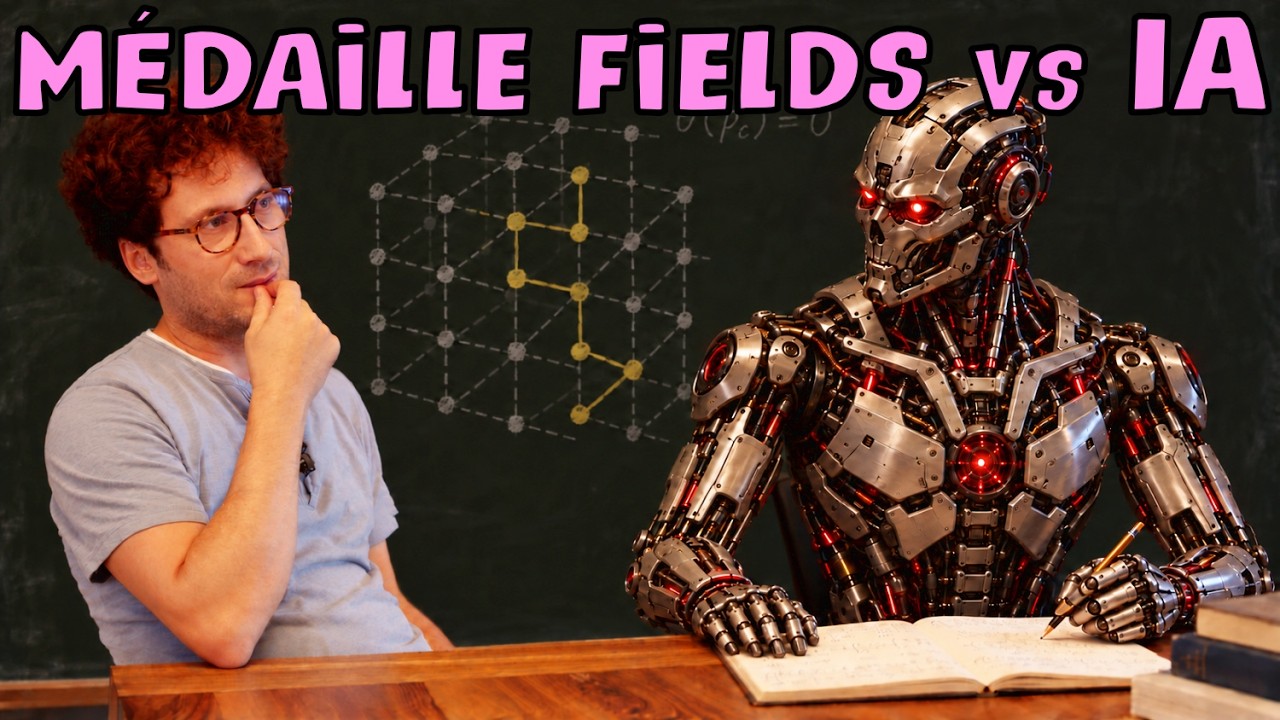
L'IA va-t-elle tuer les maths ? — L'interview d'Hugo Duminil-Copin
Will AI kill mathematics? — The interview with Hugo Duminil-Copin
Title history
- L'IA va-t-elle tuer les maths ? — L'interview d'Hugo Duminil-Copin — observed on 20261016-0202 UTC (PSI archive)
Keywords
Summary
127 words
Critical Evaluation
Value of the Information & Strength of the Argument
The video provides substantial value by giving an insider’s view on how AI is reshaping mathematics. Duminil-Copin’s arguments are well-founded, grounded in direct experience with recent breakthroughs (e.g., the resolution of the theta p_c conjecture and Navier-Stokes). He clearly distinguishes between the formal verification of proofs and human understanding, and argues convincingly that the latter remains essential. The discussion is nuanced, acknowledging both the power of AI and the potential dangers. The reasoning is solid, and the interview does not shy away from existential questions about the profession.
Scientific Rigor, Source Quality, Title Accuracy
The scientific rigor is high: the interviewee is a renowned mathematician, and the host is an experienced science communicator. The sources mentioned (the book, the article on proofsandprompts) are credible. The title is accurate and engaging, though slightly sensationalist, but it does not misrepresent the content. The video is well-structured and the claims are supported by concrete examples.
161 words
Title / Content Match
The title accurately reflects the central question discussed: AI's potential to transform or render traditional mathematical research obsolete.
Quality & Reliability
9/10
High-quality interview with a Fields medalist, discussing recent AI breakthroughs in mathematics, with concrete examples and references to ongoing debates.
Chapters
Cited Sources
- De l'autre côté du tableau noir — Book by Hugo Duminil-Copin and Emmanuel Sander on the human experience of mathematics.
- Care for a little more AI? — Text by Duminil-Copin about AI in mathematics, referenced in the description.
- ScienceEtonnante books — Page listing books by the channel author.
- ScienceEtonnante YouTube channel — Channel hosting the interview.
Concurring Sources
- De l'autre côté du tableau noir — Supports the view on human understanding.
- Care for a little more AI? — Duminil-Copin's own text.
Contribution & Novelties
The video offers a timely and authoritative perspective on AI’s impact on mathematics, particularly the recent breakthroughs. It highlights the crucial distinction between proof verification and understanding, which is often overlooked. Duminil-Copin’s personal anecdotes and explicit examples make the issues concrete.
Pour aller plus loin :
- Navier-Stokes equations — Background on the Millennium Problem discussed.
- Percolation theory — The model central to the theta p_c conjecture.
- Riemann hypothesis — Another famous conjecture that might be next.
76 words
Radar Profile
The profile shows high quality and reliability, with strong technical depth but moderate breadth (as it focuses on a specific topic). The balance between information quantity and technical level is good, making the video valuable for both experts and informed laypeople.
💬 balanced — The comments reflect a mix of admiration for the interview's depth and anxiety about AI's implications for mathematics, with many viewers sharing personal anecdotes about PhD students affected.