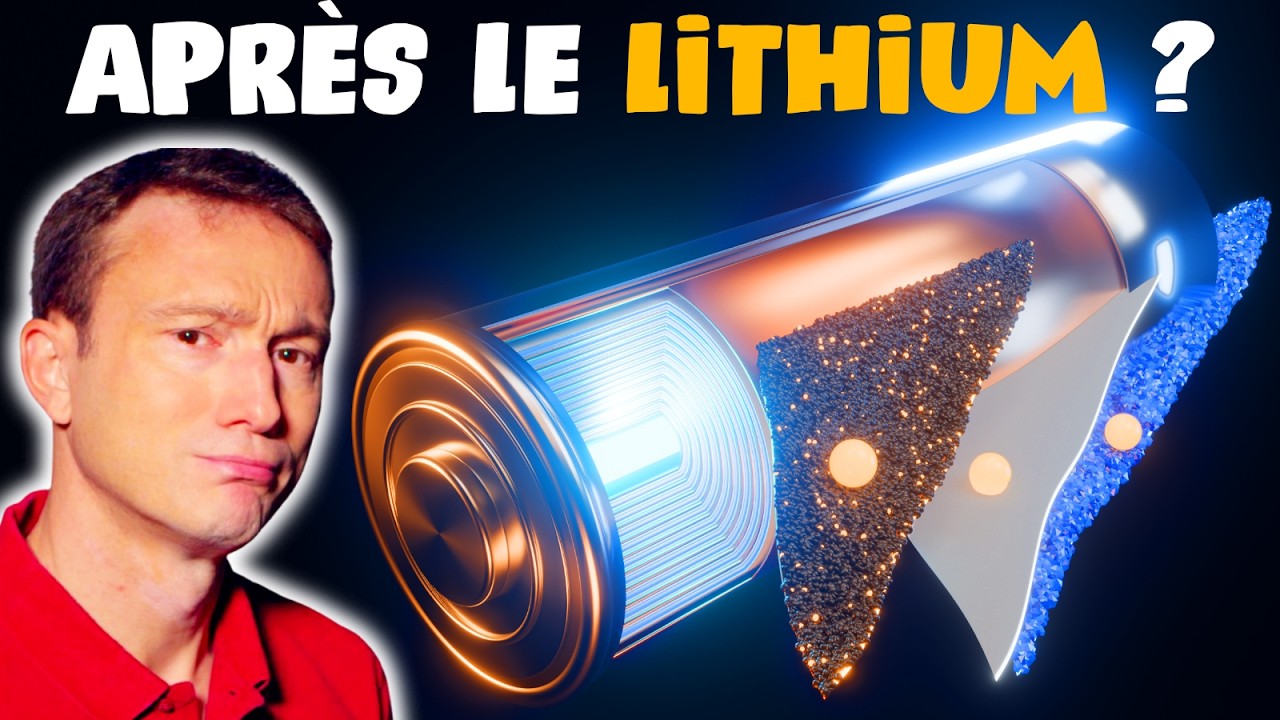
De quoi seront faites les batteries du futur ? [Le PEPR Batteries]
What will the batteries of the future be made of? [Le PEPR Batteries]
Keywords
Summary
274 words
Critical Evaluation
Value of the Information & Strength of the Argument
The informational value lies in the coherence of its pedagogical construction: each concept is introduced only when the previous one has become insufficient, so that voltage, capacity, energy and electrolyte stability window arrive exactly where a viewer would otherwise be lost. The chain runs from a simple displacement reaction to a working cell, then to a compact commercial cell, then to the constraints that forbid simply scaling up voltage, and finally to the reversibility problem that separates a pile from a battery. Concrete numbers anchor the abstractions: the Zn/Cu couple at roughly 1.1 V, the Zn/MnO2 couple at 1.5 V, water splitting above about 1.2 V theoretical, a phone at 3.7 V and 4000 mAh giving around 15 Wh, a car at 100 kWh, and the demonstration that no tabulated redox couple yields 9 V so six cells are stacked in series. The dual metaphor of the reservoir (capacity) and the push per electron (voltage) is used consistently rather than decoratively. The argumentation is also honest about its own simplifications: the arbitrary reference of electrode potential tables is flagged, the historical misnomer of ‘oxidation’ is explained rather than glossed over, and the failure modes of rechargeable chemistry (irreversible manganese oxide restructuring, dendritic deposition on rough sites) are given as physical mechanisms rather than assertions. The main weakness is asymmetry between announced scope and delivered weight: in the available transcript the discussion remains at the level of established textbook electrochemistry, and no quantitative comparison of candidate future chemistries (energy density, cycle life, cost, critical raw materials) appears before the cut-off point, so the prospective ambition of the title rests on the programme presentation rather than on demonstrated argument.
Scientific Rigor, Source Quality, Title Accuracy
On scientific rigour, the historical and physical claims checked against the transcript hold: Volta’s pile in 1800, the Daniell cell in 1836 used for telegraphy, Leclanché’s Zn/MnO2 cell in 1866, the lithium-manganese button cell developed by Saft in the 1970s, the roughly 1.23 V thermodynamic threshold for water electrolysis, and the statement that lithium combines a high charge-to-mass ratio with a strong thermodynamic drive to oxidise. The host also publishes an erratum in the description correcting the ownership of a patent to CNRS and CEA jointly, which is a good indicator of post-publication verification. On sources, however, the spoken content cites no paper, dataset or report: the production statistics at the opening are shown graphically without a named origin in the transcript, and the historical milestones are stated without references. The only documentary apparatus is in the description, which points to the website, LinkedIn page, YouTube channel and newsletter of the programme, plus links to the host’s own book. The video is explicitly produced with financial support from the research programme it presents, and a substantial final segment (from about 34:54) is dedicated to that programme’s projects; the partnership is disclosed up front, which is the correct practice, but it means the framing of which future chemistries are highlighted is not independent of the funder. It should also be noted that the transcript ends mid-sentence during the lead-acid discussion, so the lithium-ion chapter and the PEPR projects chapter could not be examined and no judgement is offered on their sourcing. On title/content fit, the title announces the batteries of the future while the accessible body is an electrochemistry primer; the promise is met only late, and the mismatch is one of timing rather than of substance.
578 words
Title / Content Match
The title promises an overview of future battery chemistries, but in the accessible portion roughly the first 35 minutes are devoted to generic electrochemistry fundamentals; the announced 'future' content is essentially deferred to the programme-focused final chapters. The fit is partial rather than misleading.
Quality & Reliability
8/10
The content is a carefully structured popular-science explanation of electrochemistry delivered by a physicist host, with historically accurate milestones (Volta 1800, Daniell 1836, Leclanché 1866, lithium-manganese button cells by Saft in the 1970s), correctly stated physical values (about 1.1 V for the Zn/Cu couple, 1.5 V for Zn/MnO2, ~1.2 V theoretical decomposition limit of water, 4000 mAh × 3.7 V ≈ 15 Wh) and explicit caveats about what limits rechargeability. Reliability is however capped by the absence of explicit bibliographic citations in the spoken content, by the partnership framing with the programme the video presents, and by the fact that the transcript supplied stops before the lithium-ion and PEPR project chapters, which therefore could not be verified. A published erratum (patents co-owned by CNRS and CEA) signals active self-correction.
Chapters
Cited Sources
- PEPR Batteries — official programme website — Website of the national priority research programme on future battery generations, created in 2023 and steered by CNRS and CEA; the video is produced with its financial support and the final chapter presents its 19 projects.
- PEPR Batteries — LinkedIn page — Institutional communication channel of the programme, listed in the description for viewers seeking updates on its projects.
- PEPR Batteries — newsletter subscription — Sign-up page for the programme's newsletter, given in the description as a follow-up resource.
- Alessandro Volta's pile (1800) — Cited in the video as the invention/discovery founding the electric cell.
- Daniell cell (1836) — Presented as the historical two-compartment cell with a salt bridge, widely used for telegraphy, and used to explain the need for ionic conduction.
- Leclanché cell (1866) — Introduced as the Zn/MnO2 chemistry that fixed the 1.5 V standard still used by most primary cells today.
- Lithium-manganese button cell developed by Saft in the 1970s — Cited as the industrial realisation of a single cell exceeding 3 V using a non-aqueous electrolyte.
Concurring Sources
- Electrochemistry — Wikipedia — Confirms the definitions used in the video: anode as the site of oxidation, cathode as the site of reduction, electrolyte ensuring ionic conduction, cell voltage tied to the difference in electrode potentials.
- Redox — Wikipedia — Consistent with the explanation of oxidation as loss of electrons, of the historical origin of the term, and of the hierarchy of couples illustrated by zinc, copper and silver.
- Lithium-ion battery — Wikipedia — Concords with the statement that lithium's low molar mass and high charge-to-mass ratio underpin high specific capacity, and with the use of non-aqueous electrolytes.
- PEPR Batteries — official programme website — Institutional source confirming the programme's existence, its CNRS/CEA steering and its mission on future battery generations.
External References
Contribution & Novelties
The original contribution is not the discovery of new results but the construction of a continuous explanatory path from a beaker demonstration to the design constraints of an industrial cell, including the often-skipped link between electrolyte electrochemical stability window and the voltage ceiling of a chemistry, and between the reversibility of a redox reaction in principle and its failure in practice through dendrite growth and structural collapse. Framing the whole sequence around a national research programme also gives a concrete institutional picture of how battery research is organised in France, which is rarely presented in science communication.
Pour aller plus loin :
- Electrochemistry — Overview of the redox, half-cell and conduction concepts that structure the first half of the video.
- Lithium-ion battery — Background for the chapter the transcript does not cover, on why this chemistry came to dominate.
- Redox — Formal treatment of oxidation states, electrode potentials and the competition between couples described with zinc, copper and manganese.
- Solid-state battery — One of the main candidate routes for the ‘batteries of the future’ announced in the title.
- Dendrite growth in metal deposition, as described for zinc and lithium anodes — Mechanism that explains why non-rechargeable cells cannot simply be cycled, cited by name only.
205 words
Radar Profile
The profile is that of a dense but deliberately paced didactic episode: information quantity and quality are high, technical level is substantial without assuming prior electrochemistry, and reliability is strong on fundamentals while constrained by the absence of explicit bibliographic citations. The relatively lower technical score reflects that the accessible portion stays at textbook level rather than reaching the comparative, quantitative assessment of emerging chemistries the title implies.