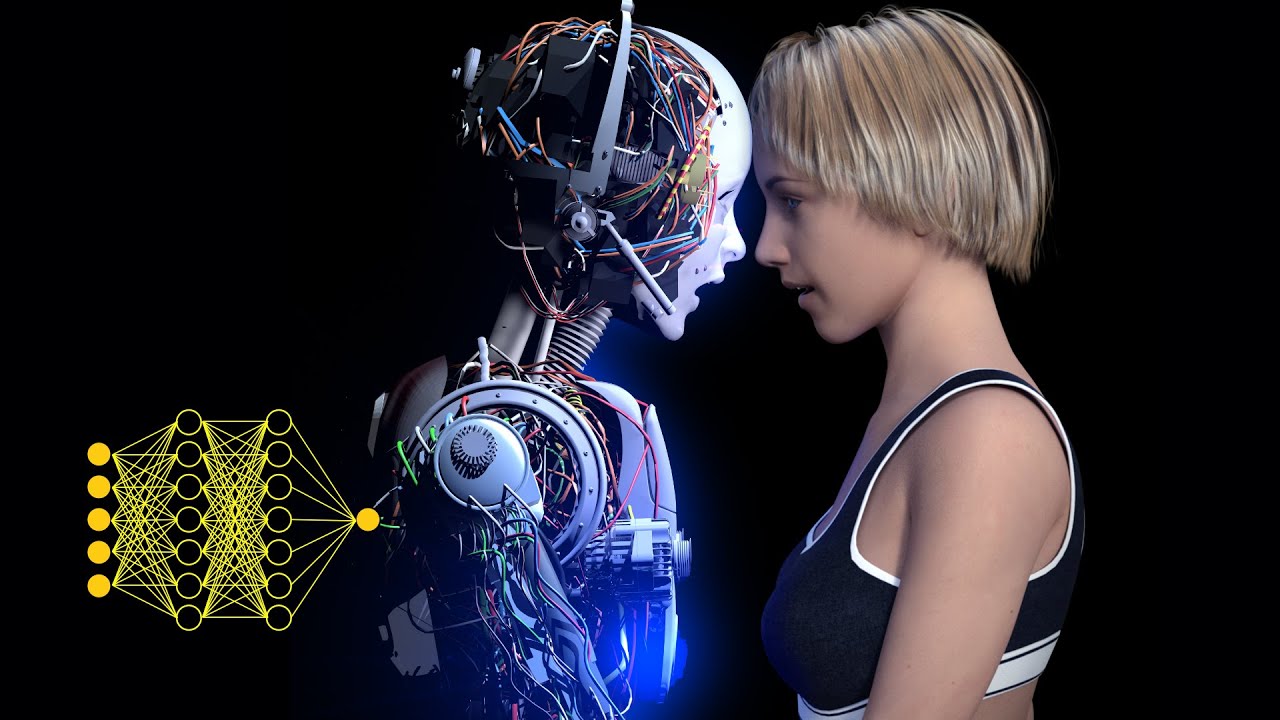
Comment les I.A. font-elles pour comprendre notre langue ?
How do AIs manage to understand our language?
Title history
- Comment les I.A. font-elles pour comprendre notre langue ? — observed on 20261019-0418 UTC (PSI archive)
Keywords
Summary
148 words
Critical Evaluation
Value of the Information & Strength of the Argument
The video delivers high pedagogical value by making complex NLP concepts accessible through intuitive analogies (e.g., “thought vectors”, vectors representing meanings). The argumentation is logical, building from basic machine learning to increasingly sophisticated architectures. It carefully explains the mathematical intuition behind embeddings and recurrent networks, while acknowledging limitations such as memory dilution. The progression is well-structured, and the explanation of attention as a solution is particularly insightful. The video avoids oversimplification, providing enough technical detail for a motivated audience.
Scientific Rigor, Source Quality, Title Accuracy
The content is scientifically rigorous, referencing widely recognized methods (Word2Vec from Google, GloVe from Stanford) and the seminal paper “Attention is all you need” (2017). The accompanying blog post offers further details, and the creator’s credentials as a physicist add credibility. The title accurately reflects the content: the video thoroughly explores how AI models process human language. No external sources are cited within the video itself, but the description provides links to complementary material. The discussion on whether AI truly understands language is treated with nuance, aligning with academic perspectives.
184 words
Title / Content Match
The title asks how AIs understand our language; the video thoroughly explains the technical methods behind natural language processing, addressing the question effectively.
Quality & Reliability
8/10
Explanation is clear, grounded in well-established techniques (Word2Vec, GloVe, RNNs, attention mechanism), and accompanied by additional resources. Some simplifications, but no factual errors detected.
Key Moments
Markers derived by PSI from the transcript: the creator did not define chapters.
- Introduction: how AI can understand natural language
- Principles of machine learning and deep learning
- Image recognition example and vectors as numbers
- Challenges of NLP: variable sentence length and word order
- Word embeddings and the concept of meaning space
- Word2Vec and GloVe examples, similarity measures
- Recurrent neural networks and thought vectors
- Encoder-decoder architecture for translation
- Memory issues, LSTMs, and attention mechanism
- Attention is all you need and the concept of comprehension
Cited Sources
- Blog post accompanying the video — Provides further details on Word2Vec, backpropagation, LSTM, etc.
- ScienceEtonnante books — Books by the creator for additional reading
- Support page (Utip) — Crowdfunding platform for the channel
- YouTube channel — Main channel for more videos
Concurring Sources
- Word2Vec (Wikipedia) — Confirms the use of word embeddings for semantic representation.
- Attention Is All You Need (arXiv) — Corroborates the description of the attention mechanism as a breakthrough in NLP.
Contribution & Novelties
The video’s contribution lies in its synthetic and intuitive presentation of NLP techniques, bridging the gap from simple embeddings to the attention mechanism, all grounded in accessible analogies. It demystifies complex architectures like RNNs and transformers without sacrificing accuracy.
Pour aller plus loin :
- Word2Vec (Wikipedia) — Official description of the embedding technique used by Google.
- Attention Is All You Need (arXiv) — The seminal paper introducing the transformer architecture, which underpins modern LLMs.
- Recurrent Neural Network (Wikipedia) — Basis for understanding sequential processing in NLP.
86 words
Radar Profile
The radar profile shows very high quantitative and qualitative information scores balanced by a moderate technical level, indicating a resource that is both rich in content and accessible to a broad audience, with strong reliability and pedagogic effectiveness.
💬 Sur les 30 commentaires analysés, l'ensemble exprime un enthousiasme marqué pour la clarté pédagogique et la qualité des explications, sans critique notable.