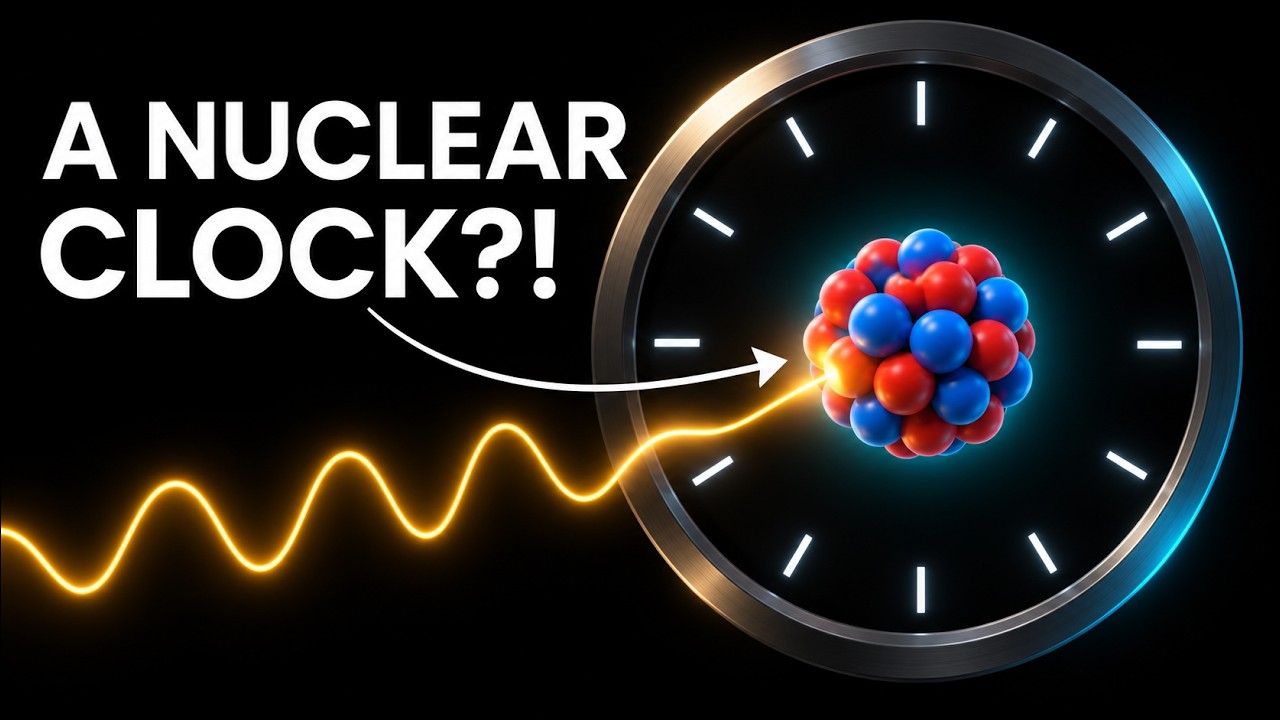
The Clever Physics Of The Thorium Nuclear Clock!
Title history
- The Clever Physics Of The Thorium Nuclear Clock! — observed on 20261117-0328 UTC (YouTube)
Keywords
Summary
147 words
Critical Evaluation
Value of the Information & Strength of the Argument
The video provides exceptional value by demystifying a complex topic with clear analogies (radio tuning) and a structured historical narrative. The argumentation is logically solid, distinguishing between indirect evidence, direct detection, and full clock operation. It correctly highlights the crucial role of feedback and the difference between finding a resonance and maintaining it. The explanation of how a response can guide correction direction via symmetric sampling is particularly enlightening. The video also honestly discusses limitations, such as potential drift and the challenge of comparing nuclear clocks to atomic clocks, avoiding overstatement of current achievements.
Scientific Rigor, Source Quality, Title Accuracy
The video demonstrates rigorous scientific practice by citing primary literature at each step, from Kroger & Reich (1976) to the two 2026 Nature papers. It distinguishes between measured values and estimates, explains experimental methods (e.g., alpha-decay spectroscopy, laser excitation, frequency combs), and notes the importance of control experiments (e.g., thorium-232). The title aligns perfectly with the content: the physics of the thorium nuclear clock is indeed cleverly explained. The video also clearly states its own limitations as an animated reconstruction and properly attributes all papers, adding to its credibility.
198 words
Title / Content Match
The title accurately reflects the central topic and the video's explanatory focus on the clever physics behind the thorium nuclear clock.
Quality & Reliability
9/10
The video is thoroughly grounded in peer-reviewed literature, correctly describes the physics and experimental history, and transparently distinguishes between verified results and open questions. The narration is precise, avoids overclaiming, and clearly explains the difference between laser excitation and a functioning clock.
Chapters
- A crystal that belongs to a clock
- 2003: a nuclear clock is proposed, but where is its setting?
- 2016 to 2024: catching the step, then driving it with a laser
- Staying tuned: a ruler made of light and which way to turn
- 2026: the working nuclear clocks
- How good is it? Wandering, averaging and the limits
- Why it matters: nature's rules, dark matter and the opening clock
Cited Sources
- Nuclear laser spectroscopy of the 3.5 eV transition in Th-229 (EPL 2003) — Proposal of thorium-229 nuclear clock by Peik and Tamm
- Features of the low-energy level scheme of 229Th as observed in the alpha-decay of 233U (1976) — First clue about the low-energy nuclear transition
- An excited state of 229Th at 3.5 eV (PRC 1994) — Refinement of the transition energy estimate
- Energy Splitting of the Ground-State Doublet in the Nucleus 229Th (PRL 2007) — Updated measurement of the transition energy
- Direct detection of the 229Th nuclear clock transition (Nature 2016) — First direct detection of the decay
- Direct detection of the 229Th nuclear clock transition (arXiv) — Preprint version of the Nature 2016 paper
- Observation of the radiative decay of the 229Th nuclear clock isomer (Nature 2023) — Detection of gamma rays from the isomer decay at CERN ISOLDE
- Observation of the radiative decay of the 229Th nuclear clock isomer (arXiv) — Preprint of the 2023 Nature paper
- Laser Excitation of the Th-229 Nucleus (PRL 2024) — First successful laser excitation of the thorium-229 nucleus
- Frequency ratio of the 229mTh nuclear isomeric transition and the 87Sr atomic clock (Nature 2024) — JILA comparison of nuclear transition with strontium atomic clock
- Frequency ratio of the 229mTh nuclear isomeric transition and the 87Sr atomic clock (arXiv) — Preprint of the JILA 2024 paper
- A thorium-229 optical nuclear clock with feedback loop (Nature 2026) — First nuclear clock with feedback loop by Vienna/PTB team
- A thorium-229 optical nuclear clock with feedback loop (arXiv) — Preprint of the Vienna/PTB 2026 paper
- A nuclear clock synchronized to 229Th (Nature 2026) — Tsinghua team's nuclear clock with continuous laser
- A nuclear clock synchronized to 229Th (arXiv) — Preprint of the Tsinghua 2026 paper
External References
Contribution & Novelties
The video’s original contribution lies in its clear pedagogical explanation of the nuclear clock concept, particularly the crucial distinction between the laser’s rhythm and the nucleus’s role as a reference. It provides a well-structured historical timeline, from the 1976 clue to the 2026 working clocks, and explains the feedback mechanism with a simple analogy. The video also offers a balanced assessment of the current performance, acknowledging that nuclear clocks have not yet outperformed atomic clocks and discussing open questions like dark matter searches.
Pour aller plus loin :
- Atomic clock - Wikipedia — Background on atomic timekeeping, complementary to nuclear clocks.
- Thulium-229 nuclear isomer - Wikipedia — Detailed technical information on the isomer used in these clocks.
- Frequency comb - Wikipedia — The measurement technique essential for comparing optical frequencies.
- Dark matter - Wikipedia — The video discusses how nuclear clocks might detect dark matter; this page provides context.
- Peik and Tamm proposal - EPL paper — The original 2003 proposal, and a direct anchor for the video’s narrative.
169 words
Radar Profile
The radar profile shows a very high quality of information (10) and reliability (9), with strong quantitative content (9) and solid technical depth (8). This indicates a well-researched, scientifically accurate video that balances technical detail with accessibility, making it valuable for both enthusiasts and those new to the topic.