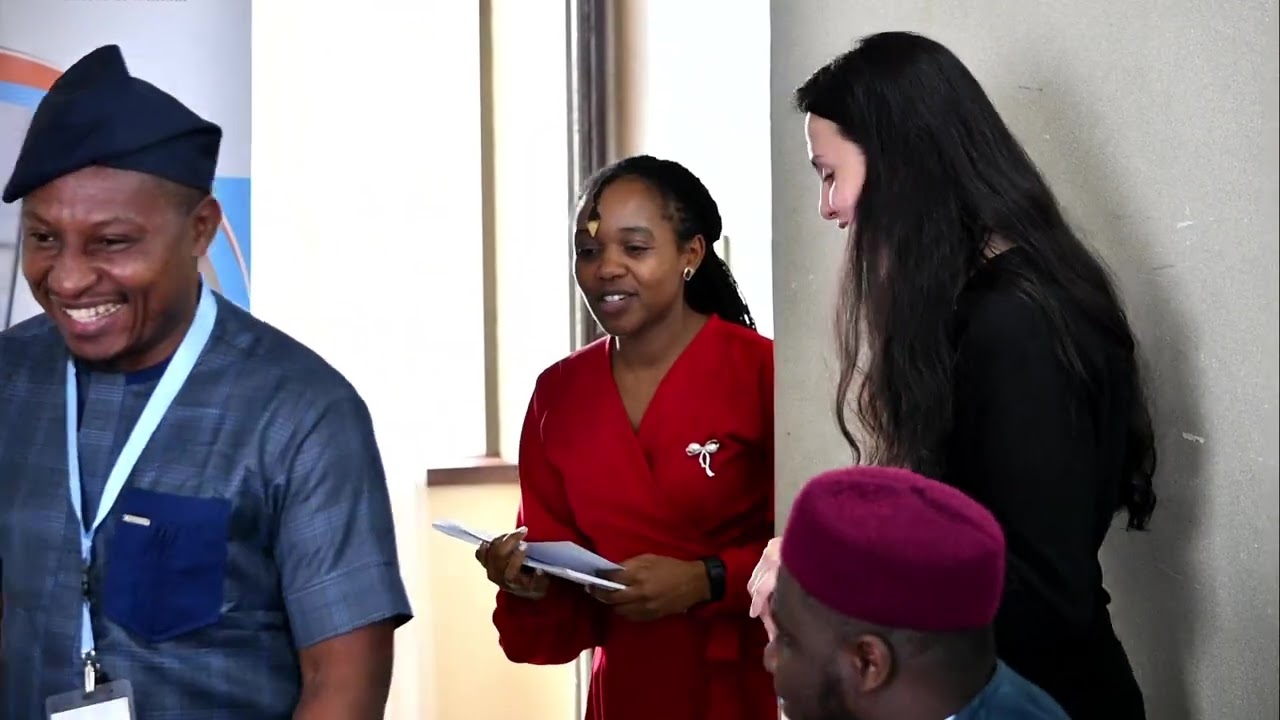
3rd AMAX Summer School Awards and Closing Ceremony - 20th May 2026
Keywords
Summary
165 words
Critical Evaluation
Value of the Information & Strength of the Argument
The informational value of the video is very low for scientific or technical purposes. It is essentially an event record: it lists group rankings, prize giving, certificate distribution, institutional thanks, and forward-looking programme remarks. No modelling results, epidemiological data, study designs, or analytical methods are presented, so the viewer gains no substantive scientific content. The argumentation is mainly ceremonial and motivational. Speakers assert that African-led modelling can inform policy and that training should lead to publications and policy briefs, but these claims are not supported by evidence, examples, or references in the transcript. The strongest argumentative thread is the emphasis on science communication and on building a sustainable African modelling ecosystem, yet it remains a set of programme-level aspirations rather than a demonstrated result.
Scientific Rigor, Source Quality, Title Accuracy
Scientific rigour is minimal in this recording. There is no hypothesis, method, dataset, analysis, or discussion of uncertainty; the event is administrative and celebratory. Source quality is also weak: the description contains no links or references, and the transcript cites no studies, reports, or datasets. Institutions and programmes are named, but they are not presented as sources of evidence. The title and content match closely: the video is indeed an awards and closing ceremony, with rankings, prizes, certificates, and closing remarks. No advertising sequence is evident in the transcript.
228 words
Title / Content Match
The title accurately describes the content: an awards and closing ceremony for the 3rd AMAX Summer School, including rankings, prizes, certificates, and closing speeches.
Quality & Reliability
2/10
The video is a ceremonial closing event rather than a scientific presentation. It contains no data, methods, references, or verifiable evidence; its claims concern programme goals, training outcomes, and future plans, which cannot be assessed from the transcript alone.
Key Moments
Markers derived by PSI from the transcript: the creator did not define chapters.
- Opening remarks announce the group rankings and mention the cholera group.
- The maternal and health group is recognised as the winning group and receives a symbolic prize.
- Judges are thanked and given tokens of appreciation.
- Certificates are distributed to participants.
- Facilitators and presenters are recognised and thanked.
- A project lead reflects on the AMAX programme and thanks the team.
- The communications team and journalists are thanked, with remarks on the role of the media.
- Closing speech outlines next steps, including publications and future summer schools in Senegal and Uganda.
Contribution & Novelties
The video offers no original scientific finding. Its main value is as a record of a capacity-building event: it shows how a summer school combines group work, policy-oriented communication, awards, and institutional networking. The closing remarks articulate a transition from training and PhD completion toward publications and policy briefs, and they situate modelling capacity within African institutions rather than external universities. This is a programme narrative, not a scientific contribution.
Pour aller plus loin :
- African Institute for Mathematical Sciences — Background on the broader AIMS network mentioned in the ceremony.
- Mathematical modelling of infectious disease — Context for the epidemiological modelling themes referenced by the speakers.
- Policy brief — Explains the publication format that the closing speech identifies as a next-step output.
123 words
Radar Profile
The profile is uniformly low: little information density, little technical content, and weak reliability as a scientific source. The event is coherent as a ceremony but does not aim to provide evidence or analysis. Its strongest dimension is topical relevance to science capacity building, not scientific rigour.