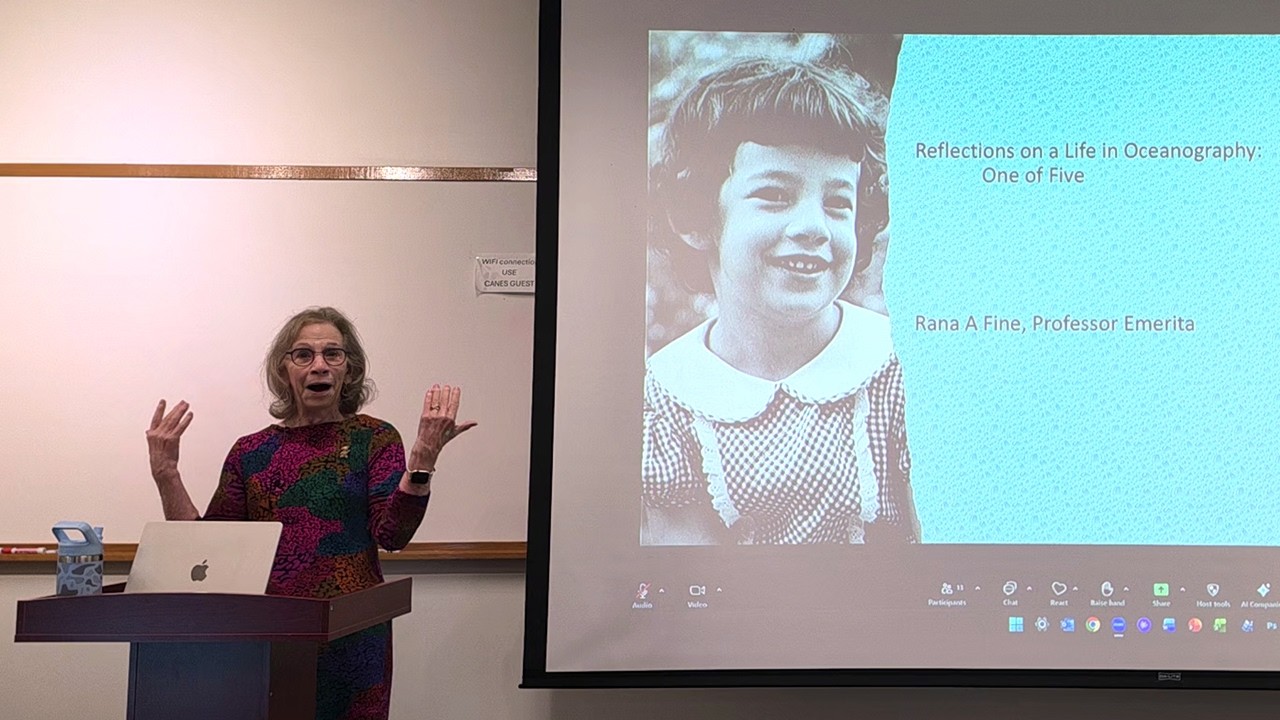
Rana Fine, Rosenstiel: Reflections on a Life in Oceanography
Title history
- Rana Fine, Rosenstiel: Reflections on a Life in Oceanography — observed on 20261112-0824 UTC (YouTube)
Keywords
Summary
196 words
Critical Evaluation
Value of the Information & Strength of the Argument
The value of this talk lies in its unique first-hand perspective on the evolution of ocean tracer research and the human dimension of scientific careers. Rana Fine provides authentic anecdotes and emphasizes the critical role of collaborative networks in advancing oceanography. The argumentation is not formal scientific reasoning but rather a narrative that logically connects her personal experiences to scientific outcomes. She explains how specific collaborations and programs contributed to her discoveries, which strengthens the credibility of her recollections. While the scientific claims are not systematically demonstrated in this talk, they are grounded in peer-reviewed work she has published. The solidity of the argumentation lies in the coherence of her story and the support of institutional and peer recognition.
Scientific Rigor, Source Quality, Title Accuracy
Scientific rigor is evident through references to specific publications, such as the Nature paper with Fritz Schott on volume transport and the paper with Joe Reid on lateral injection. She mentions key programs (WOCE, STACS, GO-SHIP) and collaborators who are well-known in the field. The quality of sources is high due to her status as a leading expert, though the lack of formal citation in the talk reduces its source transparency. The title is entirely appropriate: the talk is indeed a reflective account of her life in oceanography, and it delivers on that promise. There are no comments provided to analyse.
235 words
Title / Content Match
The title accurately reflects the content: a personal retrospective on a career in oceanography, delivered as a seminar.
Quality & Reliability
8/10
Rana Fine is a respected oceanographer with a long career, and her personal retrospective provides reliable first-hand insights into the development of tracer oceanography and scientific collaboration. The lack of formal citations and the anecdotal nature lower the score slightly.
Key Moments
Markers derived by PSI from the transcript: the creator did not define chapters.
- Introduction by Dennis Hansel, who shares personal remarks about Rana Fine.
- Rana begins her talk, overview of her scientific focus on ocean ventilation and tracers.
- Family background and education, including Bronx High School of Science and path to marine science.
- Explanation of ocean ventilation and the use of tracers to infer timescales and pathways.
- Discussion of tritium work in the North Pacific and the discovery of lateral injection; Indonesian Throughflow evidence.
- Transition to CFCs, setup of seagoing system, and findings on the deep western boundary current.
- Reflections on collaboration, major programs, and experiences as a woman in oceanography; concluding remarks.
Cited Sources
- Publication on lateral injection in thermocline ventilation (Fine & Reid, 1981) — Mentioned as a finding from tritium data in the North Pacific.
- Nature paper on volume transport estimate with Fritz Schott — Discussed in relation to Indonesian Throughflow tracer evidence.
- STACS (Subtropical Atlantic Climate Studies) program — Collaborative program led by Bob Molinari that contributed to CFC work.
- World Ocean Circulation Experiment (WOCE) — Major international program that funded and facilitated tracer data collection.
- CLIVAR and GO-SHIP programs — Successors to WOCE, mentioned in the context of ongoing collaboration.
Contribution & Novelties
This talk provides an original contribution by documenting the historical development of tracer oceanography from a personal standpoint. Rana Fine shares insights into how collaborations shaped her research and highlights the importance of soft skills and resilience in a male-dominated field. The scientific novelty lies in her recounting of specific discoveries, such as lateral injection and the Indonesian Throughflow, which were foundational in understanding ocean ventilation.
Pour aller plus loin :
- Meridional overturning circulation — Central concept in understanding large-scale ocean currents, directly relevant to her work on deep western boundary currents.
- Chlorofluorocarbon — Tracer used in her later research; understanding their properties helps appreciate their role in ocean dating.
- Tritium — Key tracer in her early work; the page explains its sources and applications in hydrology and oceanography.
129 words
Radar Profile
The radar profile shows a high fiabilite_globale (8) paired with moderate quantite_information (6) and qualite_information (7). Niveau_technique (5) is moderate, indicating an accessible talk. This suggests a trustworthy expert narrative with solid insights but not deeply technical for specialists.