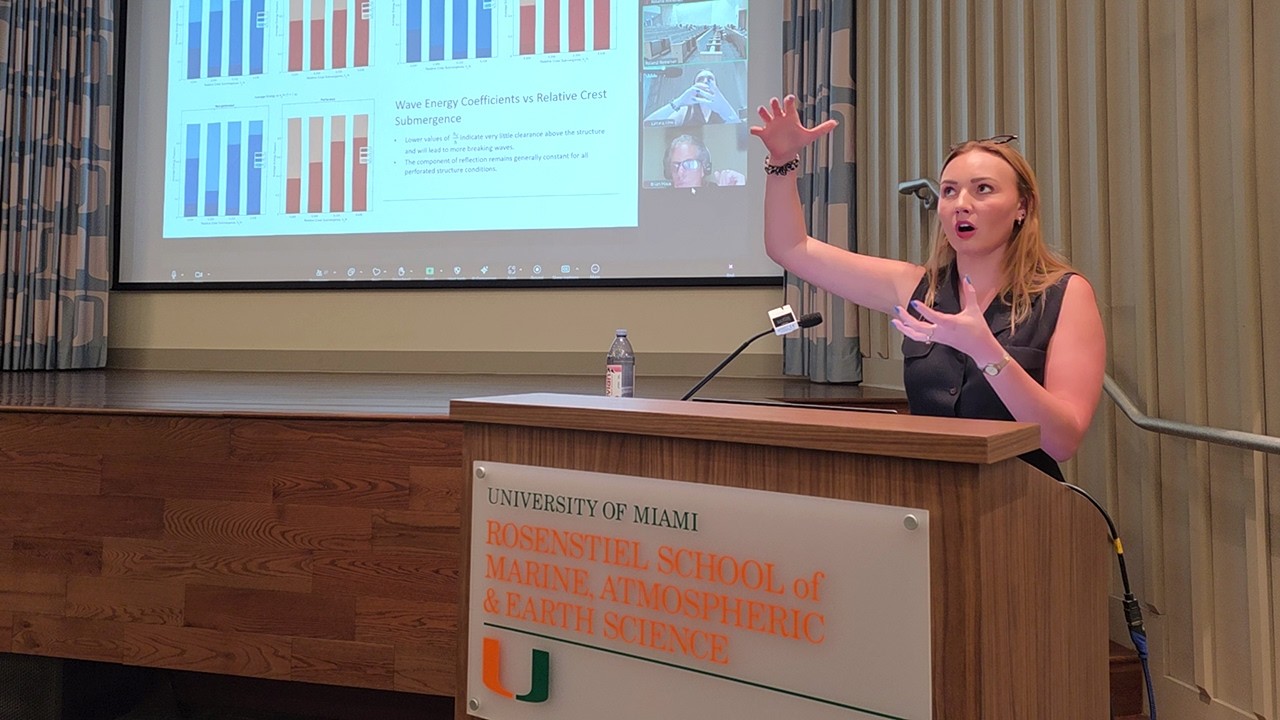
Katie Simi, Rosenstiel: Wave Interaction With a Porous Structure
Title history
- Katie Simi, Rosenstiel: Wave Interaction With a Porous Structure — observed on 20261114-0923 UTC (YouTube)
Keywords
Summary
133 words
Critical Evaluation
Value of the Information & Strength of the Argument
The value of this study lies in addressing a knowledge gap regarding porous artificial reef structures, which are less studied than traditional rubble-mound breakwaters. The argumentation is logical: the presenter clearly states objectives, describes experimental setup, and presents results with binned averages. The use of wave probes and comparison of perforated vs. non-perforated structures provides systematic evidence. The discussion of breaking vs. non-breaking waves and the role of reflection highlights the importance of structure porosity. However, as preliminary results, the conclusions are cautiously phrased, and further analysis is promised. The presentation effectively argues for the potential benefits of perforated structures in reducing reflection and enhancing wave energy dissipation, which is relevant for coastal resilience.
Scientific Rigor, Source Quality, Title Accuracy
The presentation demonstrates scientific rigor through detailed documentation of experimental parameters, scaling methods (Froude scaling), and the use of established linear wave theory. The speaker references software (Wavelab) and prior studies (e.g., Norris et al.) that provide context. However, no explicit citations with URLs are given, and the work is not yet published, so sources are limited. The title matches the content precisely, with no misleading elements. The structure of the talk follows a logical outline of chapters, with a clear focus on chapter 1 results. The speaker also mentions peer-reviewed literature indirectly, but the lack of direct references limits verifiability.
230 words
Title / Content Match
The title accurately reflects the content: a presentation on surface wave interaction with a submerged porous structure, specifically the Seahive.
Quality & Reliability
7/10
The presentation is methodical and technically detailed, but results are preliminary and not yet peer-reviewed. The experimental design is solid with appropriate scaling and multiple probes.
Key Moments
Markers derived by PSI from the transcript: the creator did not define chapters.
- Introduction of speaker Katie Simi and her background.
- Overview of Seahive structure and different configurations, including perforated and non-perforated models.
- Explanation of experimental design: 15 wave probes, 302 conditions, Froude scaling.
- Presentation of key parameters: reflection, transmission, and dissipation coefficients.
- Discussion of preliminary results: perforated structure reflects less energy and dissipates more at certain water depths.
- Outline of future work: wind forcing experiments and camera imaging analysis.
Contribution & Novelties
The study provides novel laboratory data on the wave-dissipating performance of a specific modular porous structure (Seahive) compared to a non-perforated counterpart. It systematically varies key non-dimensional parameters and identifies reduced reflection as a distinct advantage of porosity. This contributes to the limited literature on artificial reef foundations and offers guidance for coastal engineering design. The experimental design with numerous wave probes and planned integration of wind forcing and camera imaging is innovative.
Pour aller plus loin :
- Artificial reef — Overview of artificial reef structures and their ecological and coastal protection roles.
- Froude number — Dimensionless number used in Froude scaling for hydraulic experiments.
- Wave tank — Description of laboratory wave flumes used to simulate ocean waves.
118 words
Radar Profile
The radar profile shows high scores in quantity and technical level, indicating a comprehensive and specialized presentation. Quality and fiabilité are moderate, reflecting the preliminary nature of the results and lack of external peer review. The balance suggests a strong methodological foundation but with cautious conclusions.