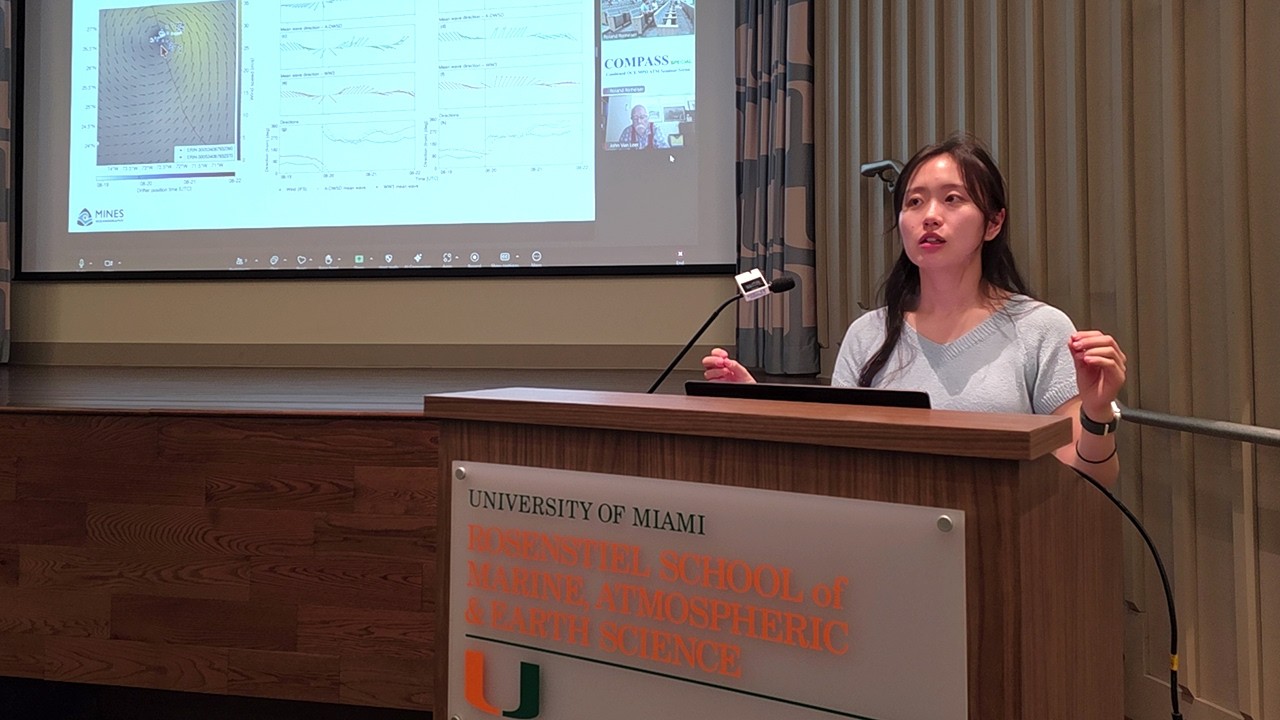
Ajin Cho, Mines: Wind and Current Effects on Waves in a Hurricane
Title history
- Ajin Cho, Mines: Wind and Current Effects on Waves in a Hurricane — observed on 20261118-0528 UTC (YouTube)
Keywords
Summary
192 words
Critical Evaluation
Value of the Information & Strength of the Argument
The presentation provides valuable insight into the processes controlling sea-state variability in tropical cyclones. The argumentation is solid: the speaker formulates clear hypotheses, uses a multi-faceted approach combining observations and models, and systematically tests the effects of wind resolution and current forcing through controlled numerical experiments. The validation against multiple observation platforms (satellites, drifters) strengthens the credibility of the results. The discussion of potential upscale effects on wind-wave misalignment and air-sea fluxes is well-reasoned and sets the stage for future coupled studies.
Scientific Rigor, Source Quality, Title Accuracy
The scientific rigour is high: the study uses well-established models (WAVEWATCH III) and datasets (ERA5, IFS, COAMPS, GLORYS), and the speaker transparently evaluates the performance of each forcing field. References to prior work are mentioned (e.g., Velasco 2025, earlier studies on current-wind interactions), though few full citations are provided. The title accurately reflects the content, and the seminar follows a logical structure. No public comments were provided, so no audience feedback is available.
170 words
Title / Content Match
The title accurately reflects the seminar content, which examines the relative roles of winds and currents on surface wave variability during Hurricane Erin.
Quality & Reliability
8/10
Presentation of an original research study with a clear methodology, in-situ observations, numerical simulations, model validation, and a rigorous scientific discussion. The speaker details hypotheses, experimental designs, and quantitative results, though some references are mentioned without full citations.
Key Moments
Markers derived by PSI from the transcript: the creator did not define chapters.
- Introduction and background on air-sea interaction and spatial scales.
- Part I: Current-wind interaction effects on tropical cyclone intensity using coupled model simulations.
- Motivation for Part II: need for high-wind surface wave data and uncertainties in drag coefficients.
- SASCWATCH field campaign and deployment of wave drifters; introduction of WAVEWATCH III model setup.
- Validation of model against observations and presentation of spatial variability in wave fields.
- Discussion of wind-wave misalignment and future work with fully coupled models.
Cited Sources
- WAVEWATCH III spectral wave model — Used for numerical simulations of surface waves.
- SASCWATCH field campaign — Provided in-situ observations including 23 wave drifters.
Concurring Sources
- Prior studies on current-wind interactions (e.g., those cited in Part I) — Support the finding that current interactions affect air-sea fluxes even under extreme winds.
Contribution & Novelties
This seminar provides new insights into the relative contributions of high-resolution winds and surface currents to small-scale sea-state variability in tropical cyclones, an area where observational data are scarce. The combination of a dense drifter array with high-resolution model experiments is original and highlights the importance of current-induced refraction for wave field structure. The identification of wind-wave misalignment behind the storm has implications for parameterizing air-sea fluxes in extreme conditions.
Pour aller plus loin :
- Wind wave — Overview of wind-generated waves and their characteristics.
- Wave-current interaction — Mechanisms by which currents modify wave propagation, including refraction and wavenumber changes.
- Tropical cyclone — General background on the structure and dynamics of tropical cyclones, relevant to the extreme wind conditions discussed.
120 words
Radar Profile
The radar profile shows very high technical level (9/10) and strong information quantity/quality (8/10), with slightly lower but still solid reliability (8/10). This reflects a research seminar that is dense and scientifically rigorous, aimed at an expert audience.