Rees et al.: Observation With a Tethered Balloon System
Title history
- Rees et al.: Observation With a Tethered Balloon System — observed on 20261101-0204 UTC (YouTube)
Keywords
Summary
196 words
Critical Evaluation
Value of the Information & Strength of the Argument
The information presented is highly valuable for environmental monitoring and research, addressing a critical gap in continuous, high-resolution observation at intermediate scales. Each speaker provides concrete case studies with empirical data, such as the sargassum drifter trajectories and aerosol vertical profiles, which demonstrate the practical benefits of the balloon system. The argumentation is solid, grounded in specific field experiments and modeling efforts. For instance, Olascoaga’s optimization of drift parameters shows improvements over the standard 1% windage assumption, and Wang’s findings on new particle formation in the decoupled boundary layer challenge common assumptions. The discussions are logical and methodical, with each presenter clearly stating their objectives and preliminary results. However, the presentation format limits deep dives, and some claims are based on limited datasets (e.g., short-duration drifter deployments). The value lies in showcasing a novel technology’s versatility, and the argumentation effectively makes a case for its adoption, though a more rigorous statistical analysis would strengthen the conclusions.
Scientific Rigor, Source Quality, Title Accuracy
The scientific rigor is reasonable given the seminar context. The speakers are experts in their fields and present original data from recent deployments. However, the talk does not cite specific peer-reviewed publications or provide detailed experimental protocols, which are likely available in follow-up papers. The sources are primarily the speakers’ own unpublished work, and no external references are given in the description. The adéquation between the title and content is good: ‘Observation With a Tethered Balloon System’ accurately captures the overarching theme, and the subtitle ‘From Sargassum to Smoke to Sharks’ nicely summarizes the three applications. The presentation structure is coherent, moving from an introduction of the technology to three distinct use cases. While the methods are not fully detailed, the presentations include enough information (e.g., sensor specs, data analysis techniques) to give an impression of scientific diligence. The lack of citations and peer-review status means the content should be considered preliminary, but the speakers’ reputations and the inclusion of field measurements lend credibility.
335 words
Title / Content Match
Title accurately reflects the focus on tethered balloon observation across three applications; concise and appropriate.
Quality & Reliability
8/10
The seminar presents original research by established scientists, with field data and technical details. However, no external references are provided, and preliminary results are not peer-reviewed in this context.
Key Moments
Markers derived by PSI from the transcript: the creator did not define chapters.
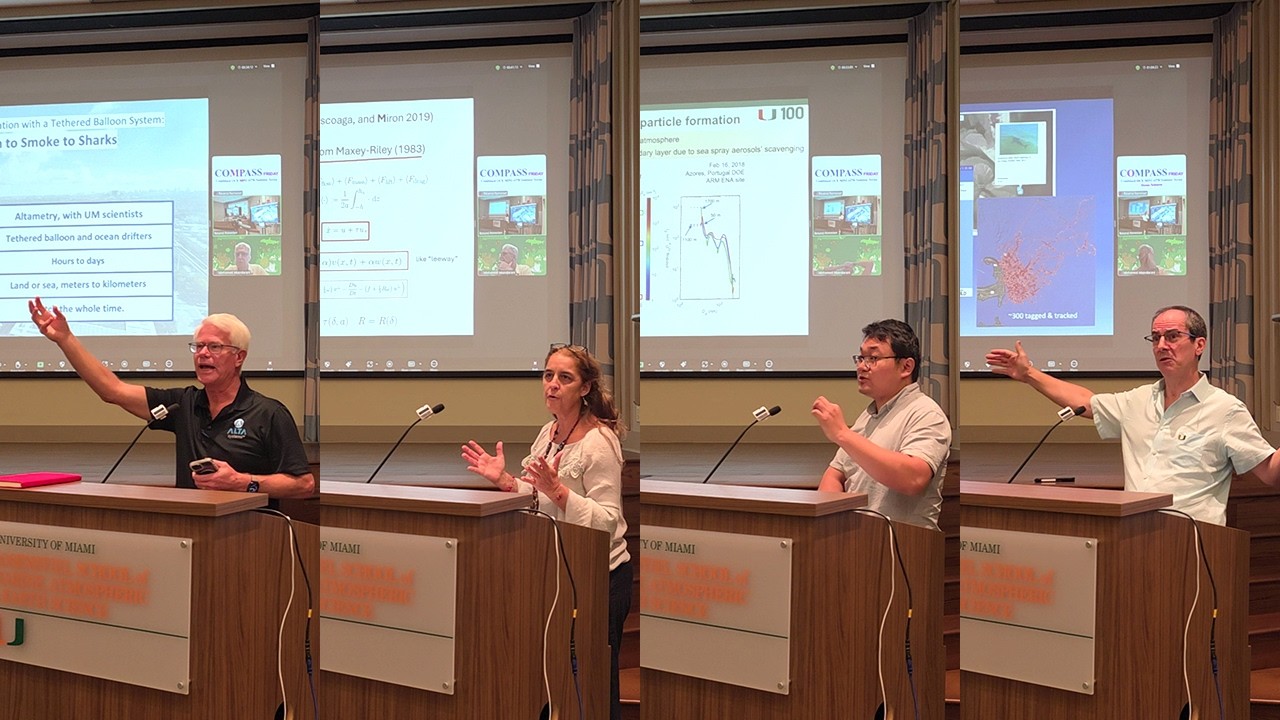
- Gary Rees introduces the tethered balloon system and its capabilities: 15ft long, 2.5kg payload, power and data via tether, can fly for days.
- Josefina Olascoaga presents her sargassum drifter experiment in Biscayne Bay, showing trajectories and the model including windage and Stokes drift.
- Yang Wang discusses aerosol vertical profiling, emphasizing new particle formation in the decoupled boundary layer, with aircraft data from the eastern North Atlantic.
- Bertrand Dano presents shark detection efforts off Cape Cod using balloon imagery and AI-assisted methods, with collaborations with the Atlantic White Shark Conservancy.
- Q&A and live demonstration of the tethered balloon system, with opportunities for attendees to engage with the team.
Contribution & Novelties
The seminar presents a novel application of a relocatable tethered balloon system as a persistent, low-altitude observation platform, addressing a gap between satellite coverage and drone flights. The specific contributions include: (1) integration of optical sensors and accelerometers into drifters to track sargassum mats and measure wave effects, leading to improved drift model parameterizations; (2) demonstration of vertical aerosol profiling to capture new particle formation events that surface measurements miss; (3) development of a prototype shark detection system using continuous aerial imagery and AI. The versatility of the platform for environmental monitoring is highlighted across three distinct case studies.
Pour aller plus loin :
- Tethered balloon — Background on tethered balloon technology and applications.
- Sargassum — Overview of sargassum ecology and its environmental impact.
- Aerosol — Definition and importance of aerosols in atmospheric science.
- Great white shark — Context for shark detection and conservation efforts.
145 words
Radar Profile
The profile shows high scores in qualitative and technical aspects, with a balanced distribution across information quantity and reliability. This indicates a technically rich presentation with credible content, though the limited number of sources and preliminary nature of results slightly lower the reliability score.