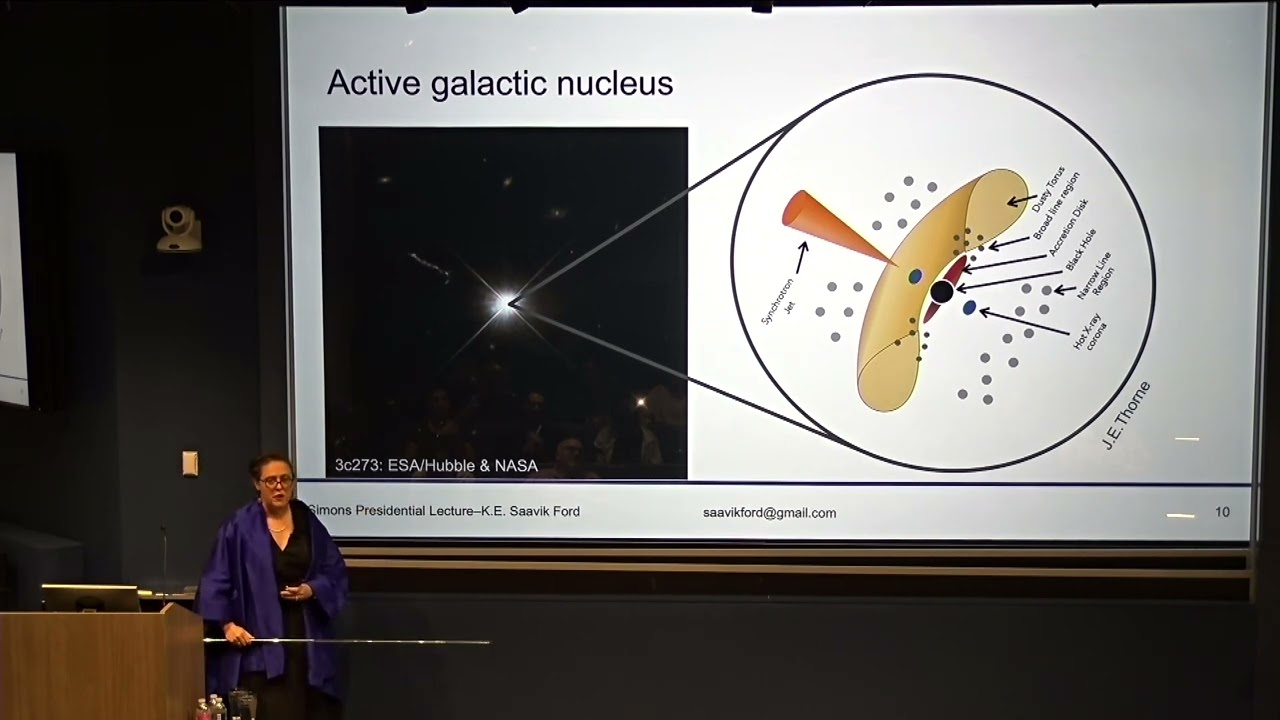
K. E. Saavik Ford: When Supermassive Black Holes Get Hungry
Keywords
Summary
201 words
Critical Evaluation
Value of the Information & Strength of the Argument
The lecture’s value lies in its clear, intuitive explanations of complex astrophysical phenomena, supported by vivid visuals and simulations. Ford builds a logical argument from basic black hole physics to the role of AGN in galactic evolution and gravitational wave production. She effectively uses analogies (e.g., escape velocity, resonant interactions) to make the science accessible without oversimplifying. The argumentation is compelling, moving from established facts (e.g., LIGO detections) to plausible hypotheses (e.g., hierarchical mergers in AGN disks), while openly acknowledging open questions. The inclusion of recent data from LIGO and simulations strengthens the credibility of the presentation.
Scientific Rigor, Source Quality, Title Accuracy
The scientific rigor is high: Ford references specific observations (stellar orbits, LIGO events, JWST images) and simulations (Phil Hopkins’ hydrodynamics, numerical relativity simulations), and she is careful to distinguish well-established results from speculative scenarios. The quality of sources is solid, drawing on peer-reviewed findings and community consensus, though no written references are provided beyond the event page. The title accurately describes the content, focusing on the ‘hungry’ aspect of supermassive black holes, which is precisely the lecture’s theme. No comments were provided for analysis.
196 words
Title / Content Match
The title, 'When Supermassive Black Holes Get Hungry,' accurately reflects the lecture's focus on accretion onto supermassive black holes and the surrounding phenomena, including active galactic nuclei and gravitational wave events.
Quality & Reliability
8/10
The presentation is given by a recognized astrophysicist, relies on established observational results (e.g., LIGO detections, stellar orbit tracking) and simulations, and is hosted by the Simons Foundation, a reputable institution. The content is accurate and well-supported, though it is primarily a synthesis rather than a peer-reviewed study.
Key Moments
Markers derived by PSI from the transcript: the creator did not define chapters.
- Introduction: viewing the Milky Way and Andromeda, historical context of galaxy understanding.
- Animation of stellar orbits around the Milky Way's central black hole, determining its mass.
- Explanation of black hole formation via escape velocity and density, and the possibility of orbiting black holes.
- Discussion of AGN feedback and its impact on star formation and galaxy evolution.
- LIGO detections of binary black hole mergers and the role of galactic nuclei in high-mass events.
Cited Sources
- Event page: When Supermassive Black Holes Get Hungry — The official event page provides details about the lecture and related background information.
Contribution & Novelties
The lecture contributes by synthesizing current knowledge on AGN and gravitational waves, offering a coherent narrative that connects black hole accretion to galaxy assembly and merging black holes. Ford highlights her group’s work on ’things in discs’ and the migration of stellar-mass black holes in accretion disks, which is a relatively novel avenue for explaining high-mass gravitational wave events. The presentation underscores the importance of AGN as environments for hierarchical mergers, a hypothesis gaining traction. The talk also clarifies the connection between protoplanetary and AGN disks, facilitating cross-disciplinary understanding.
Pour aller plus loin :
- Active galactic nucleus — Comprehensive overview of AGN, their structure, and feedback mechanisms.
- Gravitational wave — Explanation of gravitational waves, detection methods, and astrophysical implications.
- Supermassive black hole — Details on properties, formation, and role in galactic centers.
132 words
Radar Profile
The radar profile shows high scores in information quantity and quality, a moderate technical level suggesting a broad audience, and excellent reliability, indicating a scientifically dependable and content-rich presentation.