Jens Jasche: Building the Universe’s Digital Twin: Progress from...(September 17, 2026)
Title history
- Jens Jasche: Building the Universe’s Digital Twin: Progress from...(September 17, 2026) — observed on 20261113-2201 UTC (YouTube)
Keywords
Summary
209 words
Critical Evaluation
Value of the Information & Strength of the Argument
The talk provides substantial value by moving beyond summary statistics to object-by-object and location-by-location comparisons between simulation and reality—a genuinely new capability. The velocity field Olympics is a concrete, community-usable benchmark that others have already adopted, and the honest framing of the Hubble constant project (showing that selection effects, not velocity fields, dominate the error) illustrates strong scientific integrity. The argumentation systematically builds from single reconstructions to ensembles, then to physical validation (power spectrum, halo mass function, CMB lensing, X-ray), and finally to prospective future methods—each claim backed by quantitative evidence. Preliminary results are clearly labeled as such, and limitations (e.g. supernova rate modelling, cluster-by-cluster feedback differences) are openly discussed. The speaker’s caution about ’taking with a grain of salt’ reinforces a rigorous presentation style.
Scientific Rigor, Source Quality, Title Accuracy
The scientific rigor is high: the methods build on a long track record of peer-reviewed publications (BORG algorithm, Manticore series), and results are tested against independent data (Planck CMB, X-ray observations, Who is the intended audience? This is a specialist research talk—possibly given by a professor to graduate students, but more likely a scientific conference presentation. The technical level is advanced. The title accurately and specifically reflects the content: ‘Building the Universe’s Digital Twin: Progress from the BORG Working Group’ is precisely what is presented. The only minor mismatch is the truncation of the title on YouTube, which cuts off the subtitle. The source transparency is good: datasets (2M++, ZTF DR2, SDSS) are explicitly named, and the speaker credits collaborators. However, the talk does not provide URLs or detailed citations during the presentation itself; references are only available in the meeting materials.
282 words
Title / Content Match
The title accurately reflects the content: the talk presents progress on building a digital twin of the universe through the BORG working group's reconstruction efforts.
Quality & Reliability
8/10
High-quality research presentation from a leading cosmologist, based on peer-reviewed methodology (BORG, HMC with differentiable simulators). The talk explicitly acknowledges which results are preliminary ('take with a grain of salt') and which are published. The core reconstructions have been validated against multiple independent probes (CMB lensing, X-ray, SZ), lending strong credibility. Minor limitations: some claims (e.g., Perseus cool-core matching) rely on sub-selected posteriors and need further confirmation.
Key Moments
Markers derived by PSI from the transcript: the creator did not define chapters.
- Introduction to the BORG working group and the Manticore digital twin project.
- Explanation of the BORG algorithm: Hamiltonian Monte Carlo with differentiable physics simulator to infer initial conditions.
- Manticore local volume: reconstruction of the 2M++ catalog region, Lambda-CDM consistency verification.
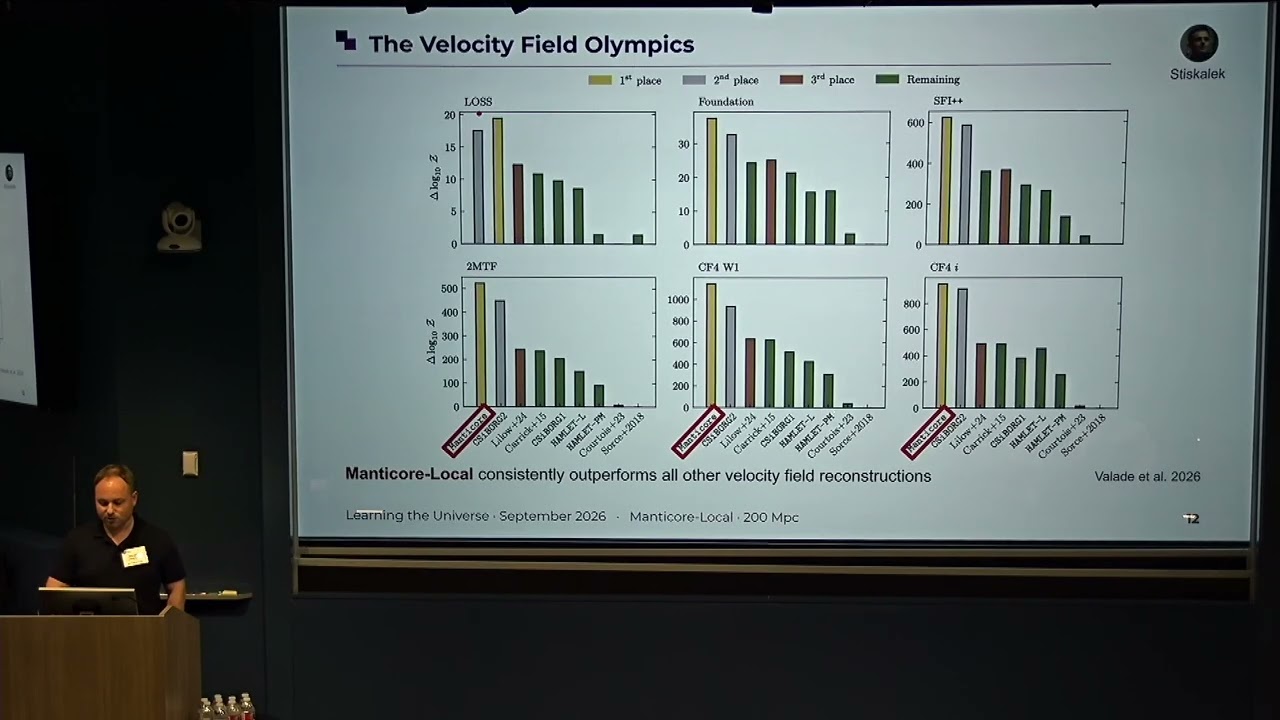
- Velocity field Olympics: Manticore model outperforms competitors in 5 of 6 benchmark tests.
- Inferring the Hubble constant from Cepheid hosts without supernovae; selection effects dominate the error budget.
- ZTF DR2 supernova rate excess at 12 sigma; supernovae trace large-scale structure but not mass alone.
- Cluster modeling: Coma and Perseus profiles, cool-core vs non-cool-core histories from the posterior ensemble.
- Manticore Deep: extended volume with SDSS data, velocity fields, dynamic range from the BOSS Great Wall to the Coma cluster.
- CMB lensing cross-correlation and ~3.5 sigma kinetic Sunyaev-Zel'dovich detection.
- Future directions: machine learning acceleration, generative posterior models (PineTree, LULU), GPU-optimized simulators.
Cited Sources
- Simons Collaboration on Learning the Universe Annual Meeting 2026 — Official event page for the meeting where this presentation was given.
- 2M++ galaxy catalog (Lavaux & Hudson 2011) — Input galaxy catalog for the Manticore local reconstruction.
- ZTF DR2 survey (Zwicky Transient Facility) — Data source for the supernova rate analysis.
- FLAMINGO hydrodynamical simulation model — Hydro simulation model used for cluster physics predictions.
- TNG300 (IllustrisTNG hydrodynamical simulation) — Zoom-in simulation for the Coma cluster.
- SDSS main sample — Spectroscopic galaxy sample used in the 2M++ catalog combination and in Manticore Deep.
Concurring Sources
- Lavaux & Hudson (2011) 2M++ galaxy catalog — The galaxy catalog that the Manticore local reconstruction is based on, providing all-sky coverage.
- Planck Collaboration 2020 cosmological parameters — The Lambda-CDM baseline model that the reconstructions are compared against for consistency.
Contribution & Novelties
This talk showcases what is arguably the most advanced attempt to build a field-level digital twin of the local universe, moving beyond summary statistics to object-level and location-by-location comparisons (e.g. matching individual clusters like Coma and Perseus to observed counterparts). A key novel element is demonstrating that the reconstructed initial-condition ensemble can be propagated through different physics simulators to make posterior predictions that are directly confrontable with multi-wavelength observations. The velocity field Olympics benchmark, and the 12-sigma supernova rate excess in ZTF DR2, are specific contributions with generalizable implications for survey cosmology and for understanding selection effects in Type Ia supernova studies.
Pour aller plus loin :
- Hamiltonian Monte Carlo — The sampling algorithm at the core of the BORG method.
- Bayesian inference — Conceptual foundation of the field-level reconstruction.
- Large-scale structure of the universe — The cosmic web reconstructed in the Manticore project.
- Weak gravitational lensing — Used in the CMB lensing cross-correlation validation.
- Type Ia supernova — The supernova rate analysis and standard candle discussion.
- Hubble’s law — Context for the Hubble constant measurement discussion.
- Galaxy bias — The relationship between galaxy clustering and dark matter used in the forward models.
193 words
Radar Profile
The radar profile is characterized by very high technical level (9) and high quality, quantity, and reliability scores (all 8). This indicates a technically dense, data-rich presentation that is primarily valuable to a specialist audience rather than a general public. The slight dip in quantity relative to technique reflects the talk's focus on a handful of in-depth projects rather than broad coverage.