Salvatore Torquato: Hidden Order: The Geometry of Complex Patterns
Keywords
Summary
142 words
Critical Evaluation
Value of the Information & Strength of the Argument
The value of the information presented is exceptionally high, as it synthesizes decades of research into a unified framework. Torquato’s argumentation is rigorous: he starts with the definition of hyperuniformity via number variance, derives a connection to the structure factor, and shows equivalence to ground states of effective pair potentials. He supports claims with mathematical proofs, references to published work (e.g., with Frank Stillinger), and concrete examples from physics, mathematics, and biology. The lecture is well-structured, progressing from fundamental definitions to advanced applications, and effectively communicates why hyperuniformity is a transformative concept. The presentation of the ‘beauty contest’ for minimal density fluctuations and the surprising link to Epstein’s zeta function adds depth. The argument for multi-hyperuniformity in bird vision is compelling and demonstrates the concept’s predictive power. Overall, the reasoning is clear, logically consistent, and backed by multiple lines of evidence.
Scientific Rigor, Source Quality, Title Accuracy
The scientific rigor is high: Torquato masterfully integrates theoretical results, computational experiments, and experimental observations. He explicitly credits relevant work (e.g., Shapiro and colleagues on bat cortex, Peter Sarnak on Epstein zeta), and the talk is rooted in established literature. The quality of sources is excellent, as the lecture is hosted by the Simons Foundation, a reputable organization, and the speaker is a pioneer in the field. The title and content align perfectly: ‘Hidden Order: The Geometry of Complex Patterns’ precisely describes the core theme of hyperuniformity. No public comments are provided, so no sentiment analysis is possible.
254 words
Title / Content Match
The title perfectly matches the content: the lecture explores hyperuniformity as a hidden order in diverse complex patterns, from crystals to disordered systems.
Quality & Reliability
9/10
The talk is delivered by a leading expert in condensed matter physics and statistical mechanics, hosted by the Simons Foundation, and accurately references peer-reviewed literature and mathematical results.
Key Moments
Markers derived by PSI from the transcript: the creator did not define chapters.
- Introduction to ordered systems: crystals, quasicrystals, and the structure factor.
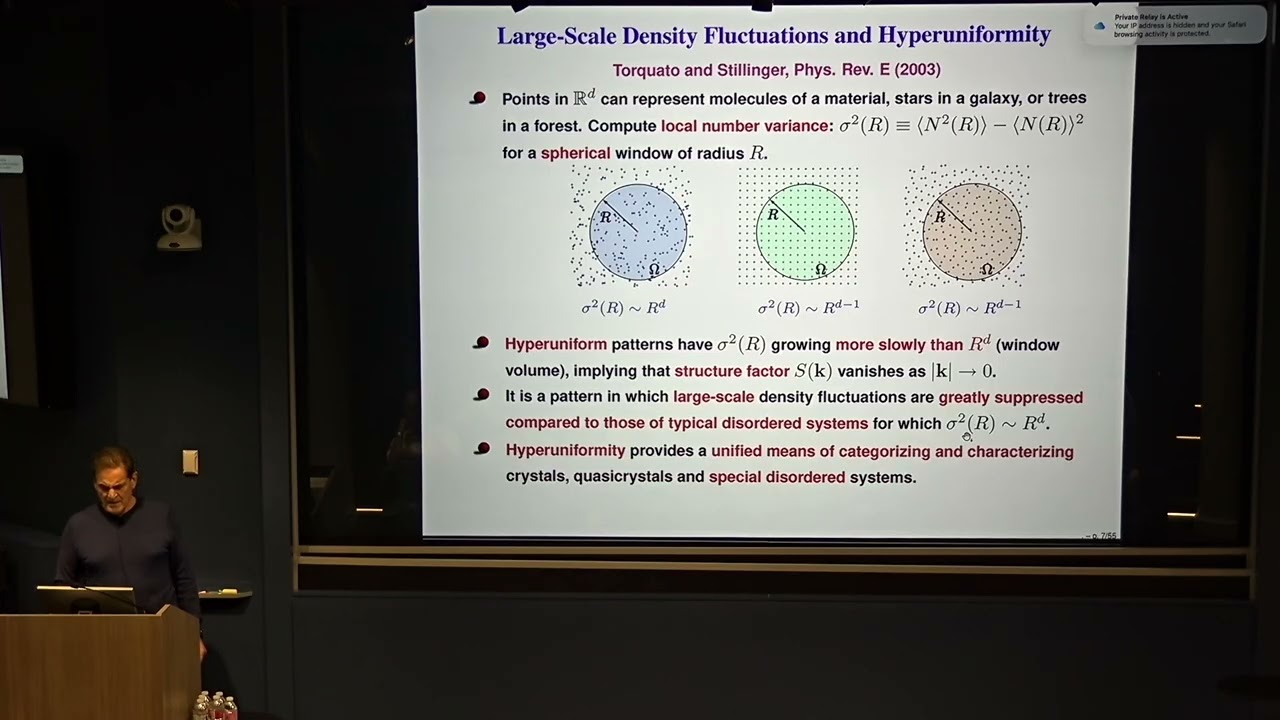
- Definition of hyperuniformity: density fluctuations in a window grow slower than volume.
- Classification of systems by large-scale density fluctuations: hyperuniform, anti-hyperuniform, and non-hyperuniform.
- Equivalence of minimizing density fluctuations to finding ground states of long-ranged repulsive potentials.
- Introduction of λ-bar (lambda bar) as a measure to rank crystals, quasicrystals, and disordered hyperuniform patterns.
- Connection to trigonometric products and derivation of the Epstein zeta function minimization.
- Examples of disordered hyperuniform systems: prime numbers, universe large-scale structure, and avian photoreceptor mosaics.
- Multi-hyperuniformity in chicken photoreceptor cells and its functional advantages for color vision.
- Jammed packings and the conjecture that all strictly jammed and saturated packings are hyperuniform.
- Stealthy patterns: disordered ground states with zero structure factor in a region of wave vectors, and their potential for photonic band gaps.
Cited Sources
- Simons Foundation Event Page: Hidden Order - The Geometry of Complex Patterns — Official event description and related resources for this lecture.
Contribution & Novelties
This lecture provides a compelling synthesis of hyperuniformity as a unifying concept across multiple disciplines, presenting a clear quantitative framework (density fluctuations, structure factor, λ-bar) and illustrating it with diverse examples ranging from number theory to biological vision. The original contribution lies in the systematic rank-ordering of structures and the connection to ground states of long-range potentials, which opens new avenues for material design and understanding of natural patterns.
Pour aller plus loin :
- Hyperuniformity (Wikipedia) — An overview of the concept and its applications.
- Penrose tiling (Wikipedia) — Provides background on quasicrystals and their diffraction patterns.
- Riemann hypothesis (Wikipedia) — Discusses the non-trivial zeros of the zeta function, which are hyperuniform in a special sense.
116 words
Radar Profile
The radar profile is nearly uniform, with all scores between 8 and 9. This indicates a lecture of high quality across all dimensions: abundant information, rigorously presented, technically deep, and highly reliable. The only slight dip is in quantity and technical level (both 8), but these are still strong. Overall, the lecture is an excellent resource for anyone interested in the physics of complex patterns.