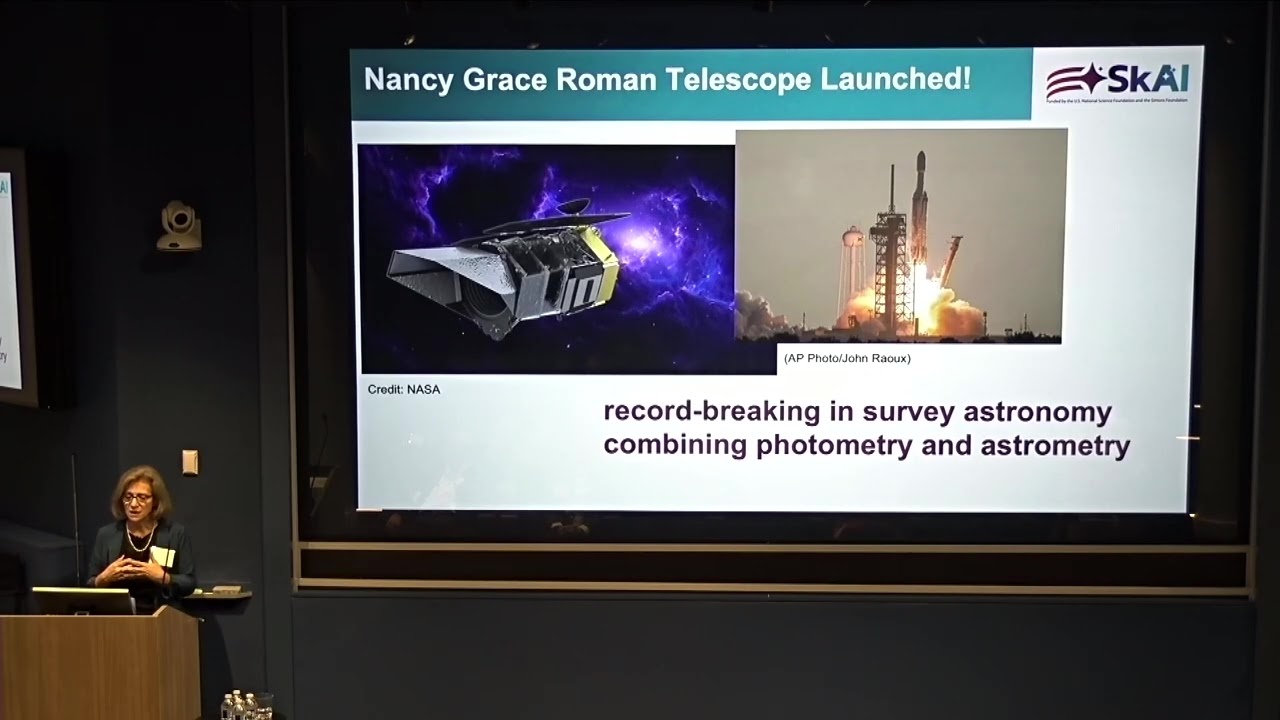
Vicky Kalogera: Toward Trustworthy AI for Astrophysics...(October 15, 2026)
Title history
- Vicky Kalogera: Toward Trustworthy AI for Astrophysics...(October 15, 2026) — observed on 20261117-1758 UTC (YouTube)
Keywords
Summary
174 words
Critical Evaluation
Value of the Information & Strength of the Argument
The presentation provides substantial value by showcasing concrete, state-of-the-art applications of AI to a fundamental astrophysical problem: stellar evolution. The argumentation is built on a clear logical chain: surveys will produce millions of stellar objects; existing simulation methods are too slow; AI-driven models can accelerate them without sacrificing physics. She supports this with quantitative comparisons of error rates and computational speedups, although the talk lacks detailed plots and raw data. The reliance on her own group’s results, while credible, could be strengthened by external validation. Overall, the value lies in demonstrating that physics-informed neural networks are not just theoretical but can be practically used for stellar population synthesis, opening new possibilities for interpreting next-generation survey data.
Scientific Rigor, Source Quality, Title Accuracy
The scientific rigor is high: Kalogera references established codes like MESA and the Poseidon pipeline, and reports peer-reviewed work. She clearly specifies the uncertainties and limitations of earlier methods. The title is an honest representation of the content, as the talk is indeed about ’trustworthy AI’—emphasizing models that respect physics and improve reliability. The only external source explicitly mentioned is the Simons Foundation event page, which serves as institutional backing. The talk does not cite external literature in the transcript, but the work is clearly rooted in a broader research context. The title adequately captures the main theme, though the ellipsis in the title might suggest more than is delivered; the talk actually covers both institute overview and specific research.
251 words
Title / Content Match
The title accurately reflects the content: the talk discusses the development of trustworthy AI methods for astrophysics, focusing on physics-informed neural networks and their application to stellar modeling and survey data.
Quality & Reliability
8/10
The talk is given by a recognized expert and director of an NSF-Simons AI institute. It presents detailed technical content and personal research results, with clear descriptions of methods and accuracies. However, without independent verification of the claims, a perfect score is not warranted.
Key Moments
Markers derived by PSI from the transcript: the creator did not define chapters.
- Introduction to the SkAI Institute: partnership of universities, physical space, and growth to over 100 members.
- Overview of the three research pillars: inference from survey data, AI-accelerated simulations, and survey/instrument design.
- Motivation for stellar simulations: surveys discovering millions of stars and binaries; need for fast population models.
- Introduction of the MESA code and the earlier Poseidon pipeline based on grid interpolation, highlighting limitations.
- Development of physics-informed neural networks (PINNs) as solvers for stellar structure; initial results and validation.
- Discussion of current work on deep neural networks for stellar evolution and near-term results from ongoing GPU-heavy computations.
Cited Sources
- Simons Foundation MPS Annual Meeting 2026 — Official event page for the talk, likely containing additional information about the conference and speaker.
Contribution & Novelties
The primary novelty is the demonstration that physics-informed neural networks can be effectively used to solve stellar structure and evolution equations, achieving high accuracy without traditional grid interpolation. This enables rapid, full-physics population simulations that were previously computationally prohibitive. The talk also highlights the organizational innovation of the SkAI Institute, which fosters collaboration between AI researchers and astrophysicists across multiple scales.
Pour aller plus loin :
- Physics-informed neural networks — Foundational concept used in the talk, explaining how differential equations are embedded in neural network loss functions.
- Vera C. Rubin Observatory — The LSST survey mentioned as a key driver for large-scale astrophysical data challenges.
- Gravitational-wave astronomy — Related to the motivation for modeling compact-object mergers, a target of the SkAI institute’s research.
123 words
Radar Profile
The radar profile shows high scores in quality, technical level, and reliability, with slightly lower but still strong scores in quantity of information. This reflects a dense, technical talk that prioritizes depth and rigor over breadth, consistent with a research seminar format.