Tjitske Starkenburg and Anshuman Acharya: From Simulated Galaxies to...(September 17, 2026)
Title history
- Tjitske Starkenburg and Anshuman Acharya: From Simulated Galaxies to...(September 17, 2026) — observed on 20261113-2201 UTC (YouTube)
Keywords
Summary
147 words
Critical Evaluation
Value of the Information & Strength of the Argument
The talk provides substantial value by detailing concrete methodological advances in synthetic observations, such as a new attenuation curve parameterization and a compression technique that minimizes observational error. The argumentation is logical and well-structured, moving from the need for synthetic observations to specific technical solutions and their validation. The speakers justify each step with evidence from simulations and comparisons, making a strong case for their approach. However, the audience is clearly specialized, and the presentation assumes familiarity with concepts like SED fitting and two-point statistics.
Scientific Rigor, Source Quality, Title Accuracy
The scientific rigor is high; the work is based on well-known simulations (CAMELS, IllustrisTNG) and comparisons with real surveys (SDSS, ACT). The presenters mention ongoing collaborations and reference prior work, though they do not cite specific papers in the talk itself. The title is somewhat incomplete, but it accurately represents the content. The description of the video provides additional context and a link to the conference page, which is the sole cited source. Overall, the sources are credible and the presentation is rigorous for a research audience.
187 words
Title / Content Match
The title accurately reflects the content, which discusses moving from simulated galaxies to observable predictions, including star formation histories, dust attenuation, luminosity functions, and CMB cross-correlations. The truncated ending suggests a longer title but doesn't mislead.
Quality & Reliability
8/10
The talk presents ongoing research by experts in the field, based on well-established simulations and methods. The claims are supported by data and comparisons, though some results may be preliminary.
Key Moments
Markers derived by PSI from the transcript: the creator did not define chapters.
- Introduction to the Synthetic Observations working group and their goal to produce synthetic surveys for inference.
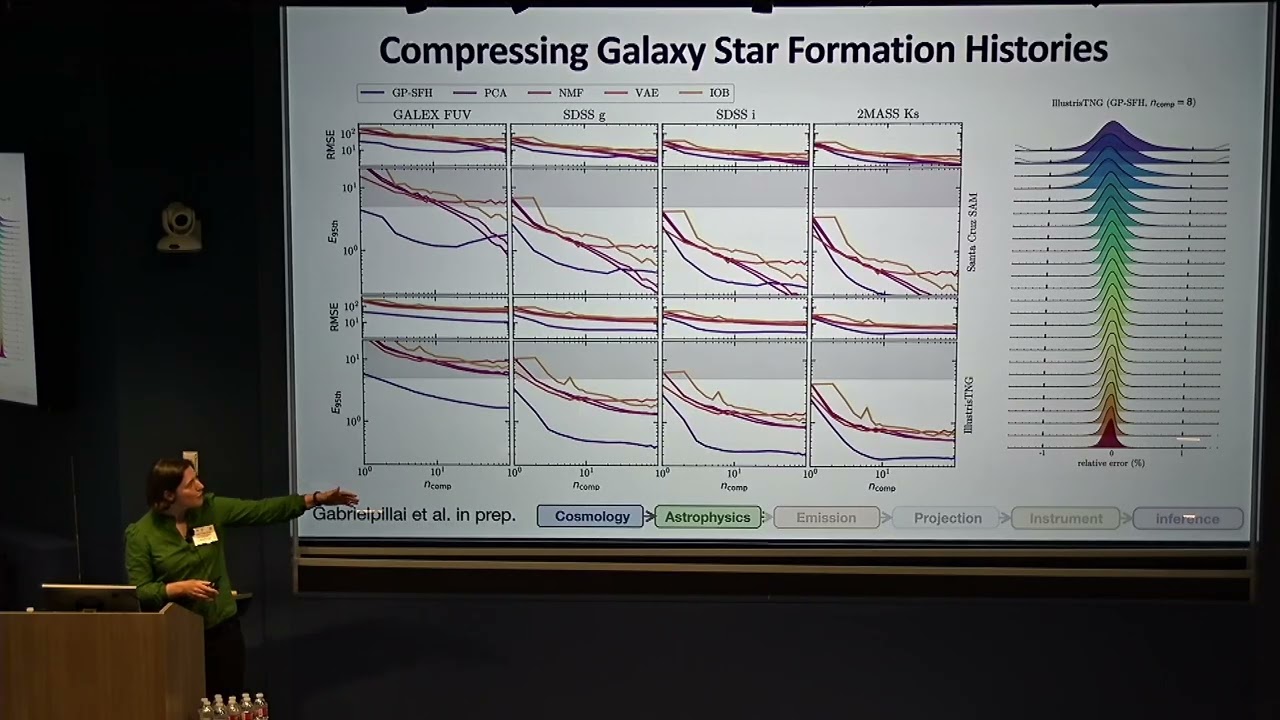
- Discussion of compressing star formation histories using Gaussian processes and Jensen-Shannon divergence for error assessment.
- Presentation of a new flexible dust attenuation curve parameterization derived from radiative transfer simulations.
- Overview of generating luminosity functions from CAMELS semi-analytic models and progress towards a mock SDSS survey.
- Introduction of the SAPPHIRE differentiable galaxy formation model and its application to scaling relation inference.
- Presentation of LTU Bench, a benchmarking tool for comparing simulations to observational datasets.
- Handover to Anshuman Acharya for the CMB section, emphasizing multi-probe observations.
- Discussion of two-point statistics for galaxy clustering, CMB lensing, tSZ, and joint inference.
Cited Sources
- Simons Collaboration on Learning the Universe Annual Meeting 2026 — Official event page for the collaboration meeting where this talk was presented.
Contribution & Novelties
The talk provides an overview of recent advancements in synthetic observations, particularly the development of a flexible attenuation curve parameterization and the compression of star formation histories using Gaussian processes. It highlights the importance of full forward modeling for cosmological inference.
Pour aller plus loin :
- IllustrisTNG simulations — Reference for the simulation suite used in dust modeling.
- Gaussian process — Statistical method used for compression of star formation histories.
- Sunyaev–Zel’dovich effect — Physical effect relevant to CMB cross-correlations.
79 words
Radar Profile
The radar profile shows high technical level and good scores in information quality and reliability, indicating a dense, expert-level presentation. The slightly lower score in quantity might reflect the focused scope, but overall the profile is balanced and strong.