Nader Engheta: Light-Based Computing with Symmetry-Inspired Metastructures (October 22, 2026)
Title history
- Nader Engheta: Light-Based Computing with Symmetry-Inspired Metastructures (October 22, 2026) — observed on 20261117-0331 UTC (YouTube)
Keywords
Summary
151 words
Critical Evaluation
Value of the Information & Strength of the Argument
The talk offers substantial value by presenting concrete new methods to scale analog optical computing, backed by simulations and experimental prototypes. Engheta’s argumentation is rigorous: he systematically compares approaches, identifies limitations (e.g., inverse design complexity), and justifies each new direction with physical reasoning and quantitative results. The progression from small matrices to scalable designs is well-structured, and the inclusion of experimental validation for the convolutional chip strengthens credibility. The presentation is nuanced, acknowledging trade-offs such as restricted matrix classes or fabrication challenges.
Scientific Rigor, Source Quality, Title Accuracy
Engheta’s scientific rigor is high; he cites foundational work (e.g., Kogelnik’s 1969 theory) and his own prior publications, and he presents simulation-experiment agreements. He does not oversell; he openly discusses the remaining bottlenecks. The title accurately represents the content, focusing on light-based computing and symmetry-inspired structures. The only external source provided is the Simons Foundation event page, but the talk itself references several key papers. Overall, the methodology and presentation meet high scientific standards.
171 words
Title / Content Match
The title accurately reflects the content: Engheta discusses symmetry-inspired metastructures for wave-based light computing, matching the talk's focus on analog optical computing.
Quality & Reliability
8/10
Lecture by a renowned expert in metamaterials, presenting both established and novel research with simulation and experimental validation; however, some ongoing work lacks peer-reviewed publication yet.
Key Moments
Markers derived by PSI from the transcript: the creator did not define chapters.
- Introduction to wave-based computing and overview of past work on metamaterials for mathematical operations.
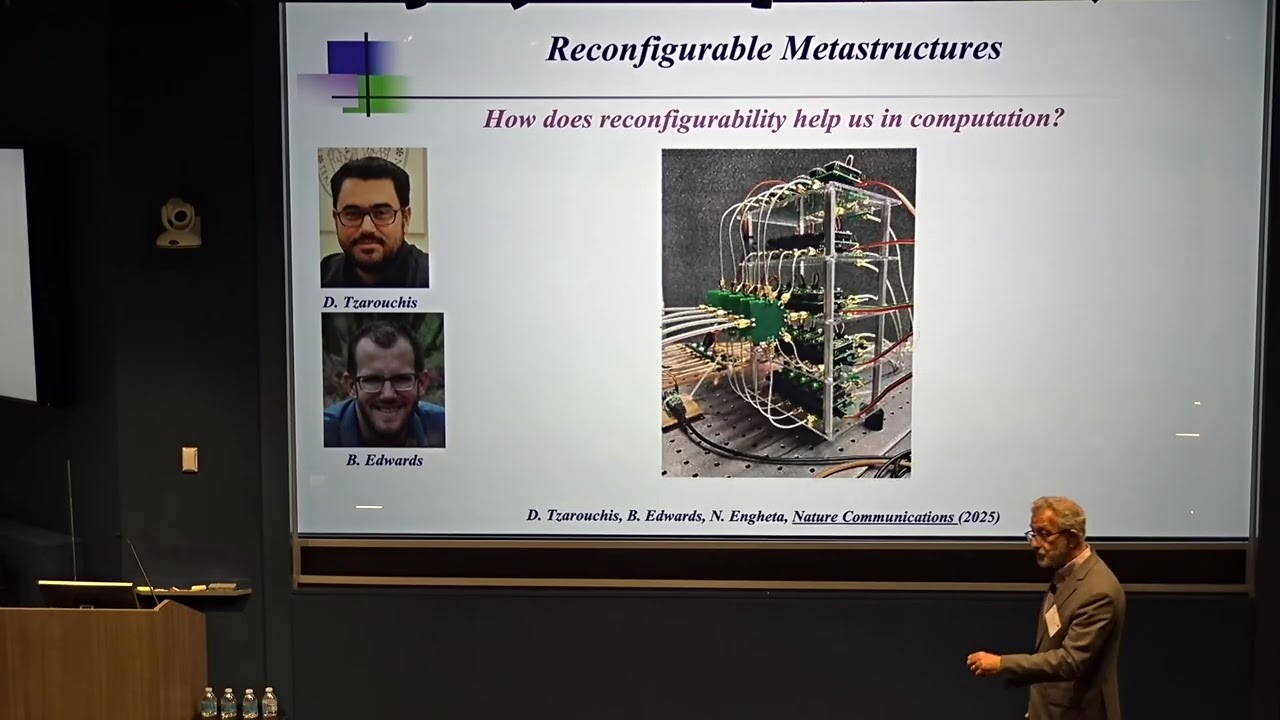
- Discussion of reconfigurable electronic matrix system for optimization and inverse scattering.
- Introduction of challenge to scale up matrix size; limitations of inverse design for large matrices.
- Presentation of banded matrices and convolutional approach with periodic elements; simulation and chip results for wavelet transform.
- Exploration of volume holography inspired approach; analytical solutions for permittivity distributions enabling 10×10 and 20×20 matrices.
- Proposal of synthetic dimensions using spatiotemporal metasurfaces for large-scale vector-matrix multiplication without physical scaling.
Cited Sources
- Simons Collaboration on Extreme Wave Phenomena Based on Symmetries Annual Meeting 2026 — Event page for the talk, providing context and potential related research.
Contribution & Novelties
Engheta’s talk presents four innovative directions to overcome the scalability bottleneck in analog wave computing: convolutional metamaterials with periodic structures, analytical volume-holography-inspired designs, reconfigurable systems, and synthetic dimensions via spatiotemporal metasurfaces. These offer distinct trade-offs and open new avenues for compact, low-power, and ultrafast optical processors.
Pour aller plus loin :
- Volume holography — Provides background on the holographic principles Engheta adapts for matrix multiplication.
- Metamaterials — Core concept underlying Engheta’s approach to wave-matter interaction.
- Kogelnik’s coupled-wave theory — The analytical framework referenced (by H. Kogelnik, 1969) for thick holographic gratings.
- Analog optical computing — Context for wave-based computation and its advantages over digital electronics.
105 words
Radar Profile
The profile shows exceptionally high technicality and information density, with strong reliability and quality. The balance among quantitative, qualitative, and technical scores reflects a deep, specialized lecture suited for expert audiences, with minor gaps in public accessibility and validation of some ongoing results.