Andrea Alù: Symmetry-Driven Wave-Based Computing (October 23, 2026)
Title history
- Andrea Alù: Symmetry-Driven Wave-Based Computing (October 23, 2026) — observed on 20261117-0331 UTC (YouTube)
Keywords
Summary
161 words
Critical Evaluation
Value of the Information & Strength of the Argument
The talk provides a high-value overview of cutting-edge research in wave-based computing, supported by concrete experimental demonstrations and comparisons with existing technologies. Alù rigorously argues for the potential of metasurfaces to perform efficient analog computing, addressing both opportunities and limitations such as static responses, linearity constraints, and lack of programmability. He systematically presents trade-offs, including computational density versus robustness, and contextualizes his results within the broader literature on photonic computing. The argumentation is logically structured, starting from basic Fourier optics and building to advanced nonlocal scatterer designs, making the case compelling and evidence-based.
Scientific Rigor, Source Quality, Title Accuracy
The presentation adheres to high scientific rigor, referencing prior work by colleagues (e.g., Professor Engheta, Professor Fan, Owen Miller, David Miller) and providing experimental data that matches theoretical predictions. The source, the Simons Foundation, is a reputable scientific organization, and the link to the event page provides context. The title accurately reflects the content, focusing on symmetry-driven wave-based computing, and the talk delivers exactly that. No significant discrepancies were noted between the title and the actual material covered.
186 words
Title / Content Match
The title accurately reflects the talk's focus on symmetry-driven wave-based computing, as presented by Andrea Alù. It is precise and directly matches the content.
Quality & Reliability
8/10
Presentation by a leading researcher in photonics, hosted by the Simons Foundation, with technical depth and multiple experimental demonstrations. No formal peer-review process evident, but the source is highly reputable and the content aligns with established scientific literature.
Key Moments
Markers derived by PSI from the transcript: the creator did not define chapters.
- Introduction to wave-based computing and the role of symmetries
- Explanation of Fourier optics and how lenses perform transforms
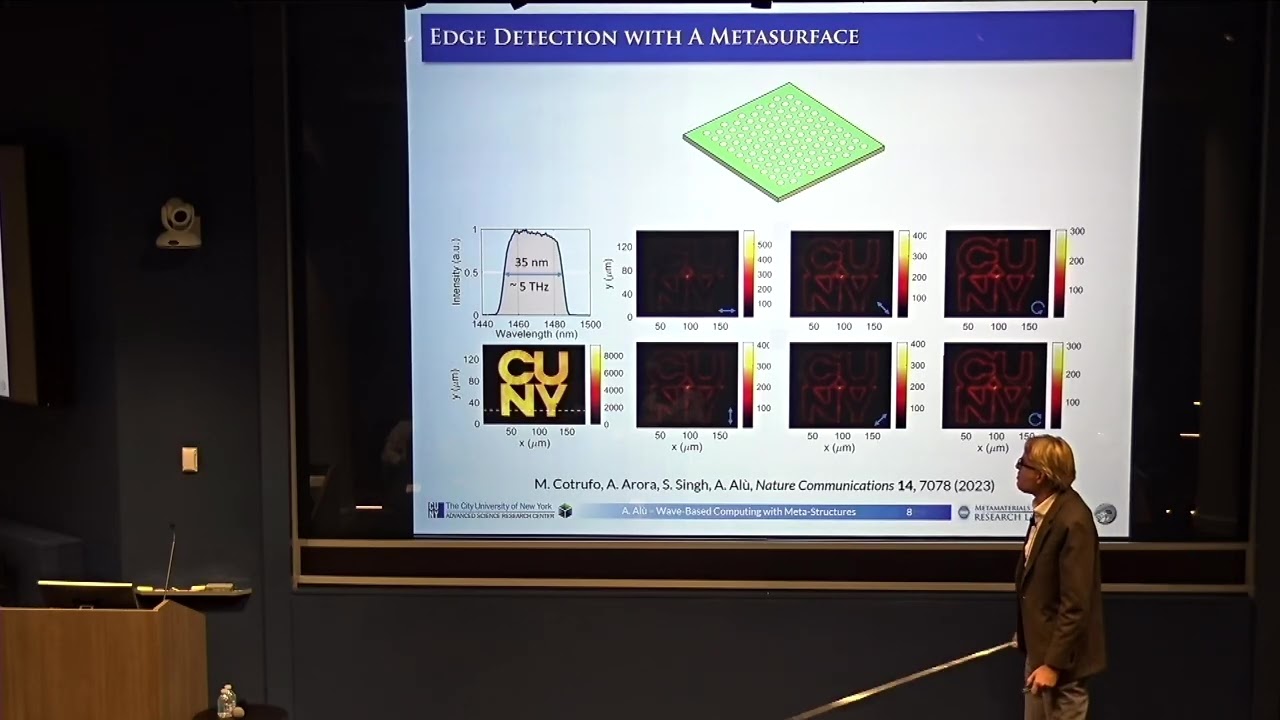
- Design of metasurfaces for edge detection and low-pass filtering
- Experimental demonstrations of image preprocessing and accuracy gains
- Nonlocal scatterers and integrated photonic circuits for solving differential equations
- Discussion of computational degrees of freedom and flops per area
- Reprogrammability and experiments with entanglement-based control
Cited Sources
- Simons Collaboration on Extreme Wave Phenomena Based on Symmetries Annual Meeting 2026 — Event page for the talk, providing context and related presentations
Concurring Sources
- Engheta, N. (2022) 'Metasurfaces for computing', Science — Referenced by the speaker as prior work on metasurface-based computing, aligning with the presented concepts.
- Miller, D.A.B. (2019) 'Self-configuring universal linear optical component', Optica — Mentioned in the talk regarding degrees of freedom in scattering structures.
Contribution & Novelties
This presentation contributes a comprehensive overview of recent advances in using metasurfaces for analog wave-based computing, emphasizing symmetry-driven designs. It showcases novel nonlocal scatterers that can perform complex mathematical operations in subwavelength volumes, with experimental validation. The talk also introduces reconfigurable and entanglement-controlled metasurfaces, pushing the boundaries of what these devices can achieve. This represents a significant step toward practical low-energy, zero-latency photonic computing platforms.
Pour aller plus loin :
- Metasurface - Wikipedia — Background on metasurfaces and their applications in wave control.
- Optical computing - Wikipedia — Overview of optical computing approaches, including analog methods.
- Photonic integrated circuit - Wikipedia — Context on integrated photonic platforms relevant to the chip-based scatterer demonstrations.
113 words
Radar Profile
The radar profile shows high scores in quantitative information, technical depth, and source reliability, indicating a dense, expert-level presentation. The slightly lower quantity score reflects the relatively focused scope of the talk, but overall it displays a balanced and strong performance across evaluated dimensions.