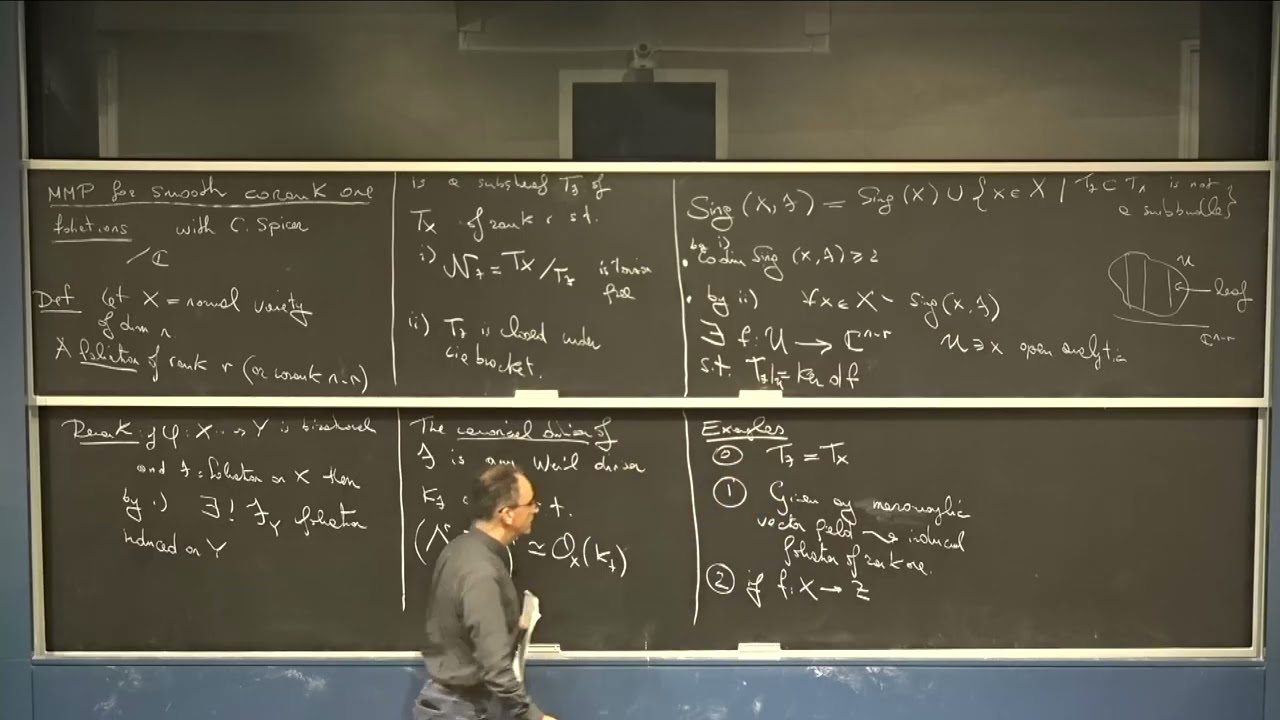
Paolo Cascini: MMP for Smooth Co-rank One Foliations (October 2, 2026)
Title history
- Paolo Cascini: MMP for Smooth Co-rank One Foliations (October 2, 2026) — observed on 20261117-1940 UTC (YouTube)
Keywords
Summary
205 words
Critical Evaluation
Value of the Information & Strength of the Argument
The value of the presentation lies in a new contribution to the minimal model program for foliations, extending classical results to the setting of smooth co-rank one foliations. The argumentation is solid, built upon established tools: Frobenius integrability, cone theory, and birational geometry. The speaker clearly explains the role of each assumption, such as co-rank one being essential for the local first integral. The proof sketch is coherent and addresses potential difficulties, notably the non-preservation of smoothness and the need for a stronger theorem. While the talk is advanced, the logical structure is rigorous and consistent with current research in the field.
Scientific Rigor, Source Quality, Title Accuracy
The scientific rigour is high: the speaker provides precise definitions and states theorems carefully, referencing prior work (e.g., results by Diller, Pym, and others, though exact references are not explicit). The only provided source is the event page from the Simons Foundation, which serves as the context for the talk. The title perfectly matches the content, being neither exaggerated nor understated. No inconsistencies between title and presentation are apparent.
186 words
Title / Content Match
The title accurately reflects the content, as the speaker indeed proves the existence of minimal models for smooth co-rank one foliations.
Quality & Reliability
8/10
The talk presents original research results with rigorous definitions and references to prior work, though it is a seminar presentation rather than a peer-reviewed publication.
Key Moments
Markers derived by PSI from the transcript: the creator did not define chapters.
- Introduction and definitions of foliations, tangent sheaf, and singular locus.
- Examples of foliations, including the tangent foliation and fibrations.
- Statement of the minimal model program conjecture for foliations.
- Main theorem: existence of minimal models for smooth co-rank one foliations.
- Discussion of difficulties and introduction of quasi-smooth foliations.
- Key lemma on tangent curves and Frobenius integrability.
- Cone theorem for foliations and its role in the MMP.
- Proof sketch and preservation of quasi-smoothness under MMP.
Cited Sources
- Simons Collaboration on Moduli of Varieties Annual Meeting 2026 — Event page providing context for the talk.
Concurring Sources
- Minimal model program (Wikipedia) — Background on the classical MMP, which the talk generalizes to foliations.
Contribution & Novelties
The talk presents an original result: for smooth co-rank one foliations of general type, the minimal model program can be run, yielding either a minimal model or a Mori fiber space. The novelty lies in showing that under smoothness, Frobenius integrability holds, which forces the foliation MMP to coincide with the usual variety MMP for tangent curves, and that the necessary properties are preserved throughout the process. This extends known results to a broader class of foliations.
Pour aller plus loin :
- Minimal model program — General context on the MMP, useful for understanding the goal of the talk.
- Foliation — Background on foliations, including definitions and local structure.
- Canonical singularity — What these singularities are and why they matter in the MMP.
123 words
Radar Profile
The radar profile shows exceptionally high technical level and good information quantity, with slightly lower scores for information quality and reliability due to the lack of explicit references in the talk. Overall, it is a highly specialized and rigorous research presentation.