Tsampikos Kottos: Symmetry-Driven In-Situ Physical Adjoint Optimization Protocols (October 22, 2026)
Title history
- Tsampikos Kottos: Symmetry-Driven In-Situ Physical Adjoint Optimization Protocols (October 22, 2026) — observed on 20261117-0330 UTC (YouTube)
Keywords
Summary
159 words
Critical Evaluation
Value of the Information & Strength of the Argument
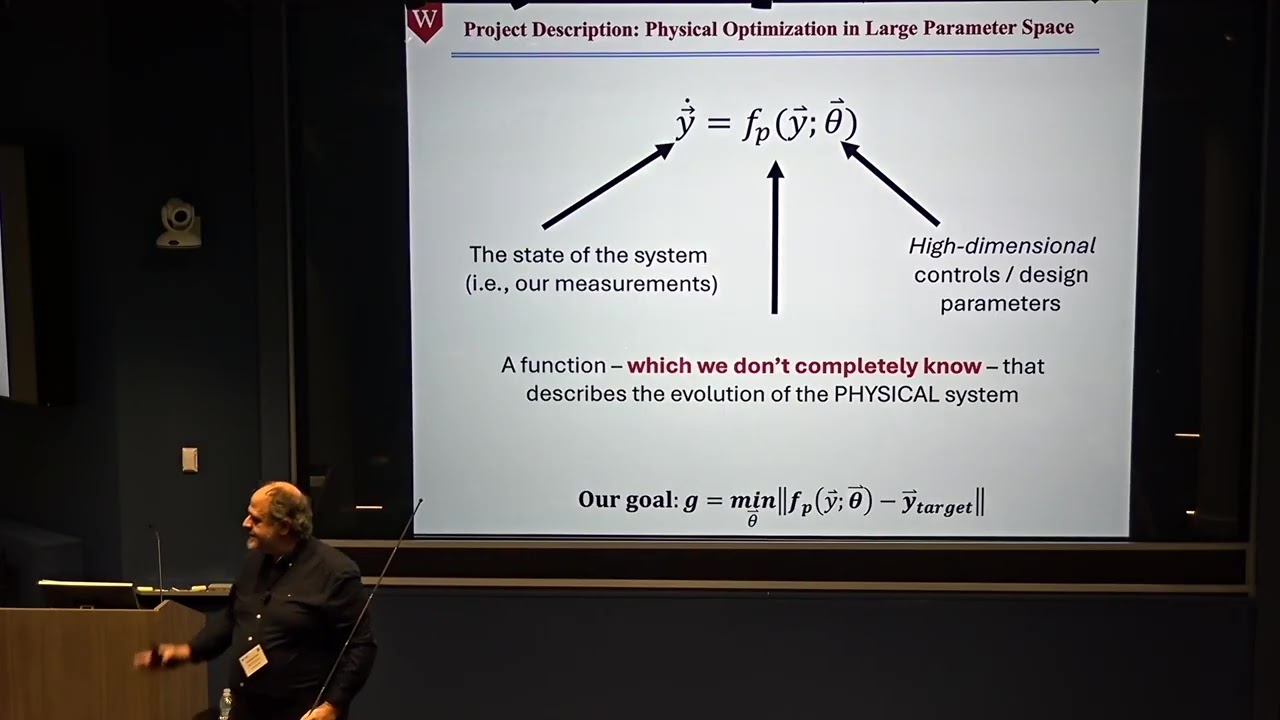
The talk’s primary value lies in proposing and experimentally validating a novel optimization paradigm that shifts computational burden from digital models to the physical system itself, thereby addressing the ‘reality modeling gap’ and reducing resource requirements. The argumentation is solid: Kottos systematically outlines the shortcomings of existing methods (scattering matrix measurement, time reversal, fully model-based optimization), then presents the new method with clear mathematical formulation and backs it with experimental results from his lab and collaborators. The use of Bayesian optimization for frequency comb shaping is demonstrated with real experimental data, including limit cycles and spectral analysis, which supports the feasibility of the approach. However, the talk does not provide a quantitative comparison with other state-of-the-art optimization techniques, and the scalability to very high-dimensional parameter spaces is only briefly discussed. The argumentation is persuasive but would be strengthened by explicit performance metrics or benchmarks.
Scientific Rigor, Source Quality, Title Accuracy
The scientific rigor is high: the methodology is clearly described, experiments are presented with sufficient detail, and the theoretical framework is mathematically grounded. The speaker acknowledges collaborators and prior work (e.g., Steven Johnson, Mathias Fink), and the link to the Simons Foundation event provides context, though no direct references to peer-reviewed publications are given in the description. The title is very accurate, capturing the essence of the talk without overpromising. The content is consistent with the title, focusing on symmetry-driven (though the role of symmetry is not explicitly elaborated in the transcript) in-situ physical adjoint optimization. Overall, the talk demonstrates a thorough understanding of the subject and a credible experimental foundation.
270 words
Title / Content Match
The title accurately reflects the content: the talk focuses on symmetry-based in-situ adjoint optimization protocols, explaining the framework, its physical implementation, and experimental demonstrations.
Quality & Reliability
8/10
The lecture presents original research with detailed experimental results and theoretical derivations, delivered by an established professor at a recognized foundation event. However, the transcript provides no explicit citations to specific papers or data sources, relying instead on the overall academic credibility and the single event link.
Key Moments
Markers derived by PSI from the transcript: the creator did not define chapters.
- Introduction and acknowledgements; sets the context of controlling waves in complex media.
- Overview of physics-based optimization methods: entropy maximization, scattering matrix approach, CPA.
- Discusses the need for scattering matrix knowledge; highlights problems with measurement and modeling.
- Introduction to time-reversal mirror approach and its limitations.
- Transition to gradient-free optimization: Bayesian optimization for frequency comb generation.
- Demonstration of frequency comb shaping with predefined envelopes (exponential, flat, W).
- Presentation of in-situ adjoint gradient computation: mathematical formulation and physical implementation.
- Experimental results for targeted channel emission and coherent perfect absorption; concluding remarks.
Cited Sources
- Simons Collaboration on Extreme Wave Phenomena Based on Symmetries Annual Meeting 2026 — Event page for the annual meeting where this talk was presented; provides additional context about the collaboration and related talks.
Concurring Sources
- Simons Collaboration on Extreme Wave Phenomena Based on Symmetries Annual Meeting 2026 — Official event page; corroborates the existence of the collaboration and the presentations, though it does not provide specific technical details.
Contribution & Novelties
The talk introduces a novel framework for adjoint optimization that leverages the physical system to compute gradients in situ, dramatically reducing the need for full modeling. This is a significant departure from traditional approaches that rely on explicit scattering matrix characterizations or iterative measurements. The method exploits the local sparsity of the system’s response, making it scalable to high-dimensional parameter spaces, and is validated with experiments in RF and microwave systems. While the concept of adjoint methods is known in other fields, its application to wave control in complex media using the system itself for computation is a fresh contribution. The talk also presents an innovative use of Bayesian optimization for crafting frequency combs with tailored envelopes, which has practical implications for communication and sensing.
Pour aller plus loin :
- Adjoint state method — Useful for understanding the mathematical basis of adjoint-based optimization in physical systems.
- Time reversal signal processing — Related to the time-reversal mirror concept discussed in the talk, its principles and limitations.
- Random matrix theory — Underlies the statistical treatment of scattering in chaotic systems, relevant to the talk’s mention of RMT.
- Coherent perfect absorber — A concept central to the talk’s experimental demonstrations, e.g., CPA in microwave cavities.
202 words
Radar Profile
The radar chart shows very high scores for quantity, quality, and technical level, with a slightly lower but still high reliability score. This indicates a dense, sophisticated, and well-executed presentation, though the lack of explicit citations slightly undermines perceived reliability. The overall profile is characteristic of a high-level academic talk suitable for an expert audience.