Mario Silveirinha: Active Wave Processing with Broken Symmetries (October 23, 2026)
Title history
- Mario Silveirinha: Active Wave Processing with Broken Symmetries (October 23, 2026) — observed on 20261117-0328 UTC (YouTube)
Keywords
Summary
214 words
Critical Evaluation
Value of the Information & Strength of the Argument
The value of the information is high, as it presents original theoretical and computational results that bridge nonlinear optics and topological physics. The argumentation is clear and rigorous, systematically building from the Berry curvature dipole model to concrete proposals for gain and topological protection. The speaker addresses questions from the audience and clarifies assumptions, such as the dominance of the nonlinear term at low frequencies and the physical interpretation of the high-k cutoff. The reasoning is well-supported by mathematical derivations and simulation examples, making a compelling case for the utility of low-symmetry conductors in wave computing applications.
Scientific Rigor, Source Quality, Title Accuracy
The talk demonstrates strong scientific rigor, with careful attention to approximations and physical constraints. The speaker cites relevant prior work, including the use of magnetized plasma for edge states and the hydrodynamic regularization in electron gases. The only provided source link is the event page from Simons Foundation, which corroborates the context of the talk. The title accurately captures the content, and the presentation aligns with the stated objectives of the meeting on extreme wave phenomena. No significant weaknesses in source quality or title-content mismatch are apparent.
199 words
Title / Content Match
The title accurately reflects the content: the talk focuses on active wave processing enabled by broken symmetries, covering both optical gain and topological isolation.
Quality & Reliability
9/10
The talk is delivered by a recognized expert in electromagnetics and photonics, based on peer-reviewed research and presented at a Simons Foundation collaboration meeting. The content is technically precise and coherent.
Key Moments
Markers derived by PSI from the transcript: the creator did not define chapters.
- Introduction: need for gain and isolation in wave computing.
- Presentation of low-symmetry conductors and the Berry curvature dipole model.
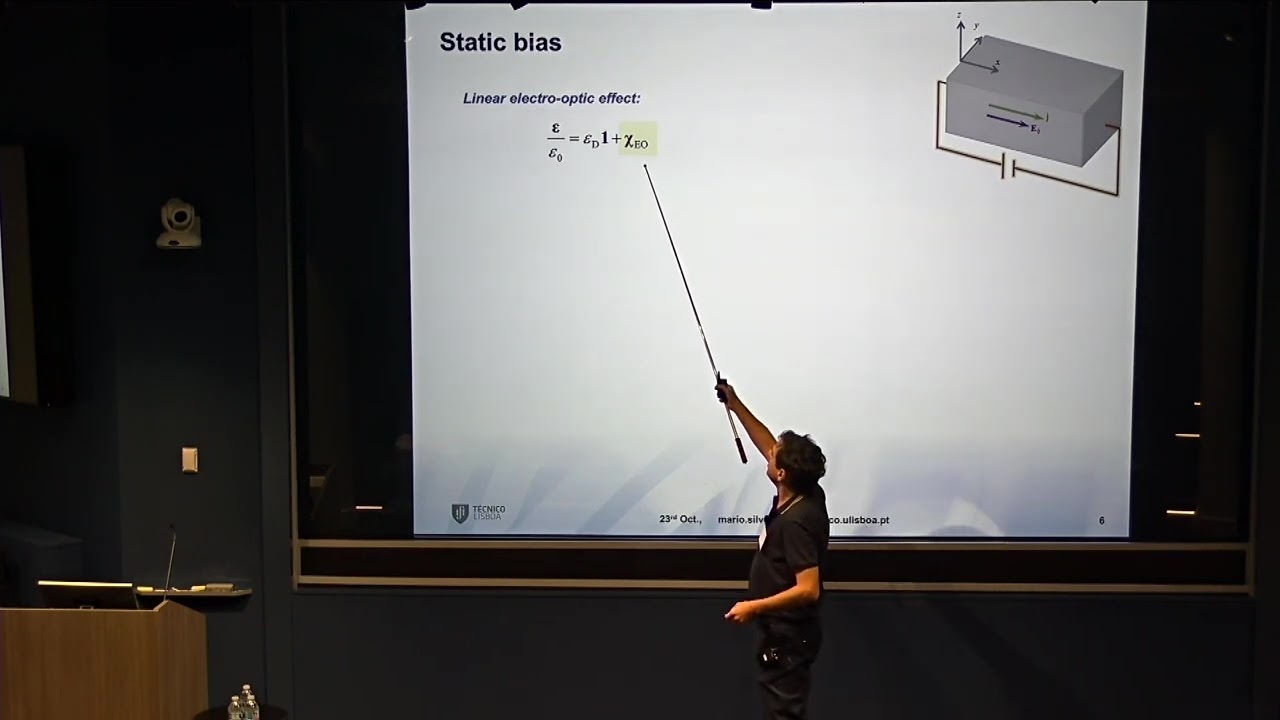
- Example with tellurium: static bias enables gain and nonreciprocity.
- Optical pump modulation and negative extinction shown in simulations.
- Transition to topological waves; challenges of continuum topology.
- Two regularization methods: high-k cutoff and hydrodynamic pressure.
- Introduction of multicomponent electron gas and physical realizations.
- Results show Chern number increases as n-1 for n components; explanation via angular momentum.
Cited Sources
- Simons Collaboration on Extreme Wave Phenomena Based on Symmetries - Annual Meeting 2026 — Official event page providing context for the talk series.
Contribution & Novelties
The talk provides novel insights into using broken symmetries for active wave processing, specifically introducing the Berry curvature dipole as a key nonlinearity for optical gain and showing how multicomponent electron gases can yield high Chern numbers. The approach of stacking topological subsystems via multiple carriers is a creative theoretical contribution.
Pour aller plus loin :
- Berry connection and curvature — Foundation for the Berry curvature dipole concept.
- Topological photonics — Overview of using topology in photonic systems.
- Non-Hermitian physics — Related to gain and loss mechanisms discussed.
88 words
Radar Profile
The radar profile shows very high scores in all dimensions, reflecting a technically dense and rigorous presentation. The lowest relative score is in quantity of information, but it remains high. The talk is well-balanced between conceptual explanation and simulation results, with excellent coherence and sourcing.