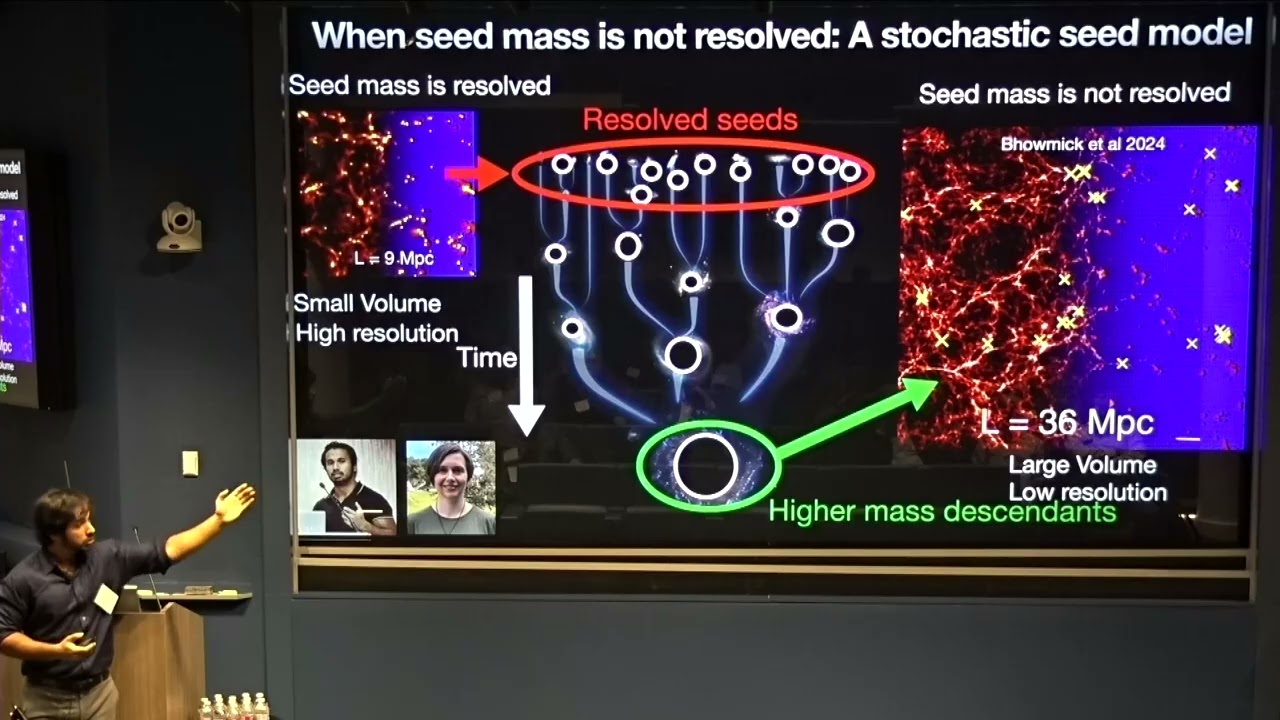
Aklant Bhowmick: Multiscale Modeling of Supermassive Black Holes...(September 17, 2026)
Title history
- Aklant Bhowmick: Multiscale Modeling of Supermassive Black Holes...(September 17, 2026) — observed on 20261113-2156 UTC (YouTube)
Keywords
Summary
194 words
Critical Evaluation
Value of the Information & Strength of the Argument
The value is exceptional for specialists, offering a clear conceptual and methodological overview of a complex, state-of-the-art field. The argumentation is robust, grounded in quantitative comparisons between models (e.g., illustrating resolution-dependent orbital decay rates for black holes with and without the subgrid friction correction, and contrasting the scaling of black hole mass-growth between Bondi and torque-driven models). The talk demonstrates a rigorous scientific approach by validating subgrid models against explicit, small-scale simulations, ensuring that approximations are calibrated to high-fidelity runs. The progression from seeding to feedback integrates multiple lines of evidence, from high-resolution idealized setups to large cosmological boxes, providing a comprehensive and logically sound narrative.
Scientific Rigor, Source Quality, Title Accuracy
The scientific rigor is high, stemming from a major collaborative project. The speaker is a researcher directly involved in several of the presented works, adding authority. While specific bibliographic references are not listed visually, the talk explicitly mentions key simulation suites (Illustris TNG, AREPO) and observational facilities (JWST, LISA), situating the methods within established frameworks. The description link provides access to the event page, which is likely to contain additional resources. The title matches the content perfectly, accurately representing the talk’s scope on multi-scale numerical modeling of SMBHs.
209 words
Title / Content Match
Perfect match: the title precisely reflects the content, which focuses on the multi-scale numerical simulation strategies used to model supermassive black holes.
Quality & Reliability
8/10
High-level presentation from the Simons Foundation's Learning the Universe collaboration, featuring detailed numerical simulations and references to published models. The talk is technically rigorous, though it primarily summarizes ongoing work rather than presenting fully peer-reviewed, published results in detail.
Key Moments
Markers derived by PSI from the transcript: the creator did not define chapters.
- Introduction and motivation: why supermassive black holes are crucial for understanding galaxy evolution.
- Presentation of the multi-scale challenge (14 orders of magnitude) and the working group's three-pronged approach.
- Stage 1: Black hole seeding models, including the Brahma simulations and stochastic subgrid seeding.
- Stage 2: Black hole dynamics, focusing on the subgrid dynamical friction model and its calibration.
- Stage 3: Accretion models—comparing Bondi, gravitational torque-driven, and free-fall accretion predictions.
- Stage 4: Bridging to small scales with idealized simulations, GRMHD runs, and machine learning emulators.
- Summary and outlook on future simulations and connections to upcoming observational facilities.
Cited Sources
- Simons Collaboration on Learning the Universe Annual Meeting 2026 — Event page provided in the video description, hosting the talk and related information.
- James Webb Space Telescope (JWST) — Mentioned as a primary observational driver for observing early black holes.
- Laser Interferometer Space Antenna (LISA) — Mentioned as a future facility expected to provide gravitational wave observations of black holes.
- IllustrisTNG — Referenced as the baseline galaxy formation model used as the framework for implementing new accretion models.
Concurring Sources
- Super massive black hole — Provides general background on the properties and characteristics of the objects being modeled.
- N-body simulation — Supports the description of numerical methods used in the discussed gravitational simulations.
Contribution & Novelties
The talk provides an original, integrated overview of a collaborative effort to tackle the multi-scale problem of SMBH growth. Its core contribution is the open discussion of a unified framework that links subgrid models calibrated on high-resolution simulations to large-scale cosmological runs, including the introduction of machine learning emulators to bridge the gap. It highlights concrete challenges like the treatment of black hole seeding in low-resolution volumes and the calibration of dynamical friction models against resolved runs, which are critical methodological steps for advancing the field.
Pour aller plus loin :
- Cosmological simulation — Relevant to the core method discussed for tracking joint large- and small-scale physics.
- Subgrid model — Clarifies the general concept of subgrid parameterizations used to represent unresolved physics.
- Galaxy formation and evolution — Provides context for the physical processes connecting black hole growth to galactic properties.
140 words
Radar Profile
The profile is strongly balanced between high quality, quantity, and technical level, with a very high overall reliability. The talk is deeply technical, requiring a high level of background knowledge, but it does not present a meta-analysis or fully verified published results, justifying a slightly lower reliability score relative to the technical depth.