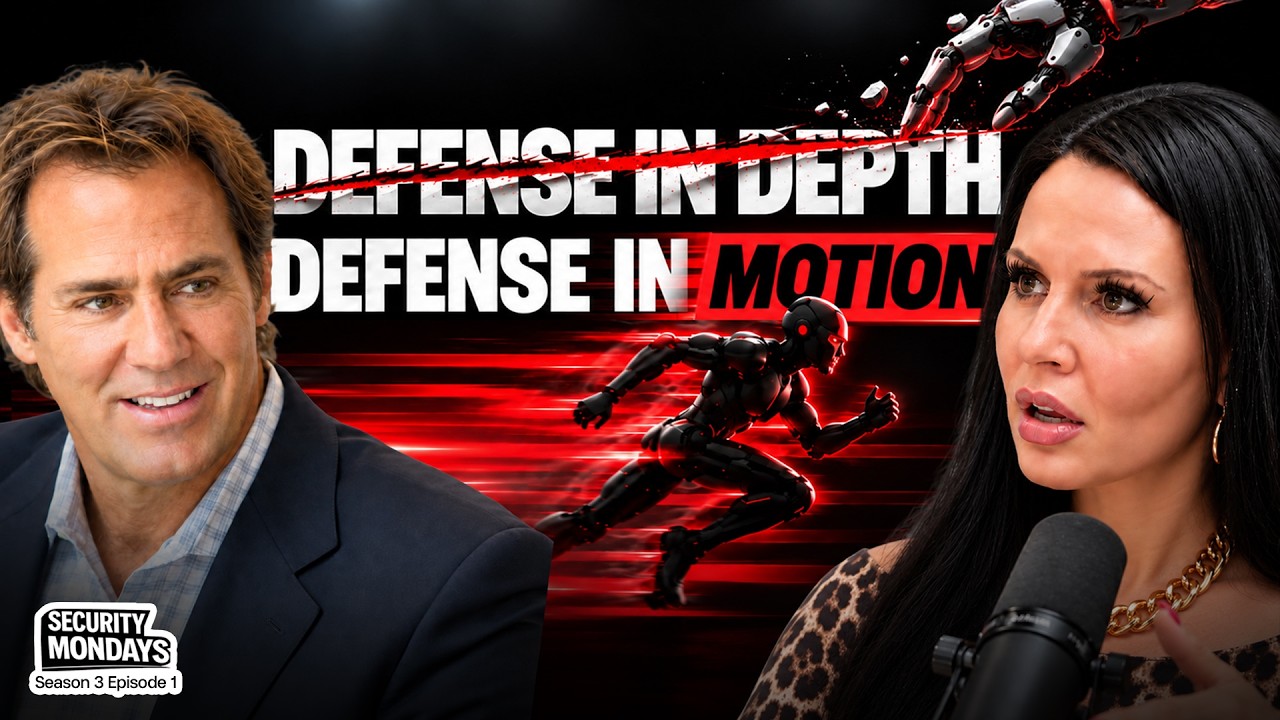
Dave DeWalt: Why Defense in Depth Is No Longer Enough | S3 | EP1
Keywords
Summary
272 words
Critical Evaluation
Value of the Information & Strength of the Argument
The value of the information is high for security practitioners seeking strategic direction. DeWalt provides concrete assertions about the current threat landscape, such as the capability of frontier models to produce zero-day exploits in minutes, and contrasts it with defensive opportunities like autonomous self-healing. He grounds these claims with references to real incidents (McAfee, CrowdStrike) and to his experience in security leadership, lending credibility. The argumentation is well-structured: he identifies a problem (asymmetric threat), proposes a solution (defense in motion with autonomous healing), and supports it with examples from his investments (Horizon3.ai) and industry trends. Some statements are alarmist (e.g., ‘dark period’) but are substantiated by the accelerating pace of AI-enabled attacks. The discussion stays at a strategic level, but the practical implications for CISOs are clear, especially regarding budget and vendor management. The logic is coherent and persuasive, though it relies heavily on anecdotal evidence and industry experience rather than peer-reviewed research.
Scientific Rigor, Source Quality, Title Accuracy
The scientific rigor is moderate; this is an opinion-driven interview, not a formal study. However, DeWalt references specific, verifiable events and company announcements (e.g., Horizon3.ai funding, CrowdStrike’s Red Tempest), and the description provides links to these resources. The title accurately reflects the content, as the video explicitly challenges the adequacy of traditional defense-in-depth. The sources cited are predominantly press releases, company pages, and the speaker’s own reports, which are acceptable for an industry perspective. There is no formal citation of academic literature, but the context is professional and current. The video’s extremely low view count (2 views) does not affect the intrinsic quality of the content, but it suggests limited peer engagement; nevertheless, the speaker’s reputation and the quality of the arguments mitigate this. Overall, the conclusions are plausible but should be verified with independent research.
304 words
Title / Content Match
The title accurately reflects the core thesis: the shift from defensive layering to continuous adaptive defense, introduced in the first minutes and elaborated throughout.
Quality & Reliability
8/10
The discussion is grounded in decades of industry experience and specific high-profile incidents (e.g., McAfee 2010 outage, CrowdStrike outage), and the speaker cites concrete examples of emerging threats and technologies. While primarily opinion-driven, the arguments are coherent and reference publicly documented events, making the content credible for an expert audience.
Chapters
- Intro
- Is Cybersecurity Still in a Dark Period?
- The Rise of the Agent State
- Why NightDragon Made a Bigger Bet on Horizon3.ai
- Auto-Fix vs Auto-Heal: Lessons From the 2010 McAfee Outage
- Defense in Motion and Scaling the SOC With Agents
- How to Trust an Autonomous Security Platform
- Measuring Risk in 2026: Always-On Red and Blue Teams
- Autonomy as the Sixth Domain of Defense
- The Four Ts: Spotting Real Companies vs Vaporware
- 2027 Budgets: The 70 Vendors You May Not Need
Cited Sources
- NightDragon Team - Dave DeWalt — Speaker's biography and role at NightDragon.
- NightDragon Market Report: Autonomous Defense — Related report mentioned in the discussion about autonomy as the sixth domain.
- Horizon3.ai NodeZero (autonomous pen testing) — Product referenced as an example of autonomous self-healing security.
- Horizon3.ai $250M Series E announcement — Recent investment mentioned by DeWalt.
- CyberScoop: 'AI is separating the companies built to scale from the ones built to sell' — Op-ed co-authored by DeWalt, referenced in the discussion about vaporware.
- AI Cyber Magazine — Magazine mentioned as a partner, with context for broader cybersecurity content.
- Dave DeWalt LinkedIn — Professional profile for verification.
Concurring Sources
- Horizon3.ai $250M Series E announcement — Supports the investment thesis and growth of the company.
- NightDragon Market Report: Autonomous Defense — Provides market data consistent with the video's claims about autonomy.
- CyberScoop op-ed — Co-authored by DeWalt, reinforcing the separation of real vs. vaporware companies.
External References
Contribution & Novelties
This video contributes a current, high-level perspective on the cybersecurity landscape in late 2026, emphasizing the shift from static defense-in-depth to dynamic, autonomous ‘defense in motion.’ The key novelty lies in the articulation of the ‘agentic state’ as a new threat actor and the proposal of auto-healing as an alternative to risky auto-patching, illustrated by a concrete product (Horizon3.ai). It also offers practical criteria (the ‘four Ts’) for investors and CISOs to evaluate autonomous security vendors, and a provocative budget recommendation to reduce vendor sprawl. While not scientific research, it provides valuable industry insight into emerging trends.
Pour aller plus loin :
- Zero-day exploit — Background on the type of attacks discussed.
- Autonomous penetration testing (Wikipedia) — Context for tools like NodeZero.
- CrowdStrike outage (Wikipedia) — Reference to the incident mentioned as a lesson for auto-fix risks.
- Artificial intelligence and cybersecurity (CISA) — Government guidance on AI-related threats and defenses.
150 words
Radar Profile
The radar profile is relatively balanced with high scores on quality of information and reliability, but slightly lower on quantity and technical depth. This reflects an interview that offers strategic insights rather than exhaustive technical details. The expertise of the speaker underpins the high reliability, while the format limits the depth of explanation for specific technologies.