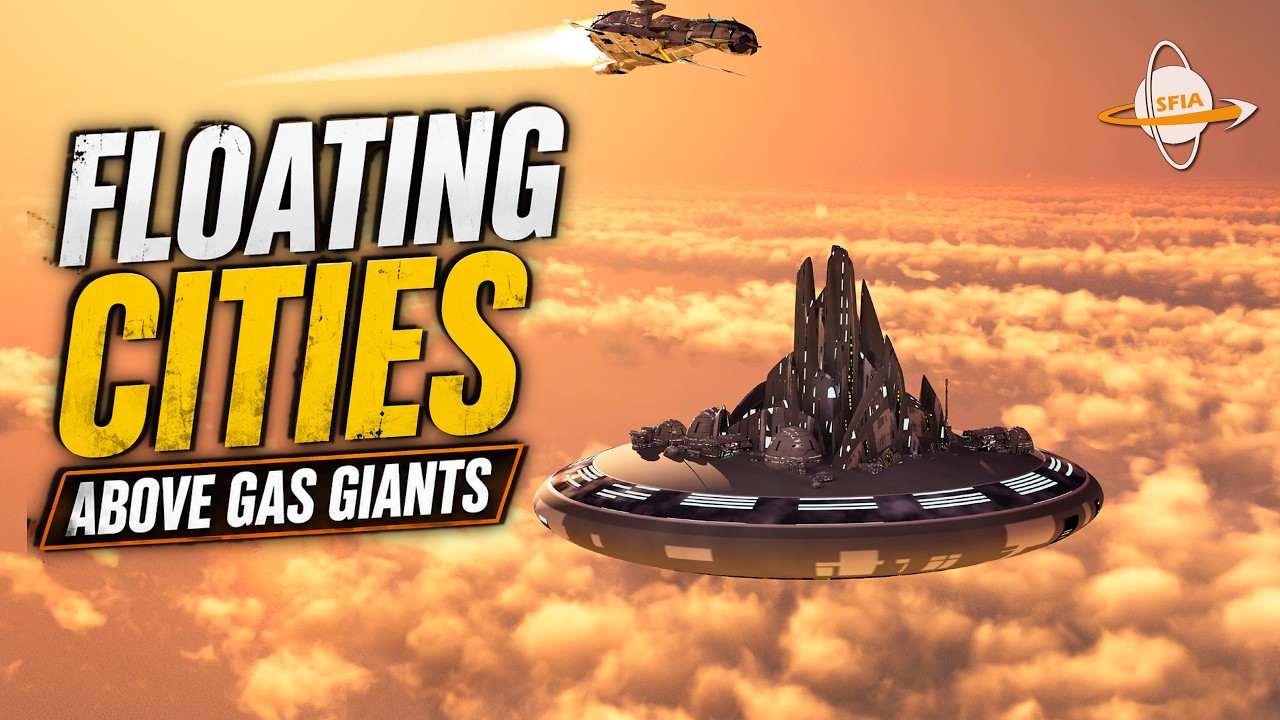
Floating Cities Above Gas Giants
Keywords
Summary
146 words
Critical Evaluation
Value of the Information & Strength of the Argument
The video’s value lies in its reframing of why gas giants are important: not as fuel sources but as massive reservoirs of raw materials like hydrogen, helium, and nitrogen, essential for reaction mass, radiation shielding, and life support. Isaac Arthur presents a coherent argument, using back-of-the-envelope calculations to show that fusion fuel demand is modest, while the need for bulk mass for interplanetary traffic is enormous. He systematically addresses engineering challenges—buoyancy, power, scale—and demonstrates that floating cities are practical even without speculative fusion technology. The argumentation is solid, grounded in known physics (e.g., Archimedes’ principle, thermodynamics) and plausible extrapolations. While speculative, the reasoning is internally consistent and avoids unsupported claims, making it a compelling exploration of future space infrastructure.
Scientific Rigor, Source Quality, Title Accuracy
The video maintains scientific rigor by relying on well-established principles of physics and engineering, and by clearly separating speculative elements from current knowledge. However, it lacks explicit citations or references to scientific papers, instead using general knowledge and back-of-the-envelope estimates. The title accurately reflects the content, which directly addresses the concept of floating cities above gas giants. The video’s tone is exploratory and educational, not overclaiming certainty. Comments from viewers are overwhelmingly positive, praising the clear explanations and original perspectives, with several long-time subscribers noting improvements in the narrator’s speech.
224 words
Title / Content Match
The title accurately reflects the content; the video focuses on the concept of floating cities over gas giants.
Quality & Reliability
7/10
The video provides a well-reasoned speculative analysis based on established physics and engineering principles, though it lacks formal citations for specific data points.
Chapters
Cited Sources
- Epidemic Sound — Music credit
- Isaac Arthur Website — Official website
- Reddit Community — Fan discussion forum
- Subscribestar Support — Support channel
External References
Contribution & Novelties
The video offers a novel perspective by challenging the common assumption that gas giants are primarily valuable for fusion fuel (deuterium/helium-3). Instead, Isaac Arthur argues that their true value lies in being vast sources of bulk hydrogen, helium, and nitrogen—materials critical for spacefaring civilization, including reaction mass, radiation shielding, and life support. This reframing makes floating cities essential even if fusion never becomes practical, and highlights their role as industrial and logistical centers rather than power plants.
Pour aller plus loin :
- Lifting gas — Explains the principles of buoyancy using gases, directly relevant to the balloon-based floating cities.
- Atmosphere of Jupiter — Provides data on composition, pressure, and temperature, which underpin the feasibility discussions.
- Space colonization — Offers broader context on the motivations and methods for settling space, where this video’s ideas fit.
134 words
Radar Profile
The profile shows a well-balanced video with high scores in information quantity and quality, reflecting the thorough exploration of the topic. Technical level is slightly lower but still solid, suitable for a general audience while retaining depth. Reliability is good given the speculative nature, supported by logical reasoning and physical principles.
💬 très positif Sur les 30 commentaires analysés, le ton est extrêmement positif, avec des éloges sur le contenu, la clarté, et une appréciation notable de l'amélioration de l'élocution de l'auteur.