Biometría II - Modelos con exceso de ceros
Biometrics II - Models with excess zeros
Title history
- Biometría II - Modelos con exceso de ceros — observed on 20261030-1718 UTC (YouTube)
Keywords
Summary
164 words
Critical Evaluation
Value of the Information & Strength of the Argument
The value of the information lies in its practical approach to a common but often mishandled problem in ecological data analysis. The instructor provides a clear typology of zeros and a step-by-step diagnostic protocol, which can be directly applied by researchers. The argumentation is solid, grounded in statistical theory and illustrated with concrete examples. The interactive format allows clarification of subtle points, such as the distinction between structural and false zeros, and the interplay between overdispersion and zero inflation.
Scientific Rigor, Source Quality, Title Accuracy
The lecture is scientifically rigorous, presenting standard methods and referencing the DHARMa package for residuals diagnostics. The title accurately reflects the content. Since no external sources are cited in the description, the evaluation relies on the coherence of the statistical concepts and the correctness of the methods taught.
142 words
Title / Content Match
The title accurately reflects the content, which focuses on models for count data with excess zeros, including zero-inflated and zero-augmented approaches.
Quality & Reliability
8/10
The video is an academic lecture presenting standard statistical methods for zero-inflated count data. The explanations are clear, well-structured and align with current practice in ecological statistics, though no external sources are cited beyond the tools mentioned.
Key Moments
Markers derived by PSI from the transcript: the creator did not define chapters.
- Introduction and review of continuous distributions (gamma, beta)
- Definition of excess zeros and theoretical probability of zero
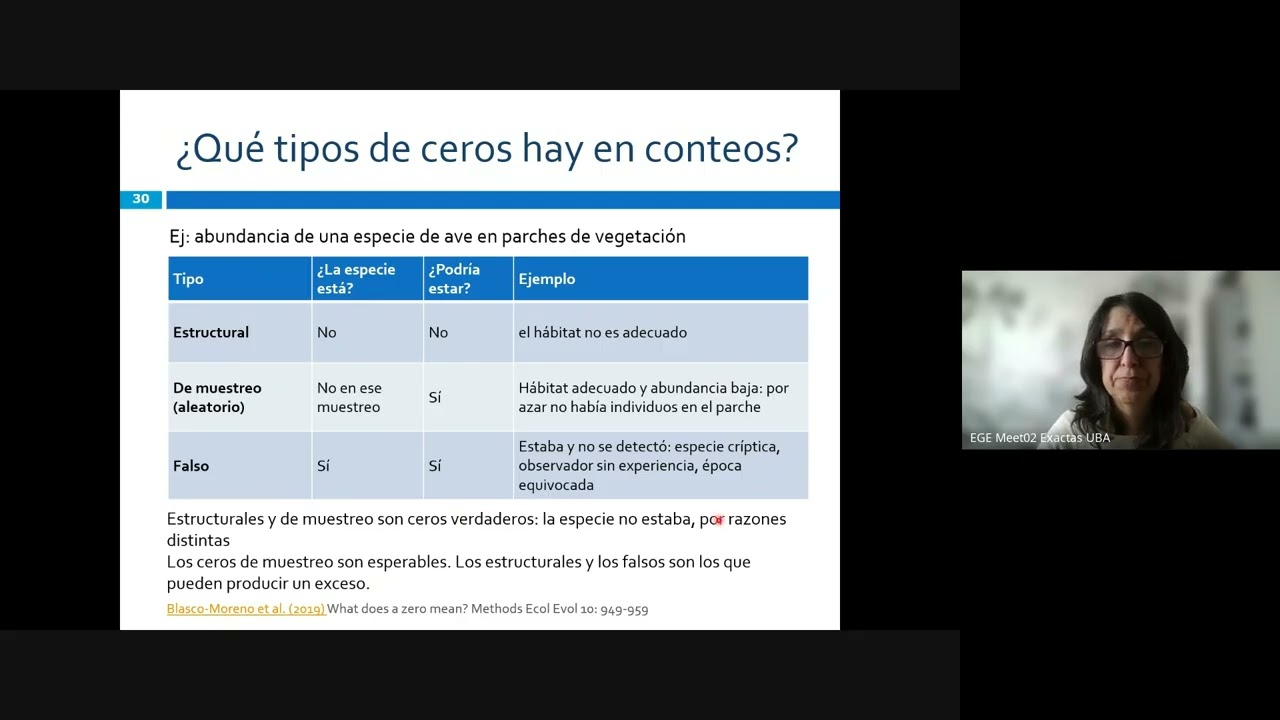
- Three types of zeros: structural, sampling, false
- Diagnostic tests using DHARMa: overdispersion and zero inflation
- Protocol: from Poisson to negative binomial and beyond
- Introduction to zero-inflated and zero-augmented models
Cited Sources
- DHARMa: Residual Diagnostics for Hierarchical (Multi-Level / Mixed) Regression Models — The instructor mentions using DHARMa to test for zero inflation and overdispersion.
Concurring Sources
- pscl: Political Science Computational Laboratory — R package that implements zero-inflated regression models, consistent with the methods taught.
Contribution & Novelties
The lecture provides a clear pedagogical framework for addressing zero-inflated count data, a common issue in ecological surveys. It clarifies the different origins of zeros and offers a systematic workflow to select appropriate models. This is particularly useful for students and researchers who often overlook these nuances.
Pour aller plus loin :
- Zero-inflated model — Provides an overview of zero-inflated distributions and their applications.
- Negative binomial distribution — Useful for understanding overdispersion in count data.
- Hurdle model — Introduces the zero-augmented (hurdle) approach mentioned in the lecture.
87 words
Radar Profile
The radar profile shows high scores in quality and technical level, reflecting a rigorous and informative lecture. Quantity is moderate, and overall reliability is high, indicating content suitable for academic audiences.