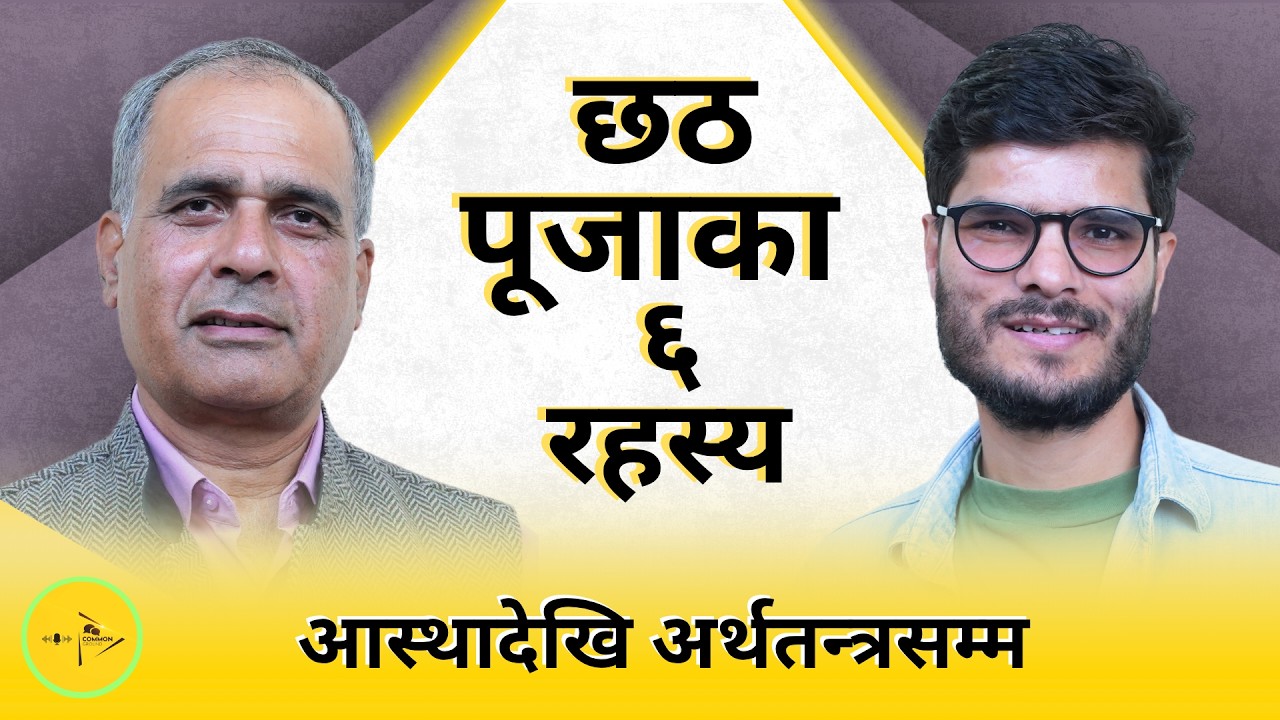
मन्त्र, मूर्ति र मन्दिरबिनाको पर्वः छठ र माओवादी विद्रोह | Common Ground with Dhirendra Premarshi
Title history
- मन्त्र, मूर्ति र मन्दिरबिनाको पर्वः छठ र माओवादी विद्रोह | Common Ground with Dhirendra Premarshi — observed on 20261114-1119 UTC (YouTube)
Keywords
Summary
228 words
Critical Evaluation
Value of the Information & Strength of the Argument
The information offered is of notable value for understanding Chhath beyond its ritual surface, particularly the guest’s analytical framing of the festival as a ‘karmic’ practice where devotees both petition and personally fulfil their own desires, with the divine serving as witness. The argumentation is anchored in lived experience: the guest draws on decades of residence across Nepal, from Kapilvastu to the Mithila heartland, and provides concrete, verifiable recollections — such as the absence of Chhath west of the Narayani river thirty years ago, or the initial handful of celebrants at Thapathali’s maternity hospital in Kathmandu. The causal claim linking the Maoist insurgency to the festival’s urban expansion is well argued through specific mechanisms: travel restrictions, police inspections of prasad items on buses that were considered purification-breaking, and the consequent decision by migrant Maithilis to celebrate locally. The argument that Chhath functions as a social equalizer is supported by evidence of shared ghats in mixed villages and the economic interdependence between castes through craft production. The ‘Lokaveda’ concept, presented as a folk counterpart to scriptural Veda, provides a coherent intellectual framework, although some assertions — such as the prevalence of non-Hindu participants or the exact timeline of expansion — remain matters of personal observation rather than systematic study.
Scientific Rigor, Source Quality, Title Accuracy
The discussion displays sound scientific rigor for a cultural-historical talk. The guest is openly cautious about claiming any precise origin for Chhath, and critically interrogates mythic narratives by noting that if the Pandavas had introduced it, all Hindus worldwide would celebrate it. Textual references include the Vishnu Purana for Mithila’s boundaries and the Mahabharata for the Pandava episodes, used selectively and with appropriate qualification. The quality of sources is predominantly oral tradition, personal observation, and a few scriptural mentions — appropriate for the subject matter, but no independent scholarly publications are cited. The title’s relevance is high: it precisely mirrors the two central themes addressed, and the connection between the Maoist rebellion and Chhath’s diffusion is explicitly and repeatedly substantiated in the body of the discussion. No public comments were available for analysis (the video has been watched by a very limited audience).
366 words
Title / Content Match
The title accurately captures the two central themes of the conversation: the festival's unusual structure without mantras, idols, or temples, and its expansion linked to the Maoist insurgency. Both are substantively addressed throughout the discussion.
Quality & Reliability
7/10
The discussion is built on the guest's decades of first-hand cultural observation across Nepal, with transparent acknowledgment of historical uncertainty and critical use of scriptural references. Claims are largely anecdotal and experiential rather than independently verifiable, yet the reasoning is coherent, self-aware, and grounded in concrete testimonies.
Key Moments
Markers derived by PSI from the transcript: the creator did not define chapters.
- Etymology of 'Chhath' traced from 'Surya Shashthi' through 'Chhathi' to 'Chhath'; introduction of the sun as the primary source of energy
- Discussion of historical origins; the guest argues festivals evolve from social welfare needs and critically dismisses the Pandava-origin myth
- Mithila region defined via Vishnu Purana (Koshi to Gandaki, Himalaya to Ganga) as Chhath's core territory
- Maoist insurgency as a catalyst: travel restrictions and police inspection of prasad at bus stops push Kathmandu-based Maithilis to celebrate locally
- International expansion of Chhath: Nepali and Indian diaspora celebrating on seashores in the US and Australia
- Explanation that Chhath has no mantras, no priests, no idols — direct worship of the sun as a 'Lokaveda' folk ritual
- Details of the four-day ritual: nahaye khaye, kharna (rice pudding), 48-hour fasting cycle, and daily offerings of locally produced fruits and grains
- Caste and social harmony: role of Dom bamboo craftsmen and potters; discussion of caste equality and the Maithili song composed by the guest on this theme
Cited Sources
- Vishnu Purana — Referenced for defining the historical boundaries of the Mithila region (Koshi to Gandaki, Himalaya to Ganga)
- Mahabharata — Cited for the Pandava legend of Chhath origin, which the guest critically evaluates as insufficient to explain the festival's distribution
- Works of Khalil Dhanatevi (gazal lyricist) — Mentioned for the gazal about uprooted farmers quoted in the discussion about the loss of connection to soil
Concurring Sources
- Chhath — Wikipedia — Confirms the festival's etymology, timing (Kartik Shukla Shashthi), and general geographic association with the Mithila region and the sun-worship core.
- Nepalese Civil War — Wikipedia — Provides historical context for the Maoist insurgency period that the guest identifies as the catalyst for Chhath's urban expansion.
Contribution & Novelties
This talk’s original contribution lies in its framing of Chhath’s expansion to Kathmandu as a direct, unintended consequence of the Maoist insurgency — a specific causal link rarely articulated in mainstream accounts of the festival’s spread. The ‘karmic ritual’ interpretation (devotees fulfilling their own wishes with the divine as witness) and the ‘Lokaveda’ concept offer a nuanced analytical lens for understanding how folk religion operates independently of Brahmanical mediation. The emphasis on Chhath’s economic role in sustaining craft castes (Dom weavers, potters) adds an under-explored socioeconomic dimension.
Pour aller plus loin :
- Chhath Puja — Wikipedia — General background on the festival, its rituals and geographical spread.
- Mithila (region) — Wikipedia — Context on the cultural and historical homeland of Chhath.
- Nepalese Civil War — Wikipedia — The Maoist conflict (1996–2006) discussed as a driver of internal migration and cultural diffusion.
- Maithili language — Wikipedia — Linguistic and literary context for the guest’s expertise and the festival’s oral traditions.
- Vishnu Purana — Wikipedia — Scriptural source used for defining Mithila’s limits as cited in the discussion.
176 words
Radar Profile
The profile shows a moderately well-rounded performance with a slight bias toward qualitative richness over technical depth. The quantity and quality of information scores are balanced (7/7), while the technical level is lower (5), reflecting a cultural-analytical rather than rigorously academic treatment. Reliability is decent (7) given the expert's first-hand experience, though the absence of external citations tempers the overall confidence.