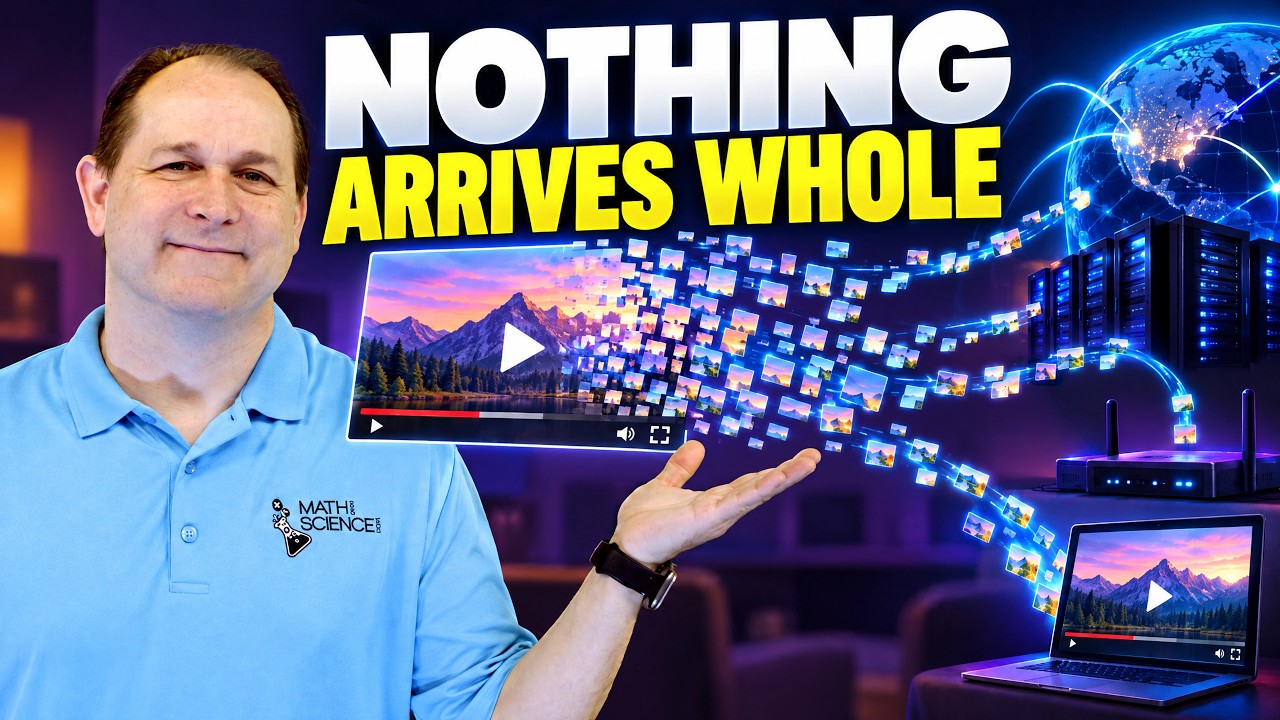
No Router on the Internet Knows Where Your Data Is Going
Keywords
Summary
158 words
Critical Evaluation
Value of the Information & Strength of the Argument
The video provides substantial educational value by demystifying a complex system with relatable analogies (mail, postal sorting, highway) and concrete numbers (1500-byte packets, 124,000 miles per second optical speed). Its argumentation is logical and incremental: from the ‘why’ (circuit switching vs. packet switching) to the ‘how’ (headers, routing, protocols), culminating in practical user-facing phenomena like buffering. The speaker’s clarity and use of visual metaphors strengthen the persuasiveness of the explanations.
Scientific Rigor, Source Quality, Title Accuracy
The video does not cite specific external sources or scientific papers, but its content aligns with established networking knowledge (e.g., RFCs, standard textbooks). The title is well-matched to the content, focusing on the decentralized nature of internet routing. While the absence of cited references reduces verifiability, the accuracy of the explanations is high, and the presentation is internally consistent. No contradictory information was presented.
149 words
Title / Content Match
The title accurately highlights a key insight about the distributed nature of internet routing, and the content fully delivers on this promise.
Quality & Reliability
9/10
The video presents accurate and well-structured explanations of internet fundamentals, using clear analogies and up-to-date information, with no discernible errors or misleading claims.
Key Moments
Markers derived by PSI from the transcript: the creator did not define chapters.
- Introduction: tapping play, video is chopped into packets, surprising fact about data routing.
- Explanation of circuit switching vs. packet switching with the highway analogy.
- Number of packets for a 10-minute video (~1 million) and how they are addressed with IP addresses.
- Role of DNS in translating names to addresses and handling of private/public IPs via NAT.
- Reliability mechanisms: TCP and QUIC, packet numbering, handshake, and error recovery.
- Physical infrastructure: undersea cables, optical fiber, and the role of light.
- Cable cuts and rerouting; local routing decisions by routers and BGP.
- Data centers and content delivery networks (CDNs) that improve speed.
- Encryption (HTTPS) ensures privacy of packets in transit.
- Reasons for buffering: congestion, last-mile bottleneck, Wi-Fi interference, and player cushion.
Concurring Sources
- Packet switching - Wikipedia — Confirms the definition and advantages of packet switching.
- Internet protocol suite - Wikipedia — Supports the description of TCP/IP layers and protocols.
- Border Gateway Protocol - Wikipedia — Explains how BGP routes packets across autonomous systems.
Contribution & Novelties
The video synthesizes existing networking concepts into an engaging narrative, making the topic accessible to a broad audience. Its originality lies in the effective use of analogies and the clear explanation of the ’no single router sees the full path’ concept. It also clarifies common misconceptions, such as the prevalence of satellites over undersea cables.
Pour aller plus loin :
- Packet switching — Core concept explained in depth.
- Internet protocol suite — Overview of TCP/IP and related protocols.
- Border Gateway Protocol — How routing decisions are made between networks.
- Submarine communications cable — Details on undersea infrastructure.
97 words
Radar Profile
The radar chart shows high scores across all dimensions, with slightly lower technical complexity reflecting the intended broad audience. The video excels in information quantity and quality, making it an excellent educational resource.