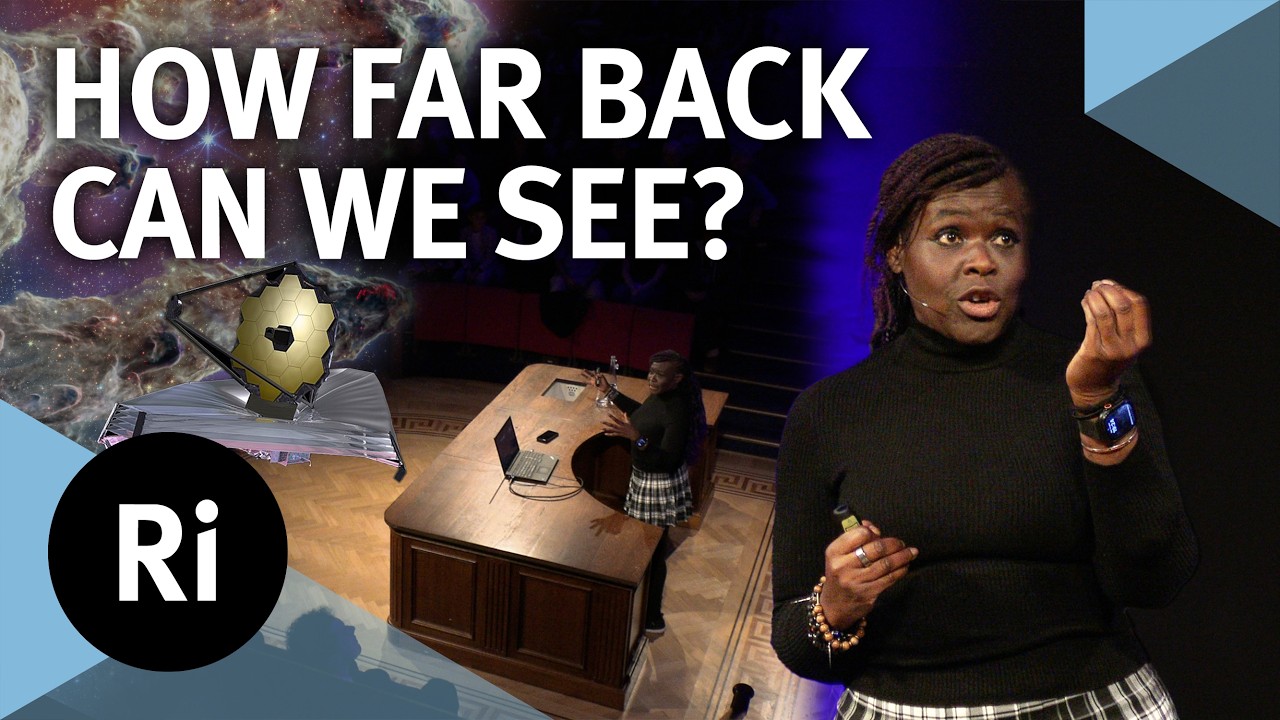
Is James Webb forcing us to rethink the early universe? | with Maggie Aderin
Keywords
Summary
318 words
Critical Evaluation
Value of the Information & Strength of the Argument
The informational value is high for a general lecture: the talk covers an unusually wide arc — archaeoastronomy, the Copernican transition, spectroscopy, stellar nucleosynthesis, instrument design, orbital mechanics and observational cosmology — without losing internal coherence, since each block is used to set up the next. The strongest passages are those where the speaker speaks from direct experience: the description of NIRSpec’s integral field unit, the rationale for a segmented mirror over transmissive optics given the poor quality of early glass, the engineering constraint that Webb cannot point at the Sun or Earth without being swamped, and the explanation of why an infrared telescope must be in space and shielded. These are not recycled popular-science formulae but the working knowledge of an instrument scientist, and they carry corresponding authority. The light-travel-time sequence is the argumentative spine and is handled well: the move from everyday latency to lunar, solar and planetary delays builds an intuition that is then scaled to cosmological distances, so that the claim ’looking far away is looking back in time’ arrives already justified rather than asserted. The treatment of the redshift–expansion link is correct in substance, though compressed: the inference from observed redshift to an expanding universe, and from expansion to a hot dense origin, is presented as a chain of reasoning rather than demonstrated, and the distinction between cosmological redshift and Doppler shift is not drawn. Some phrasings are deliberately loose for rhetorical effect — Edwin Hubble ‘realising everything is moving away from us’ glosses over the calibration history and the subsequent revision of Hubble’s constant. The discussion of the anomalies is the most epistemically interesting part: rather than presenting the ’little red dots’ and the unexpectedly bright early galaxies as problems for the standard model, the speaker explicitly frames them as the normal operation of science, which is a defensible and well-calibrated stance, but it is also where the lecture stops shortest — no candidate explanations (AGN versus stellar populations, dust, lensing contamination, calibration systematics) are weighed, so the audience learns that a puzzle exists without learning what would count as evidence either way. The historical sections are anecdotal and entertaining (Tycho Brahe’s silver nose, Newton’s childhood shutter, the misattributed Galileo portrait) and are correctly flagged as anecdote, but they are used as colour rather than as evidence about how the science actually advanced. Overall the argumentation is cumulative and mostly sound, built on consensus physics delivered with clear signposting; its weakness is that it argues by narrative momentum rather than by adjudicating between competing interpretations, which leaves the audience persuaded of the shape of the field but not equipped to evaluate a claim within it.
Scientific Rigor, Source Quality, Title Accuracy
Scientific rigour is good at the level of factual content and weaker at the level of sourcing. The numbers quoted are within accepted values: the speed of light, the 1.3-second lunar light time, the 8-minute-20-second solar light time, Jupiter’s 35-to-54-minute range and Saturn’s ~1.5 light hours are all correct, as are the order-of-magnitude figures for stars in the Milky Way and galaxies in the observable universe. Minor imprecision appears where the Sun’s mean distance is given as approximately 145 million kilometres (the accepted mean is about 149.6 million), and the elliptical-orbit explanation for the variation is correct but the perihelion/aphelion extremes are not quantified, so the audience cannot check the rounding. The framing of redshift is correct in outline but compressed in a way that would need qualification for a specialist audience. On sources, the lecture cites none: no paper, no JWST data release, no mission documentation is named, and the description’s links point to the speaker’s companion book, a Christmas Lectures playlist, the channel’s podcast and its editorial policy rather than to scientific literature. The book is the closest thing to a reference and is offered through a commercial affiliate link, which is disclosed by the channel. This means the talk functions as an authoritative synthesis of settled science but offers no verification path — a viewer cannot trace any specific claim, including the claims about the ’little red dots’, back to an observation or a preprint, and the closing discussion of anomalies is therefore asserted rather than evidenced. On title–content adequacy, the question posed in the title is genuinely engaged in the final portion and answered in the affirmative framing (yes, the early universe is being rethought), but the majority of the lecture is preparatory background, so a viewer drawn in by the title spends most of the hour before reaching the advertised subject.
762 words
Title / Content Match
The title's question about rethinking the early universe is genuinely addressed in the closing third (gravitational lenses, redshift, 'little red dots', unexpectedly bright early galaxies), but roughly two-thirds of the running time is a broader history of astronomy and a personal/technical primer on how Webb works.
Quality & Reliability
8/10
Public lecture delivered at the Royal Institution by a space scientist who worked on the NIRSpec instrument, so the technical content rests on direct professional experience. The physics presented (finite speed of light, fusion and E=mc², redshift as expansion evidence, elliptical orbits, infrared observing from L2, gravitational lensing) is standard, textbook-level and stated accurately, with only minor rounding slips (the Sun's mean distance given as ~145 million km rather than ~150 million km). No peer-reviewed papers or data releases are cited, and the treatment stays qualitative: the presentation is reliable as an introduction but does not let a viewer check any specific claim against a primary source.
Chapters
- Introduction
- Ancient astronomy: Stonehenge to the astrolabe
- Copernicus, Galileo, Kepler and Newton
- What we know now: the Big Bang and an expanding universe
- James Webb as a time machine: fusion, light and E=mc²
- Light travel time: the Moon, Sun, Jupiter and Saturn's aurorae
- Maggie's journey: Star Trek, dyslexia and ADHD
- Why Webb is an infrared telescope in space
- Webb's mirror, instruments and orbit at L2
- NIRSpec and the integral field unit
- Looking back in time: Pillars of Creation, Cosmic Owl and more
- Gravitational lenses, redshift and the earliest galaxies
- New mysteries: little red dots and early galaxies
- Cosmic history in a grain of sand
Cited Sources
- James Webb's Ancient Cosmos — Maggie Aderin-Pocock (companion book) — Book by the speaker, presented in the description as the written development of the lecture's time-machine framing of JWST. Distributed via a commercial affiliate link, disclosed as such by the channel.
- Royal Institution Christmas Lectures 2025 (playlist) — Referenced repeatedly in the talk as the source of the demonstrations on the evolution of cosmological knowledge, including the celestial-sphere model built for the lectures.
- Royal Institution — editorial policy on talks and comment moderation — Channel-level statement of editorial standards; relevant as the only published process documentation behind the content, not as a scientific reference.
- RI Science Podcast — Institutional podcast linked in the description; no specific episode is cited in support of any claim made in the lecture.
Concurring Sources
- NASA — James Webb Space Telescope mission overview — Corroborates the lecture's description of the segmented gold-coated mirror, the infrared instrument suite including NIRSpec, and the halo orbit around the second Lagrange point.
- Redshift — Wikipedia — Supports the account of redshift as the observational basis for an expanding universe, consistent with the lecture's attribution to Edwin Hubble's spectroscopic work.
- Lagrange point — Wikipedia — Confirms the thermal and geometric rationale for placing an infrared observatory at L2, as described in the talk.
External References
Contribution & Novelties
The lecture’s distinctive contribution is not new data but a practitioner’s synthesis: the speaker worked on NIRSpec, and the section on the integral field unit and on the engineering trade-offs of a space-borne infrared Observatory (why a mirror rather than a lens, why L2, why the telescope must never point sunward) is delivered from inside the project rather than reconstructed from press releases. The pedagogical arc is also well constructed: instead of asserting that looking far away means looking back in time, it derives the intuition through a graded sequence of light-travel delays from the room to the Moon, Sun, Jupiter and Saturn, then scales to cosmological distances. The treatment of the ’little red dots’ and of early bright galaxies is framed explicitly as science proceeding normally rather than as a crisis, which is a defensible corrective to the more sensational coverage the same observations have received. The weakest originality claim is in the historical sections, which retell well-worn anecdotes without new evidence.
Further reading:
- James Webb Space Telescope — NASA mission page — Official mission documentation for instruments, mirror architecture and the L2 orbit discussed in the talk.
- NIRSpec — Wikipedia — Background on the near-infrared spectrograph and its integral field unit, the instrument the speaker contributed to.
- Redshift — Wikipedia — Reference for the redshift–expansion relationship that the lecture compresses into its cosmological argument.
- Lagrange point — Wikipedia — Explains why L2 is favoured for a cryogenic infrared observatory shielded from Sun and Earth.
- Hubble’s law — Wikipedia — Context for Edwin Hubble’s spectroscopic inference of an expanding universe, including the later recalibration of the constant.
- ‘Little red dots’ — the compact, red, high-redshift sources whose nature (active galactic nuclei versus dense stellar populations) is still debated; worth reading the current literature rather than a single summary, as no specific study is cited in the lecture.
308 words
Radar Profile
The profile is that of a high-reliability, moderate-density science communication lecture: information quality and overall reliability sit high because the content is settled physics delivered by a specialist, while technical level and informational density are deliberately moderated for a general audience. The relatively lower quantity score reflects a substantial share of historical anecdote and autobiographical material rather than a weakness in the physics itself.