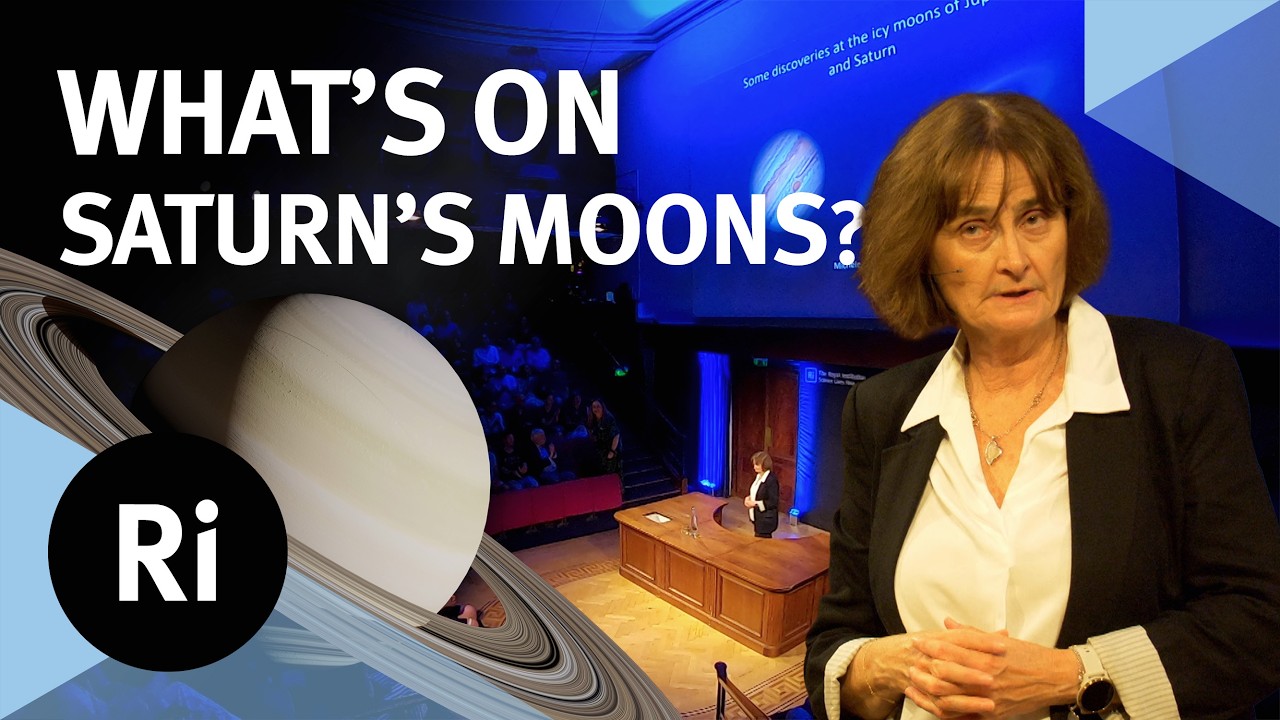
Do icy moons hide alien oceans? | with Michele Dougherty
Keywords
Summary
173 words
Critical Evaluation
Value of the Information & Strength of the Argument
The talk provides significant value by presenting firsthand scientific evidence from major missions, illustrating the process of discovery from data anomalies to hypothesis and confirmation. Dougherty’s argumentation is solid: she explains how magnetometer measurements indicated a young surface, leading to closer flybys and the detection of a plume. She carefully builds the case for subsurface oceans by linking magnetic field signatures to conducting layers, corroborated by multiple instruments. The narrative is compelling and logically structured, from observation to interpretation to broader implications for habitability. The inclusion of the scientific method and the pacing of discoveries demonstrates robust reasoning.
Scientific Rigor, Source Quality, Title Accuracy
Scientific rigor is high: the speaker is a principal investigator on both Cassini and JUICE, and the content aligns with peer-reviewed findings. Sources are primarily the mission data and publications, which are not explicitly cited in this talk but are well-established. The description provides links to the Royal Institution’s editorial policy and podcast, but no direct scholarly citations. The title matches the content closely, with no misleading elements. The talk is a public lecture, so it simplifies some details but maintains technical accuracy within the context. The use of visual data and animations further supports the explanations.
210 words
Title / Content Match
The title is a direct question that the talk thoroughly addresses, presenting evidence for subsurface oceans on icy moons and the missions that revealed them.
Quality & Reliability
9/10
Presentation by an authoritative scientist (Michele Dougherty, Astronomer Royal) at a prestigious institution (Royal Institution), with detailed firsthand accounts of mission data and a clear explanation of scientific methods. The content is technically precise and consistent with established mission outcomes.
Chapters
- Introduction: Saturn, Jupiter and a Hidden Moon
- Inside the Cassini Spacecraft
- How Scientists Measure a Magnetic Field
- Saturn's Rings and a Mysterious Moon
- Enceladus: Too Young to Be True
- Cassini's First Flybys of Enceladus
- The Gamble: Flying Closer
- Discovery: A Plume from the South Pole
- The Ingredients for Life
- Jupiter's Moons: Clues from Galileo
- The Case for a New Mission to Jupiter
- Building the JUICE Spacecraft
- Building Instruments Through Lockdown
- Launch from French Guiana
- The Long Journey to Jupiter (2023–2031)
- Ganymede: The Moon with Its Own Magnetic Field
- Callisto, Europa and the Search for Oceans
- 400 Years of Icy Moon Discovery
- Cassini's Grand Finale
- The End of an Icon
- NASA's Farewell Film
Cited Sources
- Ri podcast — This is a link to the Royal Institution's podcast, which may feature related science discussions.
- Ri editorial policy — Policy for editing talks and moderating comments, relevant to how the talk is presented.
- Donate to the Ri — Support page for the Royal Institution, mentioned in the description.
- Q&A session for members — A separate video with the Q&A session following this talk, available to members.
Contribution & Novelties
The talk’s novel contribution is the personal account of the discovery of Enceladus’ plume and the subsequent justification for the JUICE mission, offering insights into the scientific process and decision-making in planetary exploration. It also underscores the expansion of the habitable zone concept to include icy moons.
Pour aller plus loin :
- Enceladus — Detailed page on the moon, its geology, and the evidence for its subsurface ocean.
- JUICE (Jupiter Icy Moons Explorer) — Overview of the mission, objectives, and current status.
- Cassini–Huygens — The mission that orbited Saturn and discovered the plume on Enceladus.
95 words
Radar Profile
The radar profile would show high scores across all dimensions, indicating a well-balanced presentation with strong information content, technical depth, and credibility. The talk excels in both quality and quantity of information, supported by the speaker's expertise and the institutional platform.