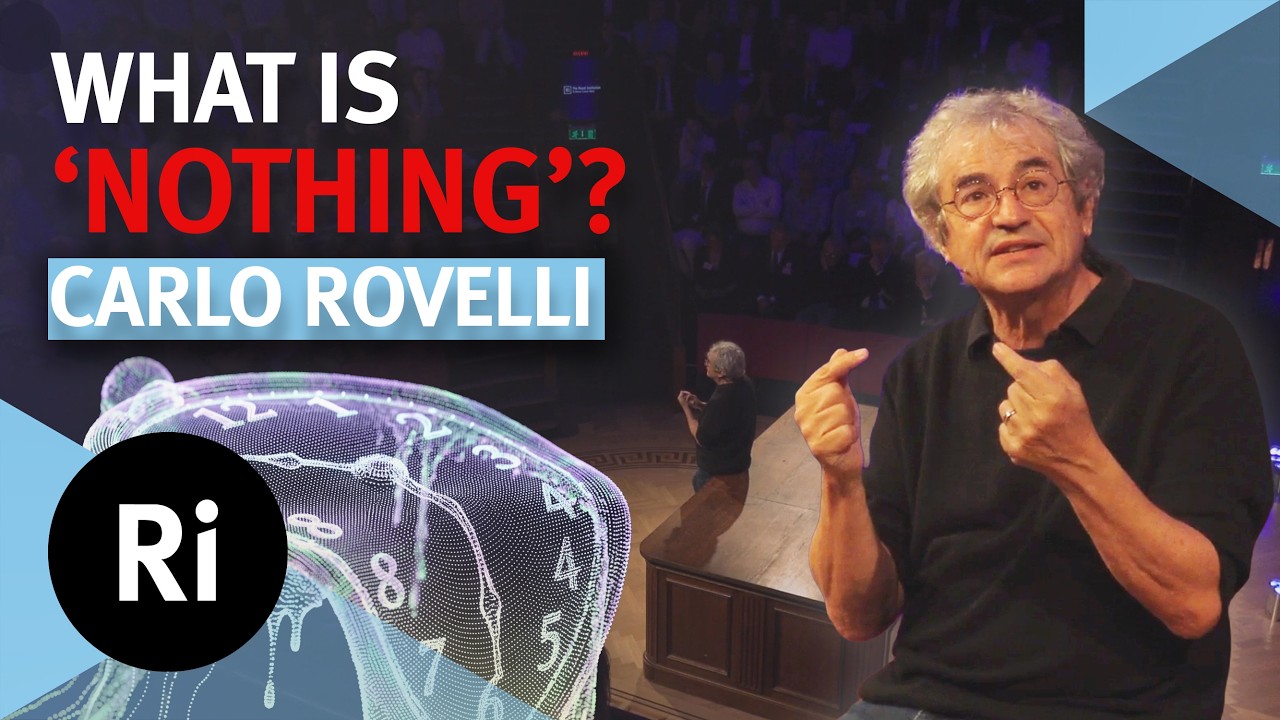
Why there is no "final story" of reality | with Carlo Rovelli
Title history
- Why there is no "final story" of reality | with Carlo Rovelli — observed on 20261120-1758 UTC (YouTube)
Keywords
Summary
176 words
Critical Evaluation
Value of the Information & Strength of the Argument
The value of the information lies in Rovelli’s ability to synthesize complex physics concepts (relativity, quantum mechanics) with philosophical implications, offering a coherent and accessible argument. His argumentation is solid: he builds from concrete examples (Jupiter vs Earth, distant friends, air as ’nothing’) to abstract principles, and then to the relational interpretation of quantum mechanics. The reasoning is logically sound and consistent with mainstream physics, though the philosophical interpretation is his own perspective. He acknowledges alternative views but does not deeply engage with counterarguments, which slightly weakens the critical edge. Overall, the lecture is intellectually stimulating and provides a clear explanation of a non-trivial worldview shift.
Scientific Rigor, Source Quality, Title Accuracy
The scientific rigor is high for a public lecture: Rovelli correctly presents established physics, such as special relativity and quantum mechanics, without distorting the facts. However, he does not cite specific papers or empirical studies, relying instead on established principles and his own book. The source quality is limited to the description’s links (mostly institutional), and the talk itself references historical figures (Copernicus, Darwin, Einstein) without footnotes. The title matches the content precisely, and the structure is clear. No comments were provided for analysis.
205 words
Title / Content Match
The title accurately reflects the central thesis: the impossibility of a final, absolute description of reality. The content directly addresses this from multiple angles, including relativity, quantum mechanics, and philosophical perspectives.
Quality & Reliability
8/10
The talk is given by a prominent theoretical physicist, Carlo Rovelli, known for his contributions to quantum gravity and relational quantum mechanics. The content is scientifically grounded, but it is a popular-level lecture without rigorous derivations or references to specific papers, relying on established concepts. The argument is coherent and aligns with current scientific understanding, but it is presented as philosophical interpretation rather than empirical evidence.
Chapters
- Welcome and Our Peculiar Corner of the Cosmos
- Why Reality Isn't Made of Solid "Things" (Jupiter vs. Earth)
- Why There Is No Universal "Now"
- What Do We Actually Mean by "Nothing" and "Empty"?
- Location, Geometry, and Local Assumptions
- How Worldviews Shift Over Time
- Can We Ever Reach the "Final Story" of Reality?
- Quantum Mechanics and Relational Perspectives
- Dialogue Between Physics and Philosophy
- Layers of Description: A Glass of Water and Consciousness
- Morality, Politics, and Living Together on a Small Planet
- Closing Reflections: One Ongoing Conversation
Cited Sources
- On the Equality of All Things (book) — Rovelli's book discussed in the talk; link provided in the description.
- The Ri Podcast — The Royal Institution's podcast, linked in the description.
- Ri Editorial Policy — Royal Institution's editorial policy for talks and comments.
External References
Contribution & Novelties
This talk offers a unified perspective connecting relativity, quantum mechanics, and philosophy, arguing that reality is fundamentally relational. While Rovelli has presented these ideas in his books, this lecture makes them accessible to a broad audience. The novelty lies in the emphasis on how our local environment biases our conceptual frameworks and how quantum mechanics forces a relational view of nature.
Pour aller plus loin :
- Relational quantum mechanics — Core concept discussed; explains the interpretation of quantum states as relative to an observer.
- Special relativity — Background to the discussion of the non-universal ’now'.
- Philosophy of space and time — Relevant to the discussion of geometry and locality.
- Carlo Rovelli’s page — Background on the author and his work.
120 words
Radar Profile
The radar shows strong scores in information quality and reliability, with moderate quantity and technical level. This reflects a well-presented, authoritative lecture that balances accessibility with depth, though it doesn't delve into mathematical formalism or exhaustive citations.