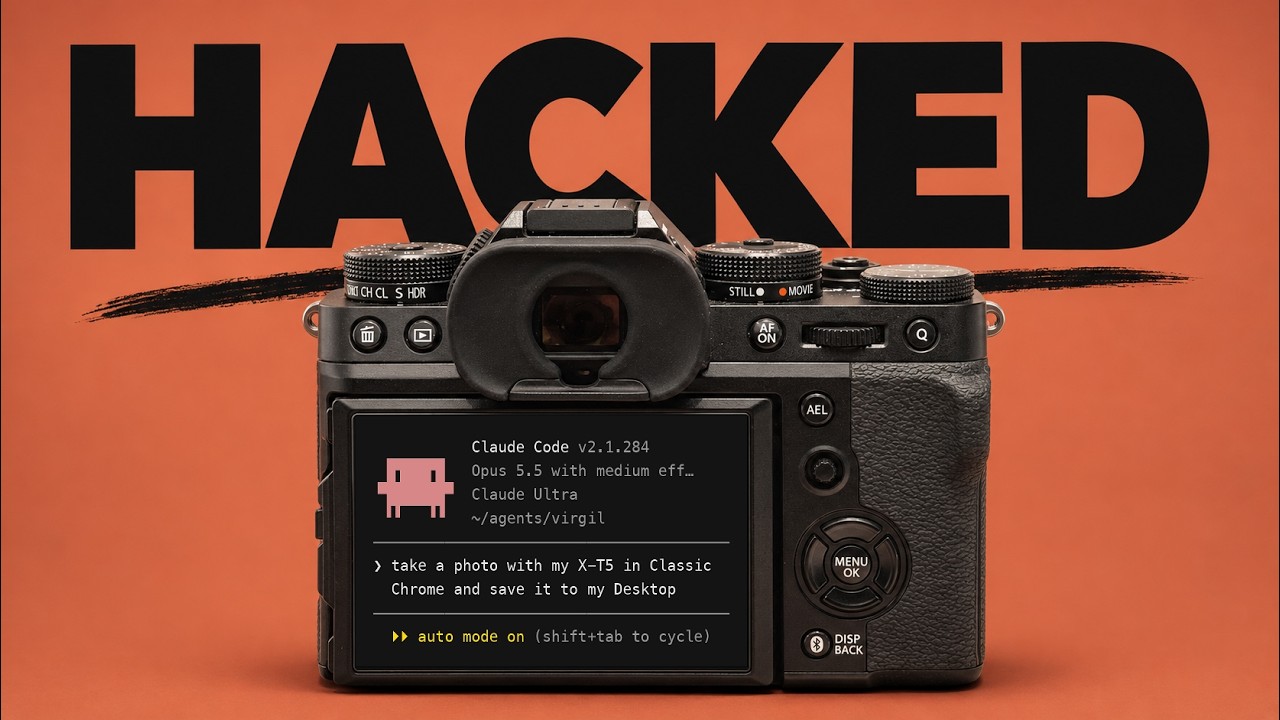
I Just Hacked My Camera With Claude Code (and so can you)
Title history
- I Just Hacked My Camera With Claude Code (and so can you) — observed on 20261107-0826 UTC (YouTube)
Keywords
Summary
146 words
Critical Evaluation
Value of the Information & Strength of the Argument
The video provides a valuable hands-on exploration of using AI agents to interact with hardware. The author walks through a logical progression from simple camera control to more complex recipe creation and batch processing, showing real results and troubleshooting. The argumentation is largely based on empirical demonstration and personal experience. The author also acknowledges limitations and risks, which strengthens the credibility. However, the claims about Claude’s capabilities are presented without systematic testing or comparison, and the technical explanations of how firmware works are shallow. Still, the value lies in the practical workflow that viewers can replicate or adapt.
Scientific Rigor, Source Quality, Title Accuracy
The author cites his own blog post for instructions and prompts, which is a helpful resource. He also mentions an open-source tool (Fuji CLI) and a GitHub repo for reverse engineering, but no direct URLs are given in the video. The sources are non-scientific and arise from the maker community. The title matches the content well, and the creator is transparent about the experimental nature. The video includes a warning about potential camera damage and does not claim scientific rigor. There is also a brief mention of a possible security notice when using a tool, but it is not elaborated. Overall, the sources are appropriate for a DIY project, but not for scientific evidence.
227 words
Title / Content Match
The title accurately reflects the content: the creator hacks his Fujifilm camera using Claude Code and explains how viewers can do the same.
Quality & Reliability
6/10
The video is a hands-on demonstration rather than a rigorous scientific study. It provides practical instructions and shows real results, but the steps rely on third-party tools and the author's personal experience. No formal citations or peer-reviewed sources are given; the main sources are the creator's own blog and an open-source tool. The author explicitly warns about risk and uncertainty, which is honest but reduces reliability.
Chapters
Cited Sources
- Claude Code Controls Fujifilm Camera – Full Setup Guide — Provided in the description as the main resource for prompts, recipes, and setup instructions.
- AI for Mortals – Newsletter Subscription — Promoted to receive similar builds, prompts, and tips via email.
Contribution & Novelties
The video introduces a novel creative workflow: using an AI coding agent to directly control a camera and automate tasks that previously required manual intervention or proprietary software. The ability to have Claude design and load its own film recipe is particularly original. The author also demonstrates a method to batch-apply recipes to RAW files without Fuji’s official software, which is a practical improvement for many users. The failed firmware experiment, though educational, shows the current limits of AI-driven hardware manipulation.
Pour aller plus loin :
- Film simulation (Wikipedia) — Provides background on the concept and its use in digital cameras.
- Reverse engineering (Wikipedia) — Explains the techniques and ethics relevant to modifying firmware.
- Claude Code by Anthropic — Official AI coding agent, though no URL is provided; users can search for its documentation.
134 words
Radar Profile
The radar profile shows strong quantitative and qualitative information, with moderate technical depth and lower reliability due to lack of external validation. The high quantity and quality scores reflect the detailed demonstration, while the lower reliability score stems from the absence of rigorous scientific backing.