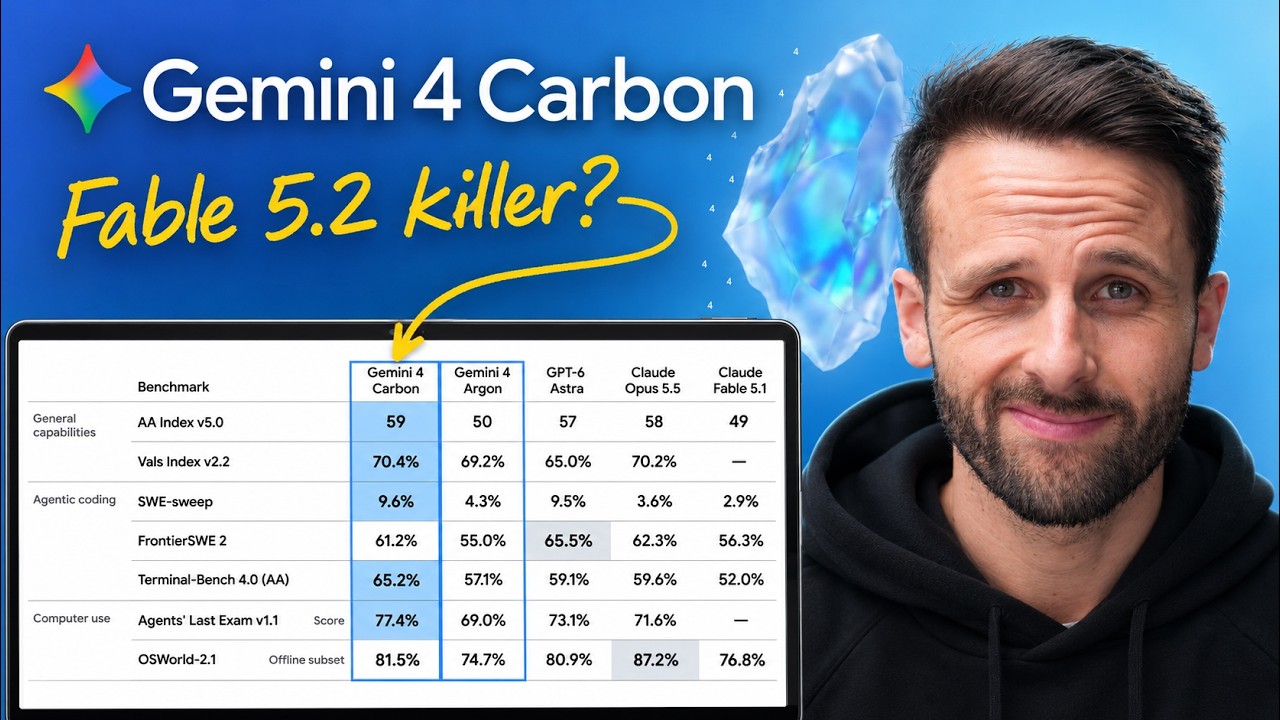
Gemini 4 Carbon: NO-HYPE Full Review (& Testing)
Title history
- Gemini 4 Carbon: NO-HYPE Full Review (& Testing) — observed on 20261112-0400 UTC (YouTube)
Keywords
Summary
154 words
Critical Evaluation
Value of the Information & Strength of the Argument
The video adds substantial value by moving beyond raw benchmarks and providing real-world stress tests that reveal practical strengths and weaknesses. The argumentation is solid: Simmons uses concrete examples, side-by-side comparisons, and transparent cost breakdowns to support his conclusions. He acknowledges the limitations of benchmark comparisons and offers pragmatic insights. However, the evaluation is inherently subjective and based on a single creator’s workflow, which may not generalize. The cost analysis is particularly instructive, highlighting the economic trade-offs between high-cost premium models and budget-friendly options.
Scientific Rigor, Source Quality, Title Accuracy
The video demonstrates reasonable scientific rigor: it clearly describes the test methodology, provides reproducible prompts (via the blog), and cites official benchmark data while critically assessing its validity. The sources are primarily Google’s blog posts and the creator’s own experiments, which are appropriate for this type of review. The title ‘NO-HYPE’ is accurate, as the creator avoids overhyping and emphasizes practical outcomes. The benchmarks are discussed with caution, and the video does not make unsupported claims. However, the reliance on a limited number of tests and the absence of independent verification of costs limit the overall rigor.
196 words
Title / Content Match
The title accurately reflects the content: it is a no-hype, practical review with actual testing.
Quality & Reliability
7/10
The review is based on three practical builds and detailed cost analysis, but relies on personal judgment and may not be representative of all use cases.
Chapters
- Intro
- Test 1: Agrumea website clone
- Agrumea rankings and costs
- Gemini 4 Carbon benchmarks and pricing
- Google's Carbon demos
- How to access Carbon
- Test 2: Motion launch film
- Launch film rankings and costs
- Test 3: 1940s dogfight flight sim
- Dogfight rankings and costs
- Final verdict
- Bonus: Carbon's Eiffel Tower build
Cited Sources
- Blog: Gemini 4 Carbon Review — Contains full prompts, live builds, and cost receipts referenced in the video.
- AI for Mortals newsletter subscription — Subscription page for weekly builds, prompts, and tips mentioned in the video description.
Contribution & Novelties
The video contributes a practical, cost-focused evaluation of Gemini 4 Carbon relative to other frontier models, highlighting real-world performance in web design, motion graphics, and game development. It also critically examines official benchmarks and reveals discrepancies, while providing detailed token and cost data for each build.
Pour aller plus loin :
- Large language model — Foundational concept for understanding AI models like Gemini 4 Carbon.
- Artificial Analysis Intelligence Index — Independent benchmark platform that the video references for comparing model intelligence; useful for checking current standings.
- Terminal-Bench — A benchmark for coding agents used in the video’s discussion of agentic tasks; see the repository for methodology details.
107 words
Radar Profile
The radar chart would likely show high scores in quantity of information and technical level, moderate scores in quality and reliability, reflecting the detailed but subjective nature of the review. The profile suggests a highly informative but somewhat opinion-based analysis, typical of expert product reviews.