BioML Seminar 5.2 - Chang Yun on Decoding the Grammar of Regulatory DNA
Title history
- BioML Seminar 5.2 - Chang Yun on Decoding the Grammar of Regulatory DNA — observed on 20261117-0328 UTC (YouTube)
Keywords
Summary
111 words
Critical Evaluation
Value of the Information & Strength of the Argument
The talk provides substantial value by presenting a comprehensive resource (ENCODE GRAMMAR) that integrates thousands of datasets, offering both predictive power and interpretability. The argumentation is solid: the speaker justifies the need for sequence-to-function models, shows concrete examples of how they overcome limitations of raw experimental data (e.g., denoising, artifact correction), and demonstrates interpretability as a means to uncover biological mechanisms. The reasoning is logical and well-supported with illustrations and comparisons to prior work.
Scientific Rigor, Source Quality, Title Accuracy
The speaker demonstrates rigorous scientific approach by referencing established projects (ENCODE) and prior lab models (BPNet, ChromBPNet), and by acknowledging equal contributions from lab members. The title accurately reflects the content, which is a detailed walkthrough of model architecture, training, and applications. The talk is grounded in known biology and computational methods, though it does not provide external references or links; however, the technical depth and coherence suggest high reliability.
159 words
Title / Content Match
The title accurately reflects the content: the talk focuses on decoding regulatory DNA grammar using sequence-to-function models.
Quality & Reliability
8/10
The talk presents original research with rigorous methodology, clear explanations of computational models, and acknowledges prior work. However, as a single seminar, it lacks peer-reviewed validation at this stage.
Key Moments
Markers derived by PSI from the transcript: the creator did not define chapters.
- Introduction and acknowledgements; overview of the talk.
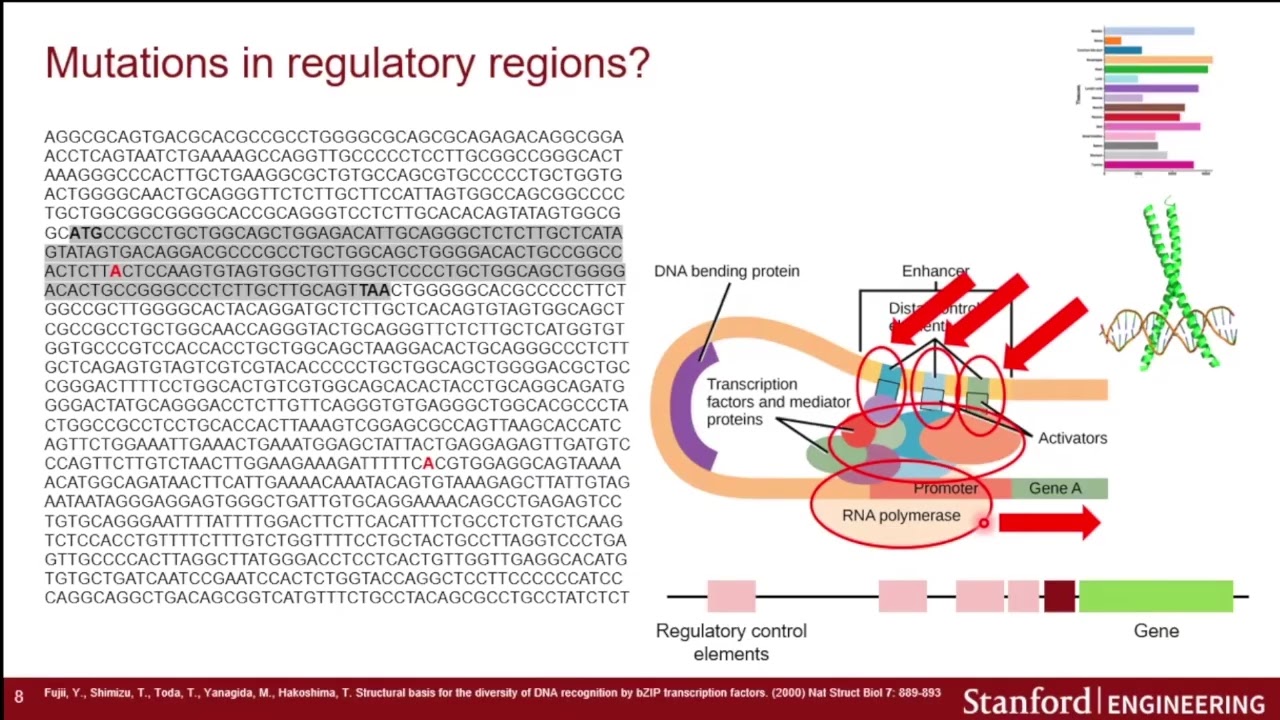
- Explanation of regulatory DNA and gene regulation, including the central dogma and cell-type specificity.
- Description of ChIP-seq and chromatin accessibility assays for mapping regulatory elements.
- Introduction to sequence-to-function models, including BPNet and ChromBPNet architectures.
- Applications: variant effect prediction, denoising experimental data, and model interpretation with DeepLIFT.
Cited Sources
- ENCODE Project — Mentioned as the source of the experimental datasets used for training ENCODE GRAMMAR.
- BPNet: Base-resolution models of transcription-factor binding reveal soft motif syntax — Prior work from the lab, used for predicting ChIP-seq data.
- DeepLIFT: Deep Learning Important FeaTures — Interpretation method used to identify important sequence features in model predictions.
Contribution & Novelties
This talk introduces ENCODE GRAMMAR, a large-scale resource combining sequence-to-function models across thousands of experiments, enabling integrative analysis of regulatory DNA. The novelty lies in the scale and the emphasis on model interpretation to extract biological rules. It builds on prior models (BPNet, ChromBPNet) but expands to multiple modalities and integrates them to decode regulatory grammar.
Pour aller plus loin :
- ENCODE Project — Provides the experimental data and resource context.
- DeepLIFT paper — Explainable AI method used for model interpretation.
- BPNet paper — Prior model for transcription factor binding prediction.
91 words
Radar Profile
The radar profile shows very high technical level and quantity of information, with slightly lower but still strong quality and reliability. This indicates a dense, expert-level presentation with substantial content but occasional reliance on the speaker's own claims without external validation.