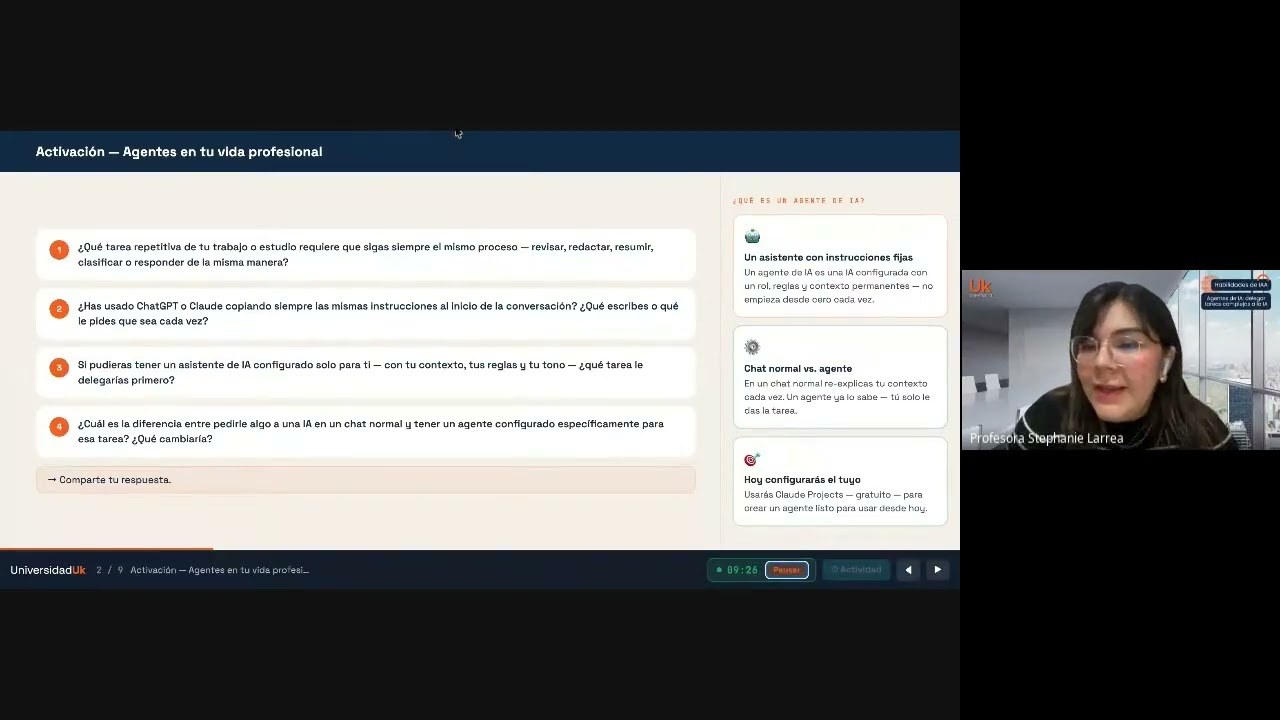
Agentes de IA: delegar tareas complejas a la IA
AI Agents: delegating complex tasks to AI
Keywords
Summary
190 words
Critical Evaluation
Value of the Information & Strength of the Argument
The video offers practical value by presenting a clear, reusable framework for anyone wanting to create specialized AI agents without programming skills. The instructor’s argumentation is coherent and grounded in relatable examples from students, such as automating quotation generation or summarizing academic readings. She effectively contrasts repeated prompt-writing in standard chats with the convenience of pre-configured agents, supported by student testimonies that highlight time savings and consistency. However, the session lacks deep technical detail—no actual demonstration of how to set up an agent in Claude or other tools is shown, and the discussion remains at a conceptual level. The instructor also notes that agents cannot directly connect to external systems (like email or WhatsApp) in this session, limiting the scope. Despite this, the argumentation is persuasive for a beginner audience and promotes critical thinking about when automation is appropriate.
Scientific Rigor, Source Quality, Title Accuracy
Scientifically, the video does not cite formal sources, research papers, or external references. The information is based on the instructor’s experience and student anecdotes, which is acceptable for a tutorial but weak for rigorous academic content. The title accurately reflects the session’s focus on AI agents for complex task delegation, matching the narrative. However, no comprehensive sources are mentioned except the tools themselves (Make, API, Claude, Gemini, NotebookLM), which are not cited with URLs. The instructor’s explanations align with common knowledge about prompt engineering and AI agent design, but they lack citation to authoritative documentation. The lack of sources reduces the scientific rigor, though the practical orientation partially compensates. The title/content alignment is strong, so this does not affect the score significantly.
276 words
Title / Content Match
The title accurately reflects the content: the session focuses on delegating complex tasks to AI through the configuration of dedicated agents, rather than simple automation.
Quality & Reliability
7/10
The video provides a structured pedagogical approach to designing AI agents, with clear definitions and practical examples from student experiences. However, it relies mostly on anecdotal evidence and lacks rigorous scientific citations or verifiable sources, limiting its academic reliability.
Key Moments
Markers derived by PSI from the transcript: the creator did not define chapters.
- Introduction and recap of previous session on automation with Make and APIs.
- Student Reina clarifies course confusion; instructor confirms the session is part of the AI skills course.
- Discussion of repetitive tasks: student Otazo describes generating quotations for his software business.
- Nestor asks about automating topographical survey quotations; instructor suggests using a configured agent.
- Casandra shares her habit of asking Claude to summarize lectures every week; instructor encourages creating an agent.
- Samuel describes his existing agents for photography and market analysis using NotebookLM and other tools.
- Instructor explains the four components of an agent: role, instructions, context, and output.
- Discussion on differences between standard chats and configured agents, emphasizing memory and MCP connections.
- Instructor elaborates on weak vs. strong role definitions and the importance of specific instructions.
- Wrap-up: students are encouraged to design their own agents; examples of output formats are given.
Cited Sources
- Make (automation platform) — Mentioned as the tool used in the previous session for task automation.
- Claude Projects — Intended for the practical part of the session to configure agents.
- Gemini Gems — Compared to Claude Projects for agent configuration.
- NotebookLM — Referenced by a student as a tool for studying with AI.
Contribution & Novelties
The video contributes a practical, pedagogical framework for designing AI agents without code, emphasizing the separation of role, instructions, context, and output. This framework helps users move from repetitive prompt writing to reusable configurations, which is a valuable skill in the context of increasing AI adoption. The instructor also highlights the limitations of standard chats (limited memory, inconsistency) and the advantages of dedicated agents, supported by student experiences. While not original research, the session offers a structured approach that can be directly applied by professionals and students.
Pour aller plus loin :
- Claude Projects documentation — Useful for understanding how to implement the described agent framework in practice.
- Prompt engineering guide — Provides detailed techniques for writing effective instructions, complementing the video’s advice.
- AI agents: a survey by IBM — Explores the broader concept of AI agents and their architectural variations.
- Model Context Protocol (MCP) — Reference for how agents can connect to external systems, mentioned in the video.
159 words
Radar Profile
The profile shows moderate scores across all dimensions, with slightly higher quality and reliability than technical level. This reflects a non-technical, practice-oriented tutorial that provides valuable conceptual insights but lacks deep technical detail.