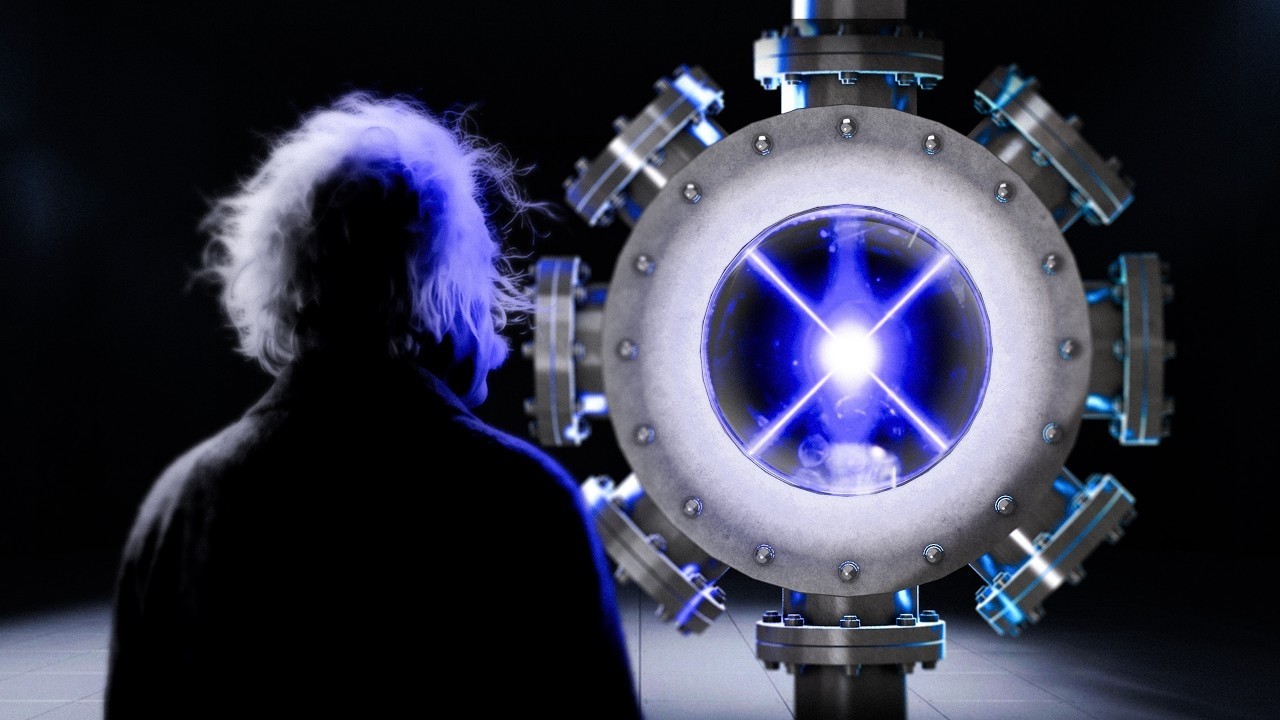
Ningún Dispositivo Podía Demostrar Que Einstein Estaba Equivocado... Hasta Ahora
No Device Could Prove Einstein Wrong... Until Now
Title history
- Ningún Dispositivo Podía Demostrar Que Einstein Estaba Equivocado... Hasta Ahora — observed on 20261117-0330 UTC (YouTube)
Keywords
Summary
154 words
Critical Evaluation
Value of the Information & Strength of the Argument
The video successfully conveys the immense precision of modern atomic clocks and the experimental challenges of comparing them at different altitudes. It provides a clear, step-by-step explanation of the physics, including laser cooling, optical lattices, and frequency combs. The argumentation is solid, grounded in real experiments and expert testimony. The narrative builds logically from the fundamental question to the technical solutions, making complex topics accessible without oversimplifying. The inclusion of both successful and partial results (e.g., the helicopter link only achieving brief connections) adds honesty and scientific rigor.
Scientific Rigor, Source Quality, Title Accuracy
The scientific rigor is high, with input from NIST researchers and university scientists. The description list provides numerous references, including a dedicated references page. The title is provocative but accurate: the video does investigate whether Einstein’s theory might fail, while careful to note that no definitive contradiction has been found yet. The content respects the current state of knowledge and does not overclaim.
166 words
Title / Content Match
The provocative title matches the content, which investigates whether Einstein's relativity could be challenged by ultra-precise atomic clock experiments.
Quality & Reliability
10/10
The video relies on top-tier scientific institutions (NIST, universities) and presents real experiments on location, with expert interviews. Detailed references are provided in the description.
Chapters
- ¿Obedece la gravedad las reglas de la mecánica cuántica?
- ¿Cómo funciona un reloj atómico?
- Por qué los relojes atómicos ópticos son tan precisos
- Cómo usar láseres para enfriar átomos
- Subiendo un reloj atómico a una montaña
- Conectando relojes atómicos a lo largo de 80 kilómetros
- Volando un reloj atómico en un helicóptero
- ¿Cómo se mide la frecuencia de la luz?
- Peines de frecuencias ópticas
- ¿Sigue teniendo razón Einstein?
Cited Sources
- NIST Time and Frequency Division — U.S. national standards institute providing expertise on atomic timekeeping.
- Veritasium Atomic Clock References — List of scientific references for the video.
- Adelaide University Precision Measurement Group — Provided portable atomic clocks for the UWA helicopter test.
- MIT Open Access Course — Free educational lectures related to the topic.
- Optical Dipole Trap information — Background on optical dipole traps used in the atomic clocks.
- Veritasium Newsletter — Sign-up for science news.
- Veritasium Patreon — Support channel and get early access.
- Elements of Truth (Kickstarter) — Pre-order for commercial edition of the game.
Concurring Sources
- Gravitational time dilation — Corroborates the predicted time difference measured in the video.
- NIST reference page — Comprehensive list of sources used by the video.
Contribution & Novelties
The video provides an inside look at cutting-edge atomic clock research, including a first-ever comparison of optical clocks across a 2.7 km vertical separation and a proof-of-concept helicopter-based optical link. It clarifies how optical frequency combs enable measurement of ultra-high-frequency signals. This contributes to public understanding of the intersection of general relativity and quantum mechanics.
For further reading:
- General relativity — Foundational theory explaining gravitational time dilation.
- Atomic clock — Detailed mechanism of these precision instruments.
- Optical lattice — The technique used to trap atoms for measurement.
87 words
Radar Profile
The scores are uniformly high, indicating a video that is both informative and technically strong, with excellent reliability. The balance between quantity, quality, technical depth, and trustworthiness makes it a standout educational resource.
💬 Très positif. Sur les 30 commentaires analysés, la majorité exprime une admiration enthousiaste pour la qualité du contenu et pose des questions scientifiques approfondies.