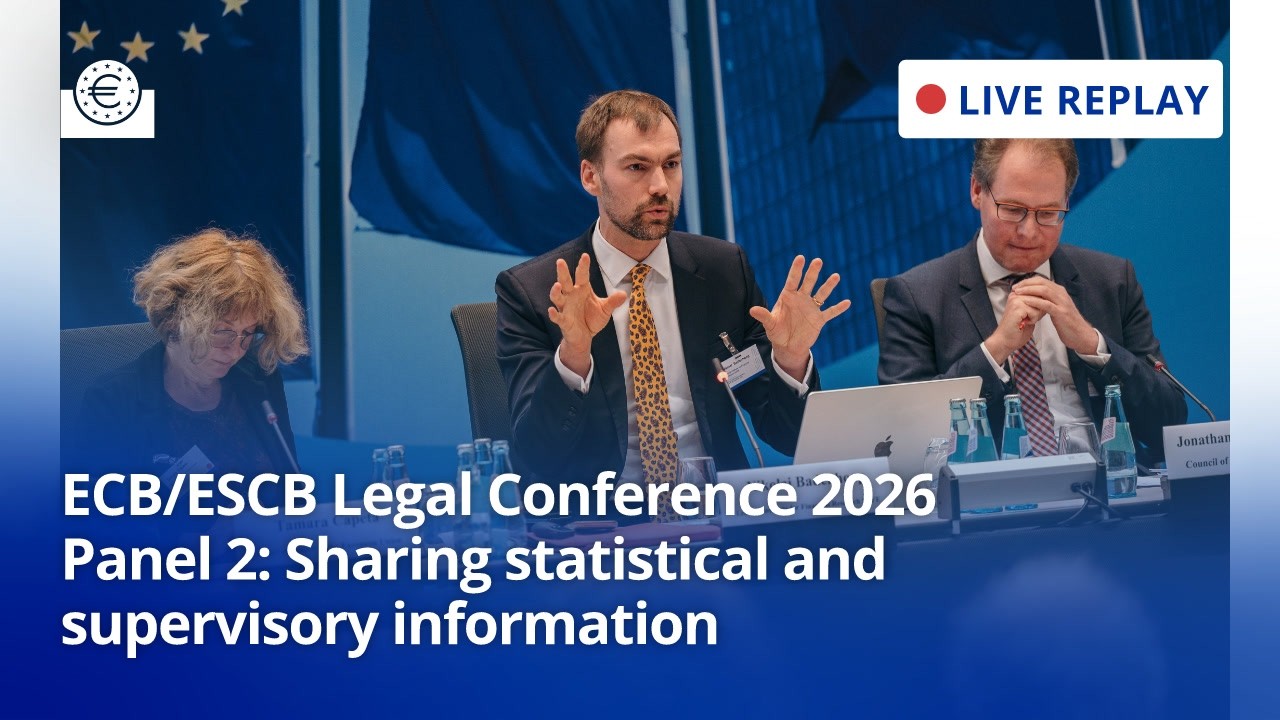
20261001 ECB Legal Conference Panel 2: Sharing statistical and supervisory information
Keywords
Summary
176 words
Critical Evaluation
Value of the Information & Strength of the Argument
The presentations provide a high-level, nuanced analysis of the legal frameworks governing information exchange in the EU banking and statistical sectors. The value lies in the expert synthesis of multiple regulations and case law, and the articulation of underlying principles such as trust, effectiveness, and confidentiality. The argumentation is well-structured, with clear definitions and examples, and draws on both academic and institutional perspectives. The speakers critically assess existing mechanisms and propose forward-looking principles, particularly regarding the use of AI and the once-only principle. The debate between different, yet complementary, viewpoints enriches the discussion. However, the analysis is inherently institutional and legal, lacking empirical data or comparative case studies, which limits its applicability beyond the EU context.
Scientific Rigor, Source Quality, Title Accuracy
The video is an official ECB conference recording, ensuring a high level of institutional rigor. The speakers mention key legal instruments such as Council Regulations 2533/1998 and 223/2009, the SSM Regulation, and CRD, and refer to relevant CJEU case law, including Baumeister and Unnim Banc. The title accurately describes the panel’s scope. The lack of formal citations with URLs is compensated by the institutional nature of the source and the speakers’ affiliations. The content is authoritative and suitable for a specialized audience, though the incomplete transcript and absence of audience interaction limit a complete evaluation.
226 words
Title / Content Match
The title accurately reflects the panel's focus on sharing statistical and supervisory information, as confirmed by the presentations.
Quality & Reliability
8/10
The content is produced by the European Central Bank and features legal scholars with specialized expertise; however, the provided transcript is incomplete, and the video has negligible viewer engagement.
Key Moments
Markers derived by PSI from the transcript: the creator did not define chapters.
- The chair introduces the panelists and the theme of sharing statistical and supervisory information.
- Nikolai Badenhoop begins his presentation on the principles underlying information exchange, focusing on effectiveness, trust, and confidentiality.
- Badenhoop discusses the definitions of confidential statistical and supervisory information, referencing the CJEU's case law in Baumeister and Unnim Banc.
- Jonathan Bauerschmidt starts his talk on supervisory information in complex administrative procedures, using the Single Resolution Mechanism as a case study.
- Bauerschmidt elaborates on professional secrecy and cooperation as key principles for an information network.
Cited Sources
- Council Regulation 2533/1998 on the collection of statistical information — Mentioned by Badenhoop as the legal basis for statistical information collection, recently reformed and applicable as of March 2026.
- Regulation 223/2009 on European statistics — Referenced as part of the statistical legal framework reforms leading to new methods of information sharing.
- Directive 2013/36/EU (CRD IV) — Cited as the legal basis for confidential supervisory information and professional secrecy obligations.
Contribution & Novelties
The panel provides a rare, cross-sectional analysis of statistical and supervisory information sharing within the EU’s financial governance framework. It bridges two usually separate policy areas and identifies common principles such as trust, effectiveness, and confidentiality, while highlighting tensions and the impact of digitalisation and AI. The discussion also explores the institutional design of a European supervisory data space, proposing principles for such a network. The originality lies in synthesising legal instruments and case law to offer operational guidance for policymakers.
Pour aller plus loin :
- Single Supervisory Mechanism — Central to the discussion on supervisory information sharing within the SSM.
- Single Resolution Mechanism — Exemplifies complex administrative procedures and information flows in banking resolution.
- European Statistical System — Relevant for the statistical information sharing and its legal framework.
129 words
Radar Profile
The radar profile shows a high level of technical expertise and information quality, with moderate scores on quantity due to the incomplete transcript and communication effectiveness. The overall strong performance in rigour and fiabilité is balanced by lower public engagement.