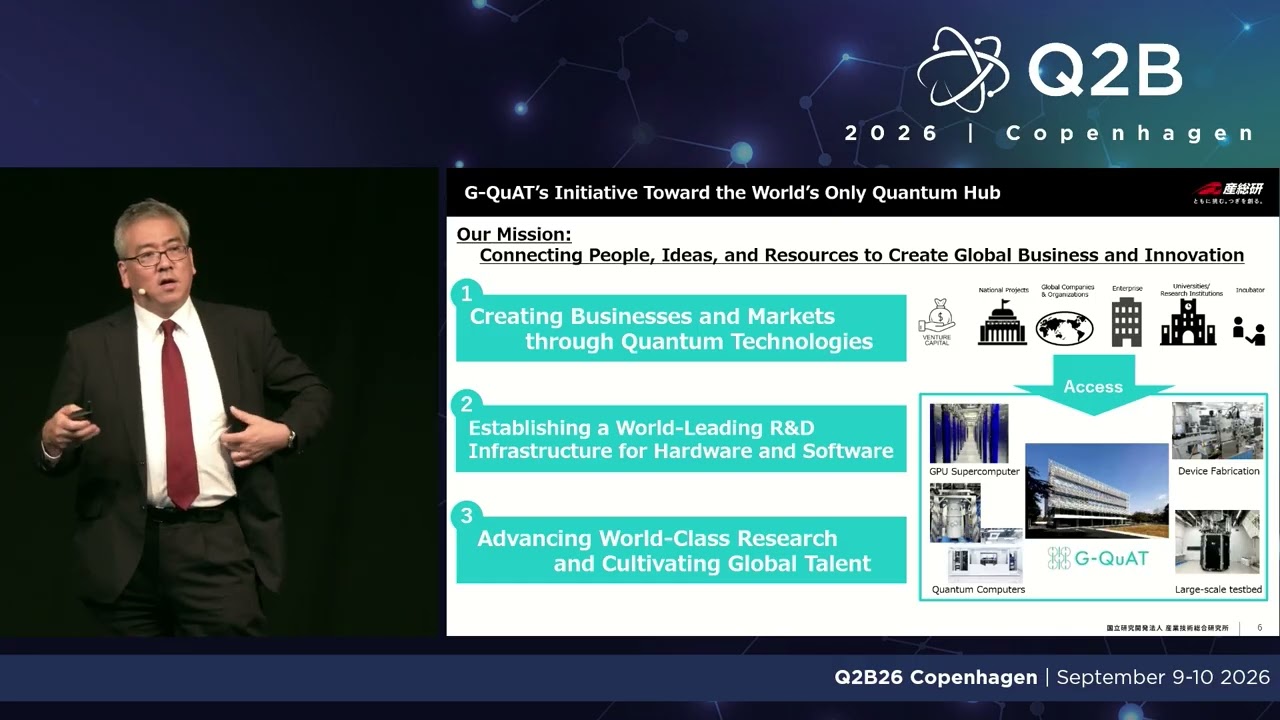
Q2B26 Copenhagen | Masahiro Horibe, Deputy Director, AIST/G-QuAT
Keywords
Summary
193 words
Critical Evaluation
Value of the Information & Strength of the Argument
The value lies in the firsthand, current information about a national quantum computing initiative, including concrete details about infrastructure (ABCI-Q, 2,000+ H100s) and international standardization efforts. The argumentation is well structured, moving from market analysis to technical architecture and future roadmap. However, it remains an institutional pitch with little independent critical assessment; claims about market size and technological progress are taken from a single consultancy report without cross-verification. The speaker’s authority and access to internal data give weight to the factual statements, but the presentation is descriptive rather than analytical.
Scientific Rigor, Source Quality, Title Accuracy
The speaker is a credible expert with direct involvement in the described projects. The main source explicitly cited is a McKinsey report (not detailed), and the official Q2B site is listed. The talk lacks peer-reviewed references and relies on institutional data. The title accurately reflects the content; the content is a professional update rather than a rigorous scientific study. The inclusion of specific hardware details (e.g., Nvidia H100, TOP500 ranking) adds credibility, but no external independent sources are provided. The presentation’s coherence and the speaker’s role partially compensate for the lack of formal citations.
199 words
Title / Content Match
Titre and content match well; it is a talk by Masahiro Horibe at Q2B26 Copenhagen, focused on the quantum-HPC computing ecosystem.
Quality & Reliability
7/10
Presentation by a recognized expert from AIST/G-QuAT, providing firsthand information about ongoing quantum-HPC projects and standardization efforts. However, it remains an institutional overview rather than peer-reviewed research, and the cited McKinsey report is not referenced with details.
Key Moments
Markers derived by PSI from the transcript: the creator did not define chapters.
- Introduction: concept of hybrid quantum-HPC computing ecosystem
- Market context: McKinsey report shows growing quantum business value
- Technical roadmap: from 1999 superconducting qubit to thousand-qubit systems
- G-QuAT history: funding and establishment of infrastructure
- G-QuAT four functions: software, ABCI-Q, Qubit testbed, and fabrication facility
- ABCI-Q details: 2,000+ Nvidia H100 GPUs, linked to quantum simulators and commercial computers
- Future plans: scaling to 10,000 logical qubits, developing components and standards
- Standardization activities: participation in ISO/JTC3 and collaboration with Europe, then conclusion
Cited Sources
- Q2B Conference Website — The event page for Q2B26 Copenhagen, where this talk was given.
Concurring Sources
- Q2B Conference Website — The official event page supporting the presentation's context.
Contribution & Novelties
The presentation offers an insider’s perspective on Japan’s national quantum-HPC initiative, providing concrete details about the ABCI-Q supercomputer and G-QuAT’s infrastructure. It highlights the shift from research to commercialization and the importance of standardization in benchmarking. This is valuable for professionals tracking quantum computing ecosystem developments, though it does not present new scientific results.
Pour aller plus loin :
- Quantum computing on Wikipedia — Provides a broad overview of the field, useful for context.
- TOP500 Supercomputer List — Benchmark list where ABCI-Q is ranked; relevant for understanding HPC performance.
- ISO/IEC JTC3 (Quantum Computing Standardization) — The committee mentioned in the talk for quantum standardization (URL uncertain, so cited without a direct link).
112 words
Radar Profile
The radar profile shows a high score in technical level (8) and moderate scores in quantity and global reliability (both 7), with quality at 6. This indicates a technical talk with substantial specific information, but limited depth in critical analysis or formal citations.