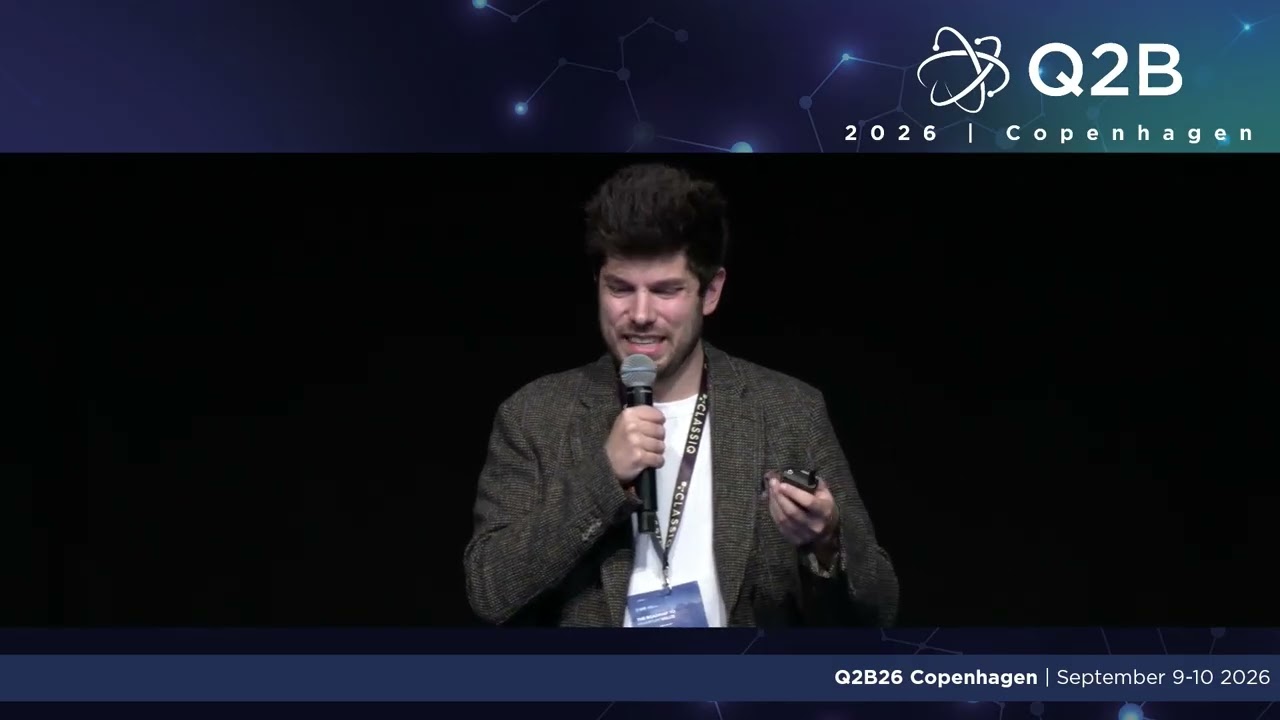
Q2B26 Copenhagen | Gian Luca Anselmetti, Quantum Computing Scientist, Boehringer-Ingelheim
Keywords
Summary
178 words
Critical Evaluation
Value of the Information & Strength of the Argument
The talk provides substantial value by presenting concrete resource estimates and algorithmic improvements from an industrial perspective, which is often scarce. Anselmetti argues convincingly that fault tolerance is necessary to surpass classical methods, and he supports this with detailed numbers and comparisons to classical techniques like coupled cluster. His argumentation is logical and well-structured, moving from the general drug design funnel to specific quantum chemistry methods and then to practical resource estimates. He acknowledges the limitations and open questions, which strengthens his credibility. The discussion on runtime reduction via Hamiltonian compression and compilation tricks is particularly insightful, offering a realistic view of what is achievable.
Scientific Rigor, Source Quality, Title Accuracy
The scientific rigor is high, as the talk is based on peer-reviewed work, including collaborations with Google and PsiQuantum, and references publications in reputable journals like Nature Physics. The speaker is transparent about the limitations and the tentative nature of the projections. The title accurately reflects the content, being a specific progress report. However, the talk relies primarily on the speaker’s own expertise and internal work; no external sources are cited beyond the conference website. The description provides a link to the Q2B conference, but no direct links to the mentioned papers are given, which is a minor weakness for verification.
221 words
Title / Content Match
The title accurately reflects the content: a talk about progress in quantum computing for drug design by a scientist from Boehringer-Ingelheim.
Quality & Reliability
8/10
Expert from a leading pharmaceutical company with peer-reviewed research, talk includes concrete technical details and references to publications, but no external verification within the talk itself.
Key Moments
Markers derived by PSI from the transcript: the creator did not define chapters.
- Introduction: speaker background and Boehringer-Ingelheim's quantum computing team.
- Overview of quantum computers and their potential for solving the Schrödinger equation in drug design.
- Drug design challenges: chemical space, target binding, and the need for accurate simulations.
- Trade-off between accuracy and system size, with quantum computers targeting high-accuracy methods like coupled cluster.
- Case study on cytochrome P450: resource estimation, 1000 logical qubits, and 3-day runtime.
- Algorithmic improvements with PsiQuantum: Hamiltonian encoding and compilation tricks reduce runtime to 2 hours.
- Projection of progress and comparison with recent Google results, highlighting the need for 1-2 orders of magnitude improvement.
- Open questions: whether drug chemistry is hard enough for quantum advantage and the need for more advanced algorithms.
Cited Sources
- Q2B Conference — Conference website where the talk was presented, providing context for the venue and event.
Contribution & Novelties
The talk presents original industrial insights into the resource requirements for quantum computing in drug design, notably the reduction of runtime for simulating cytochrome P450 from three days to two hours through algorithmic and compilation improvements. This is a significant contribution to the field’s understanding of practical scalability. Anselmetti also raises the critical question of whether current drug molecules are sufficiently hard for quantum computers to outperform classical methods, which is a key research direction.
Pour aller plus loin :
- Quantum computing — Overview of quantum computing principles, including qubits and superposition.
- Quantum chemistry — The field focused on applying quantum mechanics to chemical systems, central to the talk.
- Cytochrome P450 — The enzyme family discussed, important in drug metabolism.
- Fault-tolerant quantum computer — Concepts behind error correction and fault tolerance, essential for the speaker’s arguments.
136 words
Radar Profile
The scores indicate a technically deep and information-rich presentation, with very high technical level and moderate reliability due to lack of external citations. The balanced scores across quantity and quality suggest a dense but credible talk, though the narrow focus may limit general applicability.