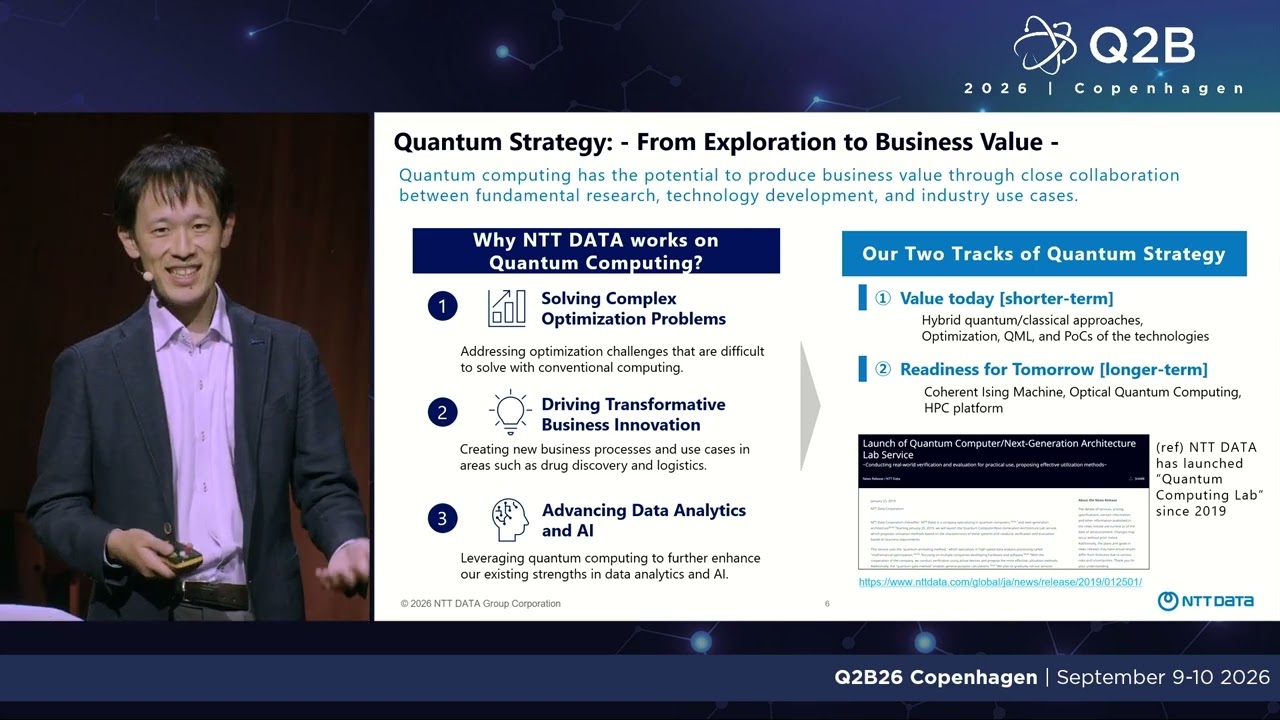
Q2B26 Copenhagen | Mikiya Tanizawa, Senior Expert, NTT DATA Group Corporation
Keywords
Summary
204 words
Critical Evaluation
Value of the Information & Strength of the Argument
The talk provides a clear and structured framework for how a large IT services company navigates the quantum computing landscape. It argues convincingly for a pragmatic, business-first approach, avoiding hype and focusing on measurable value. The case studies illustrate concrete lessons, such as the value of quantum-enhanced features in classical ML pipelines and the necessity of system integration for quantum hardware to be effective. The argumentation is solid, though it remains at a high level without deep technical details. The emphasis on partnerships and ecosystem building is realistic, and the distinction between short-term and long-term strategies is well-articulated.
Scientific Rigor, Source Quality, Title Accuracy
The presentation does not cite external scientific sources; instead, it relies on NTT DATA’s own research and partnerships. The only link provided is the Q2B conference site, which does not offer supplementary materials. The speaker’s credibility is high given his senior expert role, but the content is inherently promotional. The title matches the content accurately, and the talk is well-organized. However, the lack of independent references limits scientific rigor. The audience reaction cannot be inferred as no comments were provided, but the low view count suggests limited public engagement.
202 words
Title / Content Match
The title accurately reflects the content: a presentation by Mikiya Tanizawa at Q2B26 Copenhagen about NTT DATA's quantum computing innovation strategy.
Quality & Reliability
7/10
The speaker is a senior expert at NTT DATA, and the talk is a corporate presentation, which introduces potential bias but also provides insider perspective on quantum computing adoption strategies. The content is based on real projects and partnerships, though details are limited.
Key Moments
Markers derived by PSI from the transcript: the creator did not define chapters.
- Introduction: Mikiya Tanizawa introduces the talk's objectives and main message.
- Overview of NTT and NTT DATA: research foundation and global IT business.
- Innovation centers as bridges between technology and business.
- Three opportunities for quantum computing in business.
- Dual-track strategy: short-term hybrid and long-term optical quantum.
- Case study 1: Predictive maintenance in mining with DQFM.
- Case study 2: Production planning in chemical industry with CIM.
- Case study 3: Material discovery for CO2 capture and future quantum role.
- Conclusion: Three key messages and call to collaboration.
Cited Sources
- Q2B Conference — Conference where the talk was given; may provide additional context but no specific external references.
Contribution & Novelties
The presentation offers insight into how a major IT company structures its quantum computing strategy, emphasizing the integration of long-term research with system integration capabilities. The distinction between short-term value creation and long-term preparation is a practical model. The case studies provide real-world examples of quantum techniques applied to business problems, highlighting the importance of benchmarking against classical methods. The principle ‘quantum where it adds value, classical where it is strongest’ is a succinct guide for practitioners.
Pour aller plus loin :
- Quantum computing - Wikipedia — Overview of quantum computing principles and status.
- Coherent Ising machine - Wikipedia — Description of the technology used in one case study.
- Quantum machine learning - Wikipedia — Relevance to the DQFM approach and quantum-enhanced features.
- Quantum-inspired optimization — Explains the classical heuristics derived from quantum concepts.
134 words
Radar Profile
The radar profile indicates a moderate score across all dimensions, with slightly higher values in information quantity and reliability, reflecting a well-structured but non-detailed corporate presentation. The low technical level suggests accessibility to a broad audience, while the moderate quality score indicates that the content is insightful but lacks independent validation.