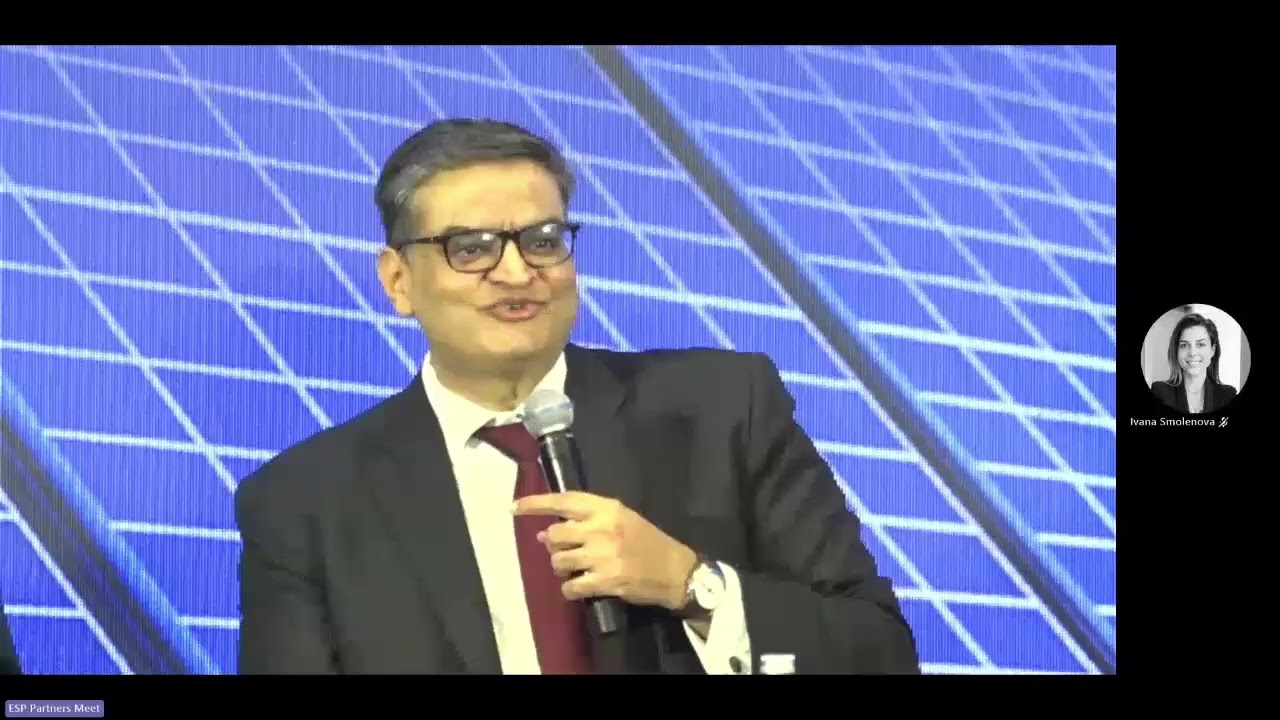
ESP Forum Day 1: Opening Remarks
Title history
- ESP Forum Day 1: Opening Remarks — observed on 20261119-1754 UTC (YouTube)
Keywords
Summary
212 words
Critical Evaluation
Value of the Information & Strength of the Argument
The video provides substantial value by presenting up-to-date statistics and concrete examples from various countries, illustrating the progress and challenges in energy storage deployment. The speakers argue convincingly that storage is the missing link for renewable integration, supported by data points such as India’s 171 GW solar capacity and the 20-fold increase in battery storage within months. The argumentation is cohesive, linking policy, finance, and technology, and emphasizes the importance of knowledge transfer across the global south. The panelists’ authority—senior experts from major international organizations—strengthens the credibility of the claims. The presentation by Vunsi Rakutun-Raman adds a structured overview of the World Bank’s approach, with clear lessons learned, making the content actionable for other regions.
Scientific Rigor, Source Quality, Title Accuracy
The content demonstrates high scientific and institutional rigor. All speakers represent reputable organizations (World Bank, ISA, Enerjiva) and cite specific, verifiable data (e.g., tender results, capacity figures). However, no external sources or URLs are provided in the description, so the reliance is primarily on the speakers’ expertise and the event context. The title ‘ESP Forum Day 1: Opening Remarks’ is perfectly aligned with the content, accurately reflecting the nature of the video. There is no discernible bias, and the discussions appear factual and balanced, offering both successes and challenges (e.g., the gap between announced manufacturing capacity and actual installation in India).
231 words
Title / Content Match
The title accurately describes the content as opening remarks of the ESP Forum Day 1.
Quality & Reliability
8/10
The content is from official organizational remarks by senior experts from World Bank, International Solar Alliance, and Enerjiva Ventures, with concrete data and references to ongoing projects. The information is reliable and lacks evident bias.
Key Moments
Markers derived by PSI from the transcript: the creator did not define chapters.
- Xiaoping Wang welcomes participants and introduces the forum's purpose and agenda.
- Ashish Khanna discusses solar growth, transmission constraints, and the need for storage, citing Mauritius and Sri Lanka examples.
- Dr. Sachin Kumar highlights India's renewable scaling and outlines three priorities for scaling storage: economics, closing gaps, and identifying value.
- Chandra Shekhar Guvindarajuru addresses energy security for small island states and the importance of customization for grid integration.
- Vunsi Rakutun-Raman presents the World Bank's energy storage program, including lessons learned and regulatory measures.
Contribution & Novelties
The video contributes original insights from senior leaders in the energy sector, offering a high-level yet data-driven overview of the current state of energy storage deployment and policy. It underscores emerging trends such as the rapid growth of distributed renewable generation and the financial burdens on small island states. The inclusion of the World Bank’s operational perspective adds a pragmatic dimension, presenting six lessons learned and four regulatory measures that are directly applicable to developing countries.
Pour aller plus loin :
- Energy storage — Provides a comprehensive overview of storage technologies and applications.
- Battery energy storage system — Details on the most common type of storage system discussed.
- International Solar Alliance — Background on one of the co-organizing organizations.
- Variable renewable energy integration — Explains the challenges and solutions for integrating renewables like solar into the grid.
137 words
Radar Profile
The radar profile shows strong scores in information quantity, quality, and reliability (8 each), with a slightly lower technical depth (6). This indicates a content-rich and trustworthy video that, while not overly technical, provides substantial and accurate information suitable for a broad professional audience.