Academy Training Day 3: System Integration
Title history
- Academy Training Day 3: System Integration — observed on 20261119-1958 UTC (YouTube)
Keywords
Summary
176 words
Critical Evaluation
Value of the Information & Strength of the Argument
The value lies in the practical, practitioner-oriented insights drawn from EPRI’s collaborative research with numerous utilities. The argumentation is solid, grounded in real system experiences and recognized phenomena like the Iberian blackout. The speaker explains complex concepts such as inertia, rate of change of frequency, and inverter controls in a accessible yet technical manner, using examples and charts to illustrate how battery storage can mitigate challenges. The argumentation is logical: storage provides fast injection and reduces inertia needs, but requires careful control and modeling to avoid oscillations. The Q&A adds value by tailoring advice to specific use cases, such as load flow studies for peak shifting. The overall reasoning is coherent and supports the thesis that while storage brings benefits, successful integration hinges on understanding its dynamic behavior and performing appropriate studies.
Scientific Rigor, Source Quality, Title Accuracy
The speaker relies on EPRI’s extensive research and industry collaboration, but no specific studies or publications are cited. The content is based on expert experience and common industry knowledge, which is generally reliable given EPRI’s stature. The title accurately reflects the content, as the session covers system integration comprehensively. The lack of formal citations is offset by the practical, well-substantiated claims. The presentation is of high technical rigor, discussing dynamics, control interactions, and simulation methodologies. The adequacy between title and content is strong. No comments are provided for analysis.
236 words
Title / Content Match
The title accurately reflects the content, which focuses on integrating battery storage and inverter-based resources into power systems, as part of a training academy day.
Quality & Reliability
7/10
The presentation is based on EPRI's extensive research and industry collaboration, with practical examples and recognized challenges. However, it lacks formal citations or references, and relies on the speaker's professional experience.
Key Moments
Markers derived by PSI from the transcript: the creator did not define chapters.
- Introduction of EPRI and the purpose of the presentation.
- Q&A about EPRI's tools and integrated resource planning services.
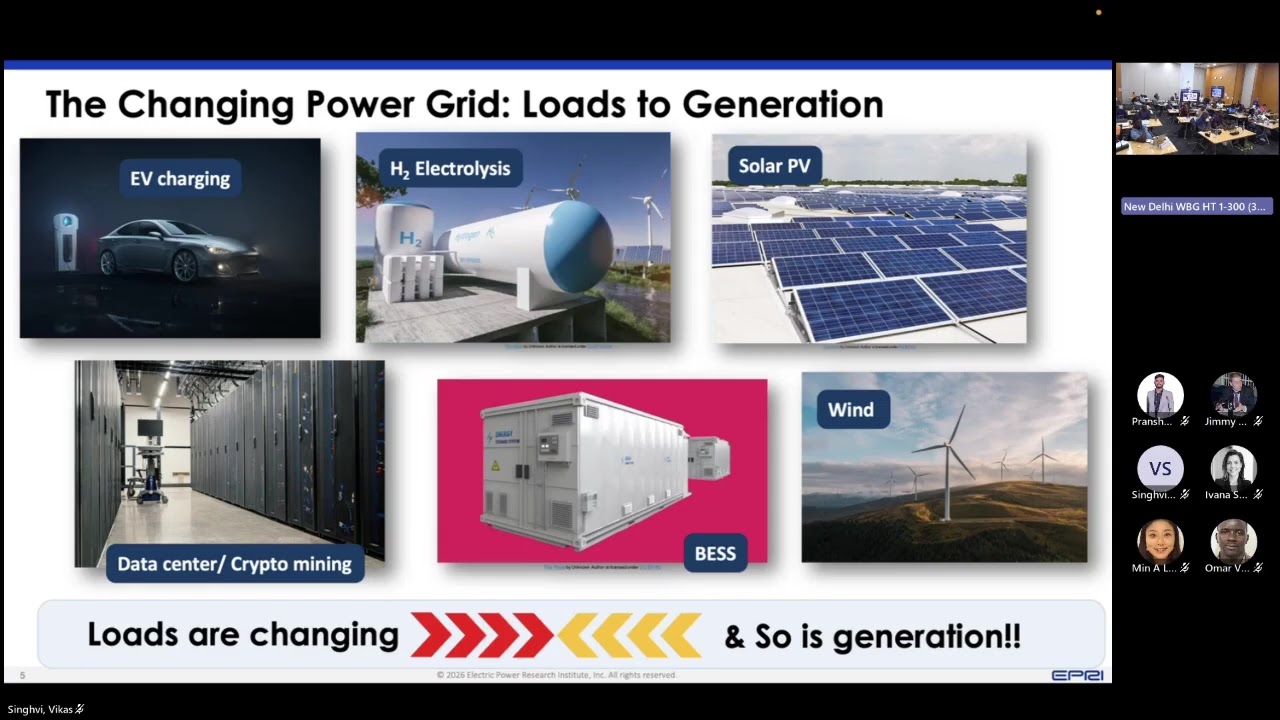
- Discussion on changing grid landscape and growth of battery storage.
- Explanation of inertia, frequency stability, and how battery storage provides fast frequency response.
- Challenges of inverter-based resources: oscillations and weak grid issues.
- Q&A on studies required for battery integration, focusing on developing countries.
Contribution & Novelties
This presentation provides a clear, structured overview of system integration for battery storage, emphasizing practical aspects often missing from academic treatments. It synthesizes EPRI’s collaborative research into accessible insights, highlighting the trade-offs between fast response and oscillatory risks, and the necessity of appropriate simulation studies. The Q&A adds value by addressing real-world planning needs.
Pour aller plus loin :
- Grid energy storage — For general concepts of storage in power systems.
- Inertia (power systems) — Detailed explanation of inertia and its role in frequency stability.
- Rate of change of frequency — Key metric discussed in the presentation.
- Iberian blackout — Event referenced as an example of oscillation-induced instability.
108 words
Radar Profile
The radar profile shows high values for technical level and quality, reflecting the advanced and reliable content. Quantity is also strong. Reliability is high due to EPRI's expertise. Overall, the profile indicates a technically dense, reliable training session.