Noche y día en el Templo Mayor de Tenochtitlan Leonardo López Luján
Night and day in the Templo Mayor of Tenochtitlan Leonardo López Luján
Keywords
Summary
265 words
Critical Evaluation
Value of the Information & Strength of the Argument
The value lies in the multi-layered approach combining textual, iconographic, and archaeological evidence. López Luján does not merely repeat existing theories; he presents new data from his excavations, such as the sculptures and mural paintings from Stage 4A, which materially support the hypothesis that the Templo Mayor was an architectural evocation of Coatepec. The argumentation is systematic: he first establishes the myth through primary sources, then analyzes its symbolic meaning, and finally demonstrates how the built environment embodied that meaning. He carefully distinguishes between established facts (the discovery of the Coyolxauhqui monolith) and plausible interpretations (the exact function of certain sculptures), maintaining scholarly prudence. However, some counterarguments could be raised regarding the speculative nature of correlating specific architectural features with mythological elements, but the presenter acknowledges these as hypotheses well-grounded in comparative evidence.
Scientific Rigor, Source Quality, Title Accuracy
The scientific rigor is exemplary, drawing on both codices and original archaeological contexts. López Luján demonstrates mastery of the sources, including the Florentine Codex, which he reads in Nahuatl, and indicates when he provides new translations. He cites the views of established scholars like Seler, Matos Moctezuma, and López Austin, but also offers his own contributions. The title ‘Night and Day’ fittingly reflects the solar/lunar dichotomy central to the myth, and the lecture thoroughly addresses this duality in architecture and ritual. The only minor weakness is that the lecture format does not allow for critical interrogation of some hypotheses, which is common in such presentations.
253 words
Title / Content Match
The title 'Night and Day' aptly captures the solar/lunar symbolism central to the Huitzilopochtli myth and its material counterpart at the Templo Mayor; the content directly addresses this duality.
Quality & Reliability
9/10
The presentation is given by a highly respected archaeologist and director of the Templo Mayor Project, drawing on primary sources (Florentine Codex, Historia de los mexicanos por sus pinturas) and original archaeological excavations. The argumentation is rigorous and well referenced, with clear distinctions between confirmed data and hypotheses.
Key Moments
Markers derived by PSI from the transcript: the creator did not define chapters.
- Introduction by Patricia Ledesma, presenting Leonardo López Luján's credentials.
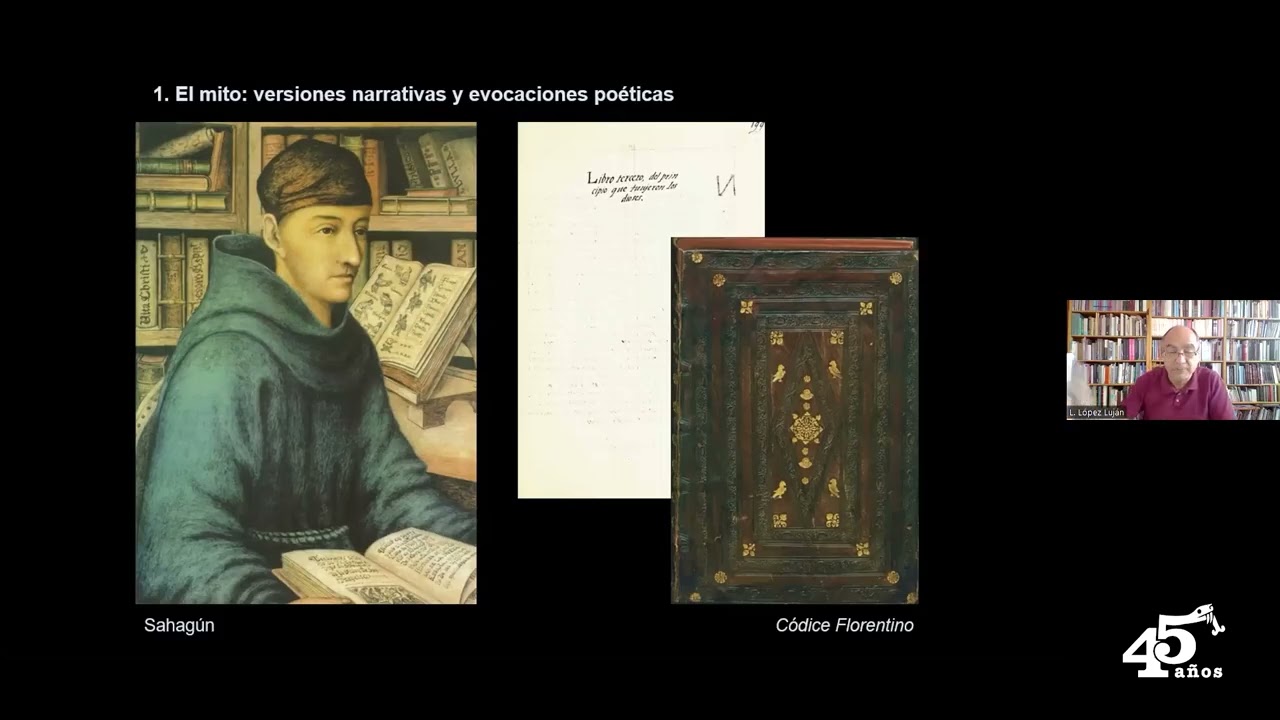
- Reading the myth of Huitzilopochtli's birth from the Florentine Codex, with detailed description of Coatlicue and Coyolxauhqui.
- Comparison with other versions: Historia de los mexicanos por sus pinturas, the poetic 'Canto del que nace sobre el escudo', and the Crónica Mexicayotl.
- Interpretation of the myth as an astral saga (sun, moon, stars) following Eduard Seler, and the discussion of its historical adaptation.
- Matos Moctezuma's proposal that the Templo Mayor architecturally embodies the myth, with the Coyolxauhqui monolith and serpent iconography.
- Presentation of new archaeological discoveries from Stage 4A: sculptures and murals reinforcing the connection between myth and temple.
- Discussion of the temple as a stage for ritual reenactment of the myth, linking architecture, iconography, and practiced religion.
Cited Sources
- Florentine Codex (Códice Florentino) by Bernardino de Sahagún — The primary Nahuatl text providing the fullest version of the Huitzilopochtli birth myth.
- Historia de los mexicanos por sus pinturas — An alternative version of the myth, describing the 400 Huitznahua and the outcome of Coyolxauhqui.
- Crónica Mexicayotl — A historical account that reinterprets the myth as a migratory episode, translated by Adrián León.
- Primeros Memoriales by Bernardino de Sahagún — Contains the poetical 'Canto del que nace sobre el escudo' quoted in the lecture.
- Works of Eduard Seler — Provided the foundational astral interpretation of the myth as sun-moon-stars conflict.
- Eduardo Matos Moctezuma's publications on the Templo Mayor — Developing the idea that the temple is a material expression of the myth, especially regarding the Coyolxauhqui monolith and architecture.
Concurring Sources
- Eduard Seler's astral interpretation of the myth — Early 20th-century study that established the solar-lunar-stellar symbolism in the Huitzilopochtli myth.
- Eduardo Matos Moctezuma's architectural hypothesis — López Luján supports Matos's proposal that the Templo Mayor was built to embody the myth of Coatepec, citing his excavations.
Contribution & Novelties
This lecture adds new archaeological evidence, particularly from the presenter’s own excavations of Stage 4A, that strengthens the connection between the Huitzilopochtli myth and the Templo Mayor’s architecture and iconography. The originality lies in the systematic integration of pictorial, sculptural, and architectural data, and in the explicit linking of the myth to ritual performance. The presentation also highlights lesser-known versions of the myth, such as the poetic one, enriching the interpretation.
Pour aller plus loin :
- Templo Mayor — Site of the Aztec main temple, central to the discussion.
- Huitzilopochtli — The Aztec sun and war god whose birth myth is analyzed.
- Coyolxauhqui — The moon goddess whose dismemberment is a key element of the myth and monument.
118 words
Radar Profile
The radar profile shows very high scores for information quality and reliability, with slightly lower but still strong measures for quantity and technical level. This indicates a dense, well-sourced academic presentation with significant depth, though it may demand some background knowledge from the viewer.