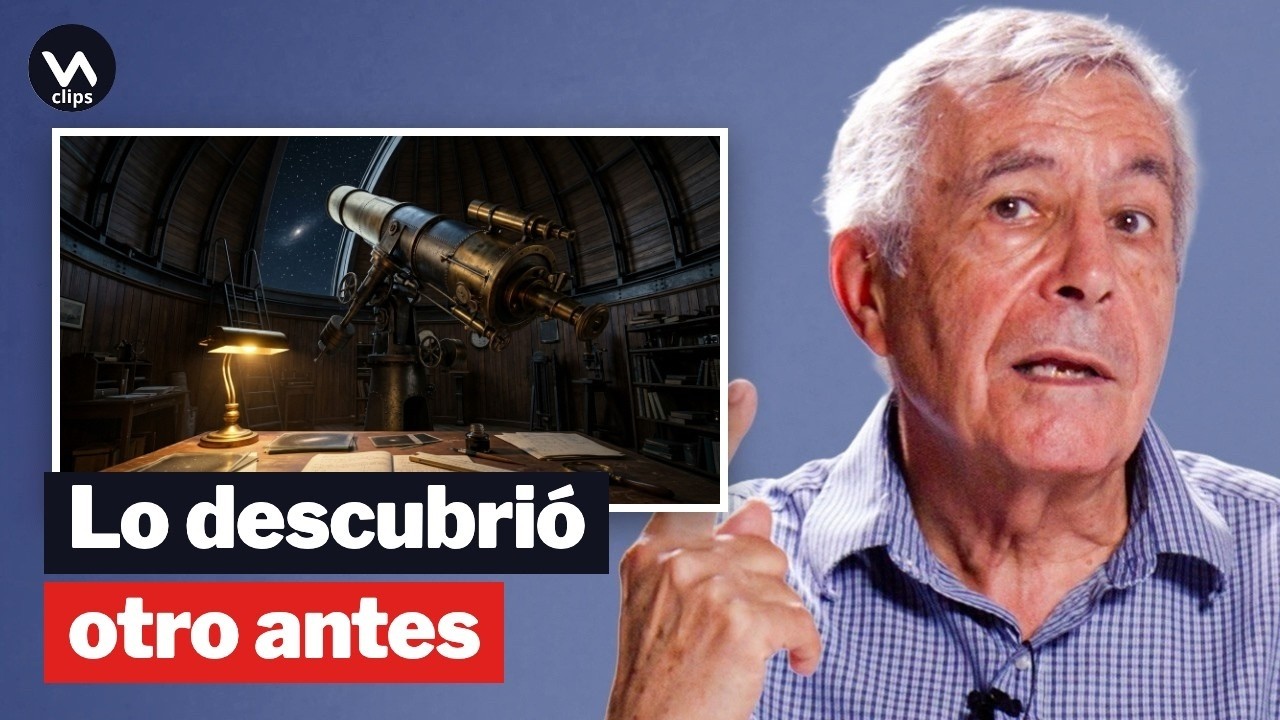
Hubble nunca creyó que el universo se expandiera | Emili Elizalde
Hubble never believed that the universe was expanding | Emili Elizalde
Title history
- Hubble nunca creyó que el universo se expandiera | Emili Elizalde — observed on 20261117-1940 UTC (YouTube)
Keywords
Summary
159 words
Critical Evaluation
Value of the Information & Strength of the Argument
The information presented is valuable for understanding the historical context of cosmology’s foundational discovery. The argumentation is solid, as it draws on specific historical documents, such as Hubble’s letters to de Sitter and Lemaître’s thesis, and the speaker’s own experience voting on the IAU resolution. The speaker is clear about distinguishing between observational data and theoretical interpretation, and he provides a compelling case for why Hubble remained skeptical.
Scientific Rigor, Source Quality, Title Accuracy
The speaker does not cite specific sources during the talk, but he references historical figures and documents. The only source provided is the full interview link in the description. The title accurately reflects the content, as the entire video is centered on this claim. The video is well-structured, though it relies on the speaker’s memory and interpretation.
140 words
Title / Content Match
The title accurately reflects the central claim of the video, which is that Hubble never accepted the expansion interpretation. The subtitle includes the guest's name, matching the content.
Quality & Reliability
8/10
The speaker is a cosmologist and research professor, providing historical insights based on primary sources and personal involvement. However, some interpretations are presented as personal opinions, and no external sources are cited directly.
Key Moments
Markers derived by PSI from the transcript: the creator did not define chapters.
- Hubble combined Slipher's velocities with his distances and found proportionality.
- Explanation of tired light effect as an alternative interpretation.
- Hubble's argument about the universe's age being 2 billion years vs Earth rocks 5 billion.
- Lemaître's visit to Slipher and Hubble, and his derivation of the law two years earlier.
- Lemaître's interpretation of expansion and the primeval atom.
- Einstein's comment on Lemaître's theory.
Cited Sources
- Full interview: Vidas Ajenas - Emili Elizalde — Link provided in the video description as the complete interview.
Contribution & Novelties
The video provides a nuanced historical account, correcting the common misconception that Hubble discovered universal expansion. It highlights Lemaître’s priority and correct interpretation.
For further reading:
- Hubble’s law - Wikipedia — Provides the standard formulation and historical context.
- Georges Lemaître - Wikipedia — Details on Lemaître’s life and contributions.
- Tired light - Wikipedia — Explains the alternative hypothesis mentioned in the video.
- Expansion of the universe - Wikipedia — Overview of the modern understanding.
74 words
Radar Profile
The scores indicate a high quantity and quality of information, with a moderately high technical level and strong overall reliability, though the subjective nature of some claims slightly lowers the reliability score.