Arbitrarily fast dispersion in long range crystals
Title history
- Arbitrarily fast dispersion in long range crystals — observed on 20261108-0801 UTC (YouTube)
Keywords
Summary
190 words
Critical Evaluation
Value of the Information & Strength of the Argument
The talk presents a significant original contribution: the construction of a one-dimensional crystal with arbitrarily fast polynomial dispersal, breaking the previously known best rate of t^{-1/2}. The argumentation is rigorous and well-structured, moving from simple examples to the main theorem and its necessity. The reliance on advanced tools from harmonic analysis and dynamical systems (Weierstrass functions, transfer operators) is justified by the irregularity of the phase, and the speaker clearly explains the breakdown of classical bounds. The inclusion of sharp lower bounds and the impossibility of exponential decay demonstrates a thorough and mathematically sound treatment. The value of the information is high, both for spectral theory of long-range operators and for the methodology introduced.
Scientific Rigor, Source Quality, Title Accuracy
The scientific rigor is exceptional: the talk is based on a peer-reviewed research paper (joint work) and includes precise statements, proof sketches, and connections to open problems. The speaker cites relevant literature (e.g., earlier works with Kerner, Täufer, Post) and points to open questions on random Toeplitz matrices. The only source provided in the description is the official Simens Institute talk page, which properly links to the abstract and possibly further references. The title accurately captures the core contribution, and the talk stays on topic throughout. No significant discrepancies between title and content are observed.
224 words
Title / Content Match
The title accurately reflects the content: the talk demonstrates the existence of crystals with arbitrarily fast dispersion.
Quality & Reliability
9/10
Presentation of original research by a leading mathematician, with rigorous proofs and clear exposition.
Key Moments
Markers derived by PSI from the transcript: the creator did not define chapters.
- Introduction to the model: ℤᵈ periodic graphs, one-dimensional case, definition of long-range hopping with weights w_k.
- Definition of dispersive estimates, prior best result (β=1/2), and statement of the main theorem: for any N, construct λ such that decay is t^{-N}.
- Discussion of examples: w_k = 1/k² gives β=1/2; odd-only edges lead to soliton behavior; mixed weights lead to frozen mass.
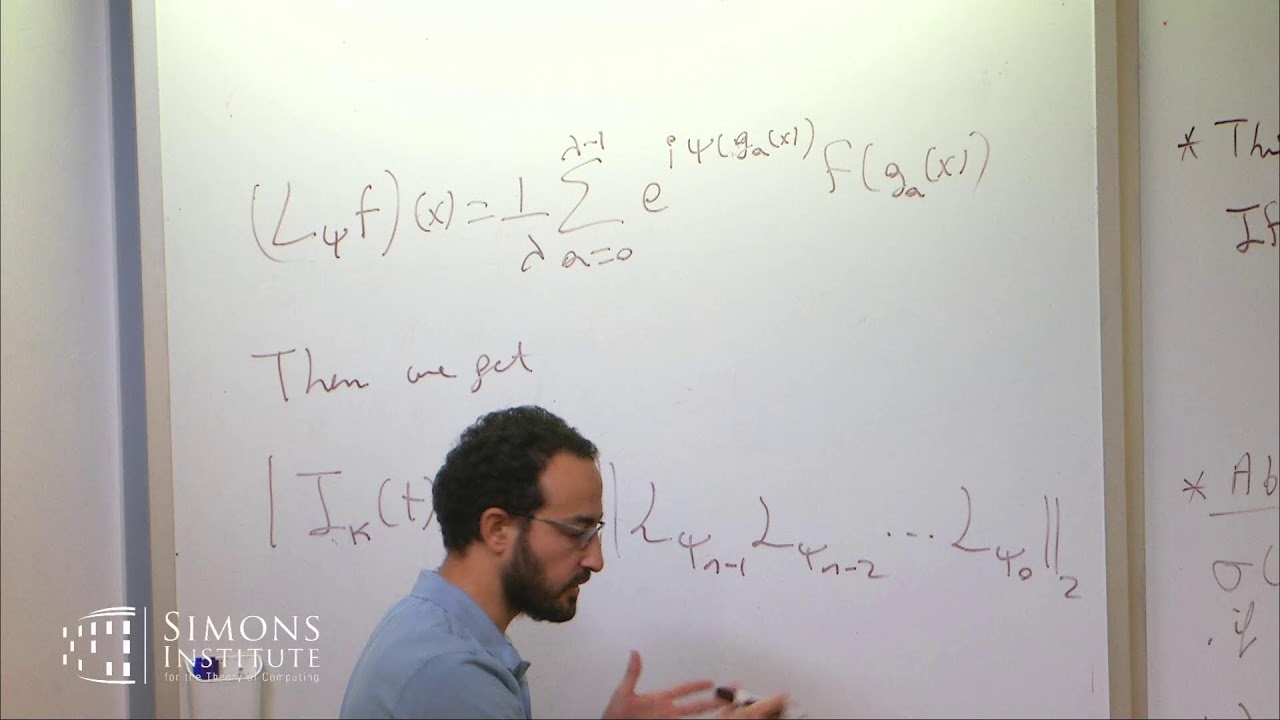
- Proof idea: Fourier transform relates to Weierstrass function W; reduction to oscillatory integral; difficulties with irregular phases.
- Main theorem refined: β = c/α with α = log μ / log λ; sharpness; relation to Hölder regularity.
- Spectral implications: absolutely continuous spectrum in the fast dispersion regime; conjecture about singular continuity on critical line.
Cited Sources
- Simons Institute Talk Page: Mostafa Sabri — Official page for the talk, containing abstract and possibly slides.
Contribution & Novelties
The talk breaks new ground by constructing one-dimensional long-range graph Hamiltonians exhibiting arbirtrarily fast polynomial decay of wave packets, surpassing the previous universal bound of t^{-1/2}. The methodology—using the Weierstrass function as a phase and a Dolgopyat-type transfer operator—is novel in this domain and is likely to inspire further work on irregular oscillatory integrals. The result answers a question of Geman and Horowitz (1980) about local times of Weierstrass functions for large lacunarity.
Pour aller plus loin :
- Weierstrass function — The phase appearing in the Fourier representation; classical example of nowhere-differentiable continuous function.
- Van der Corput lemma — A standard tool for oscillatory integrals that fails here due to irregular phase; the authors develop new variants.
- Transfer operator — The Dolgopyat-inspired method used to control the integrals; originally from dynamical systems, now applied to harmonic analysis.
- Dispersive estimate — The central concept studied; general context in PDE and spectral theory.
151 words
Radar Profile
The radar profile shows extremely high scores in technical level and quality of information, reflecting a mathematically deep and rigorous talk. Quantitative information is slightly lower due to the focus on a single result, while overall reliability remains very high.